


Image du cadre
Raumbeispiel
4
Andy Warhol
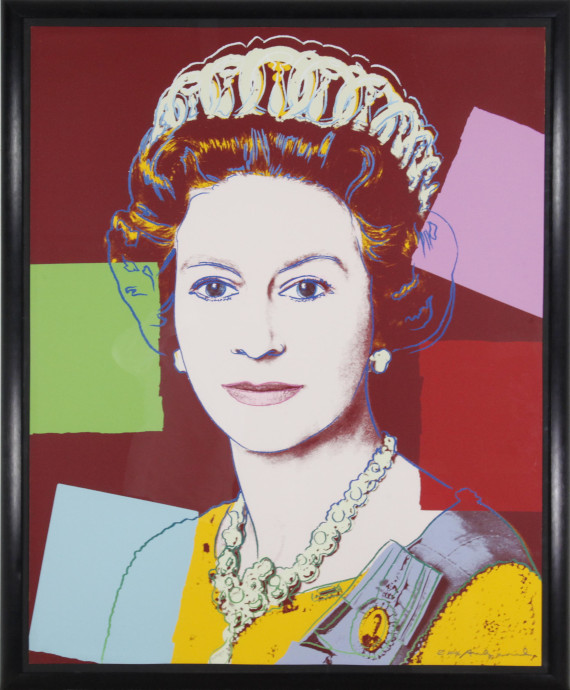
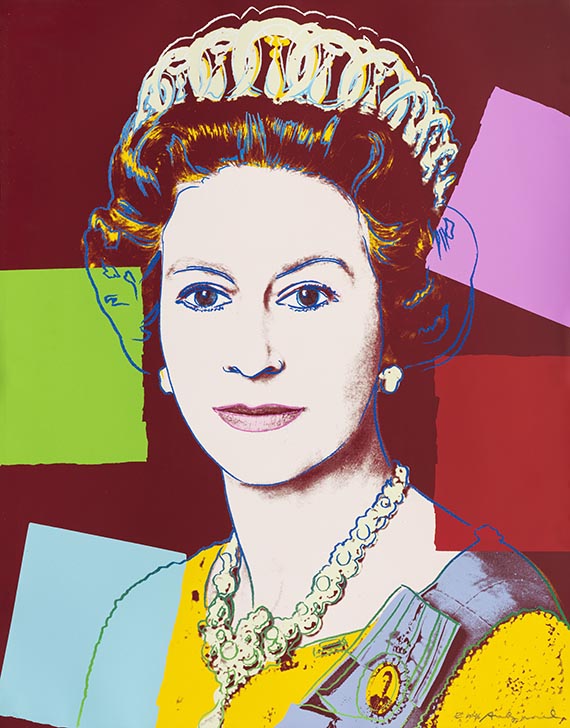
Queen Elizabeth II (Royal Edition), 1985.
Silkscreen in colors with diamond dust
Estimation:
€ 150,000 / $ 172,500 Résultat:
€ 412,800 / $ 474,719 ( frais d'adjudication compris)
4
Andy Warhol
Queen Elizabeth II (Royal Edition), 1985.
Silkscreen in colors with diamond dust
Estimation:
€ 150,000 / $ 172,500 Résultat:
€ 412,800 / $ 474,719 ( frais d'adjudication compris)
Andy Warhol
1928 - 1987
Queen Elizabeth II (Royal Edition). 1985.
Silkscreen in colors with diamond dust.
Signed and numbered. With the copyright stamp on the reverse. One of 2 PP copies (Printers Proof), aside from the edition of 30 copies. On Lenox Museum Board. 100 x 80 cm (39.3 x 31.4 in).
The first of a total of four portraits of Queen Elizabeth II from the Royal Edition of the famous “Reigning Queens” portfoliob of silkscreens with diamond dust, which, in addition to portraits of the British Queen, also includes portraits of Queen Beatrix (Netherlands), Queen Margrethe (Denmark), and Queen Ntombi Twala (Swaziland). Printed by Rupert Jason Smith, New York (with the blindstamp), and published by George C. P. Mulder, Amsterdam. [JS].
• Warhol’s “Queen Elizabeth II” (Royal Edition) – a sparkling icon of royal glamour.
• Pop Art at its finest: one of Warhol’s most famous portraits, extraordinary for its unique materiality
• A rare gem from the Royal Edition: copy from the de-luxe edition with diamond dust comprising only 30 prints.
• “Queen Elizabeth II” (Royal Edition): one of Warhol's last portraits and part of his most sought-after silkscreen prints.
PROVENANCE: The Andy Warhol Foundation for the Visual Arts, New York.
Galerie Triebold, Rheinfelden.
Private collection, Rhineland (acquired from the above in 2001).
LITERATURE: Frayda Feldman, Jörg Schellmann, Claudia Defendi. Andy Warhol Prints. A catalogue raisonné 1962-1987, New York 2003, CR no. II. 334 A (illustarted, different copy).
Tamara Janowitz, When I first met the Queens, quoted from: www.phillips.com/article/112394632/when-i-first-met-the-queens.
1928 - 1987
Queen Elizabeth II (Royal Edition). 1985.
Silkscreen in colors with diamond dust.
Signed and numbered. With the copyright stamp on the reverse. One of 2 PP copies (Printers Proof), aside from the edition of 30 copies. On Lenox Museum Board. 100 x 80 cm (39.3 x 31.4 in).
The first of a total of four portraits of Queen Elizabeth II from the Royal Edition of the famous “Reigning Queens” portfoliob of silkscreens with diamond dust, which, in addition to portraits of the British Queen, also includes portraits of Queen Beatrix (Netherlands), Queen Margrethe (Denmark), and Queen Ntombi Twala (Swaziland). Printed by Rupert Jason Smith, New York (with the blindstamp), and published by George C. P. Mulder, Amsterdam. [JS].
• Warhol’s “Queen Elizabeth II” (Royal Edition) – a sparkling icon of royal glamour.
• Pop Art at its finest: one of Warhol’s most famous portraits, extraordinary for its unique materiality
• A rare gem from the Royal Edition: copy from the de-luxe edition with diamond dust comprising only 30 prints.
• “Queen Elizabeth II” (Royal Edition): one of Warhol's last portraits and part of his most sought-after silkscreen prints.
PROVENANCE: The Andy Warhol Foundation for the Visual Arts, New York.
Galerie Triebold, Rheinfelden.
Private collection, Rhineland (acquired from the above in 2001).
LITERATURE: Frayda Feldman, Jörg Schellmann, Claudia Defendi. Andy Warhol Prints. A catalogue raisonné 1962-1987, New York 2003, CR no. II. 334 A (illustarted, different copy).
Tamara Janowitz, When I first met the Queens, quoted from: www.phillips.com/article/112394632/when-i-first-met-the-queens.
Marilyn, Jackie, Mao, and the Queen—Andy Warhol’s iconic depictions of celebrities have become part of our collective memory in bold, vibrant colors and as icons of the 20th century. Throughout his life, Warhol was not only a master of provocation but also of selection. Using his Polaroid Big Shot Camera, he became a keen observer and chronicler of his time. To this day, his ability to identify visual material with the special quality and depth to preserve a singular moment of contemporary history from the flood of images in mass media remains unrivaled. Not only Warhol, but also his art quickly became a brand name with international recognition. Vibrantly colorful, striking, and serial in nature, his epic work has earned him a permanent place in the history of international art. In his iconic portrait series “Marilyn Monroe” (1967), Warhol made serial reproduction his artistic trademark. The nonconformist Warhol dared to take the bold step of a radical artistic new beginning in New York. Merging art and commerce with confidence and courage, he left behind all traditional notions of art and the artist. Provocative and subtle, Warhol’s art plays with originality and aura—until then the central characteristics of art—which he questions and deftly puts to the test through his sequential works. It is precisely his legendary serial portraits “Marilyn,” “Mao,” and “Queen Elizabeth II” —motifs that would make Warhol’s name in art history and which are celebrated as icons of American Pop Art today —that exude—seemingly paradoxically—a very special aura.
Not least because of its unique, sparkling materiality—which distinguishes the extremely rare prints in the diamond-dust-enriched Royal Edition—this portrait of “Queen Elizabeth II” holds a prominent place within Warhol’s oeuvre. Warhol first experimented with the sparkling diamond dust in the “Shadows” silkscreen portfolio from 1979; a year later, he took it to the next level in his shimmering “Shoes” Deluxe Edition, and finally brought it to perfection in his glamorous “Queen Elizabeth II” Royal Edition from 1985. Warhol’s plan for this iconic portrait—which he created based on a widely reproduced portrait photograph taken on the occasion of the Queen’s Silver Jubilee in 1977—dates back as far as 1982, as evidenced by correspondence with the British Royal Family: “I am instructed by The Queen to acknowledge your letter […] regarding Mr. Warhol’s plans to paint portraits of Their Majesties the Queens of Great Britain, Denmark, and the Netherlands. While The Queen would never wish to place any obstacles in Mr. Warhol’s way, she would not dream of offering any comment on this idea.” Such is the regal, cautious response that Sir William Heseltine drafted on behalf of the Queen regarding this project. Warhol’s art is necessarily parasitic on the myths of his time and, by extension, on the machinery of fame and advertising. Yet, it has made transience its central artistic principle and, in doing so, seems to have overcome it. Drawing on the rapid flood of images in the print media of his time, Warhol succeeded in creating auratic Pop Art icons and, with this rare, glamorously sparkling silkscreen print, in creating a lasting monument, not only to the Queen but also to himself, two years before his unexpected death. [JS]
Not least because of its unique, sparkling materiality—which distinguishes the extremely rare prints in the diamond-dust-enriched Royal Edition—this portrait of “Queen Elizabeth II” holds a prominent place within Warhol’s oeuvre. Warhol first experimented with the sparkling diamond dust in the “Shadows” silkscreen portfolio from 1979; a year later, he took it to the next level in his shimmering “Shoes” Deluxe Edition, and finally brought it to perfection in his glamorous “Queen Elizabeth II” Royal Edition from 1985. Warhol’s plan for this iconic portrait—which he created based on a widely reproduced portrait photograph taken on the occasion of the Queen’s Silver Jubilee in 1977—dates back as far as 1982, as evidenced by correspondence with the British Royal Family: “I am instructed by The Queen to acknowledge your letter […] regarding Mr. Warhol’s plans to paint portraits of Their Majesties the Queens of Great Britain, Denmark, and the Netherlands. While The Queen would never wish to place any obstacles in Mr. Warhol’s way, she would not dream of offering any comment on this idea.” Such is the regal, cautious response that Sir William Heseltine drafted on behalf of the Queen regarding this project. Warhol’s art is necessarily parasitic on the myths of his time and, by extension, on the machinery of fame and advertising. Yet, it has made transience its central artistic principle and, in doing so, seems to have overcome it. Drawing on the rapid flood of images in the print media of his time, Warhol succeeded in creating auratic Pop Art icons and, with this rare, glamorously sparkling silkscreen print, in creating a lasting monument, not only to the Queen but also to himself, two years before his unexpected death. [JS]