


 Lot 249
Image du cadre
Autre image
Autre image
Autre image
249
Jonathan Meese
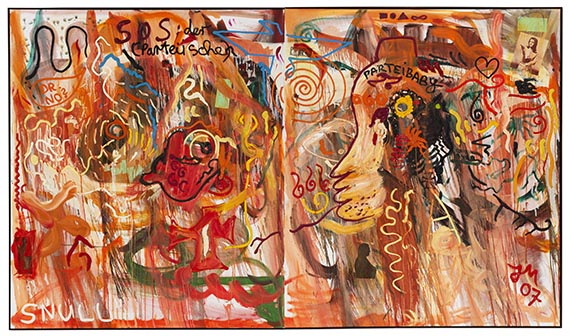
Politikkätzchen "Pfötchen hoch" (zweiteilig), 2007.
Oil, acrylic and paper collage on canvas
Prix d´après-vente: € 60,000 / $ 70,800
Politikkätzchen "Pfötchen hoch" (zweiteilig). 2007.
Oil, acrylic and paper collage on canvas.
Monogrammed and dated in the lower right corner. Signed, dated, titled, and inscribed with the work number “MEE/M 1729” and “rechts” and “links” on the reverse of the canvas. Each 220 x 190 cm (86.6 x 74.8 in). [AW].
• Colorful two-part work comprising painting, text, and a typical Meese collage.
• Meese's iconic and often enigmatic titles encourage viewers to reflect on art.
• The artist's works are included in the collections of, among others, the Museum of Modern Art, New York, the Centre Pompidou, Paris, the Saatchi Gallery, London, and the Pinakothek der Moderne, Munich.
PROVENANCE: Contemporary Fine Arts, Berlin (with the gallery label on stretcher and various stamps).
Gary Tatintsian Gallery, Moscow.
Private collection (acquired from the above).
Private collection, Berlin (acquired from the above in 2014).
EXHIBITION: Bad Planet, Gary Tatintsian Gallery, Moscow, April 15 - May 14, 2008.
LITERATURE: Christie's, Amsterdam, 3049th auction, November 4/5, 2014, lot 155.
Jonathan Meese in an interview with Alain Bieber, artnet, May 19, 2006
Oil, acrylic and paper collage on canvas.
Monogrammed and dated in the lower right corner. Signed, dated, titled, and inscribed with the work number “MEE/M 1729” and “rechts” and “links” on the reverse of the canvas. Each 220 x 190 cm (86.6 x 74.8 in). [AW].
• Colorful two-part work comprising painting, text, and a typical Meese collage.
• Meese's iconic and often enigmatic titles encourage viewers to reflect on art.
• The artist's works are included in the collections of, among others, the Museum of Modern Art, New York, the Centre Pompidou, Paris, the Saatchi Gallery, London, and the Pinakothek der Moderne, Munich.
PROVENANCE: Contemporary Fine Arts, Berlin (with the gallery label on stretcher and various stamps).
Gary Tatintsian Gallery, Moscow.
Private collection (acquired from the above).
Private collection, Berlin (acquired from the above in 2014).
EXHIBITION: Bad Planet, Gary Tatintsian Gallery, Moscow, April 15 - May 14, 2008.
LITERATURE: Christie's, Amsterdam, 3049th auction, November 4/5, 2014, lot 155.
Jonathan Meese in an interview with Alain Bieber, artnet, May 19, 2006
249
Jonathan Meese
Politikkätzchen "Pfötchen hoch" (zweiteilig), 2007.
Oil, acrylic and paper collage on canvas
Prix d´après-vente: € 60,000 / $ 70,800
Commission, taxes et droit de suite
Cet objet est offert avec imposition régulière ou avec imposition différentielle.
Calcul en cas d'imposition différentielle:
Prix d’adjudication jusqu’à 800 000 euros : frais de vente 32 %.
Des frais de vente de 27% sont facturés sur la partie du prix d’adjudication dépassant 800 000 euros. Ils sont additionnés aux frais de vente dus pour la partie du prix d’adjudication allant jusqu’à 800 000 euros.
Des frais de vente de 22% sont facturés sur la partie du prix d’adjudication dépassant 4 000 000 euros. Ils sont additionnés aux frais de vente dus pour la partie du prix d’adjudication allant jusqu’à 4 000 000 euros.
La commission comprend la TVA, mais celle-ci n'est pas indiquée.
Calcul en cas d'imposition régulière:
Prix d'adjudication jusqu'à 800 000 € : 27 % de commission.
Prix d'adjudication supérieur à 800 000 € : montants partiels jusqu'à 800 000 € 27 % de commission, montants partiels supérieurs à 800 000 € : 21 % de commission.
Prix d'adjudication supérieur à 4.000 000 € : montants partiels supérieurs à 4.000 000 € : 15 % de commission.
La TVA légale de 7 % est prélevée sur la somme du prix d'adjudication et de la commission.
Si vous souhaitez appliquer l'imposition régulière, merci de bien vouloir le communiquer par écrit avant la facturation.
Calcul en cas de droit de suite:
Pour les œuvres originales d’arts plastiques et de photographie d’artistes vivants ou d’artistes décédés il y a moins de 70 ans, soumises au droit de suite, une rémunération au titre du droit de suite à hauteur des pourcentages indiqués au § 26, al. 2 de la loi allemande sur les droits d’auteur (UrhG) est facturée en sus pour compenser la rémunération liée au droit de suite due par le commissaire-priseur conformément au § 26 UrhG. À ce jour, elle est calculée comme suit :
4 pour cent pour la part du produit de la vente à partir de 400,00 euros et jusqu’à 50 000 euros,
3 pour cent supplémentaires pour la part du produit de la vente entre 50 000,01 et 200 000 euros,
1 pour cent supplémentaire pour la part entre 200 000,01 et 350 000 euros,
0,5 pour cent supplémentaire pour la part entre 350 000,01 et 500 000 euros et
0,25 pour cent supplémentaire pour la part au-delà de 500 000 euros.
Le total de la rémunération au titre du droit de suite pour une revente s’élève au maximum à 12 500 euros.
Calcul en cas d'imposition différentielle:
Prix d’adjudication jusqu’à 800 000 euros : frais de vente 32 %.
Des frais de vente de 27% sont facturés sur la partie du prix d’adjudication dépassant 800 000 euros. Ils sont additionnés aux frais de vente dus pour la partie du prix d’adjudication allant jusqu’à 800 000 euros.
Des frais de vente de 22% sont facturés sur la partie du prix d’adjudication dépassant 4 000 000 euros. Ils sont additionnés aux frais de vente dus pour la partie du prix d’adjudication allant jusqu’à 4 000 000 euros.
La commission comprend la TVA, mais celle-ci n'est pas indiquée.
Calcul en cas d'imposition régulière:
Prix d'adjudication jusqu'à 800 000 € : 27 % de commission.
Prix d'adjudication supérieur à 800 000 € : montants partiels jusqu'à 800 000 € 27 % de commission, montants partiels supérieurs à 800 000 € : 21 % de commission.
Prix d'adjudication supérieur à 4.000 000 € : montants partiels supérieurs à 4.000 000 € : 15 % de commission.
La TVA légale de 7 % est prélevée sur la somme du prix d'adjudication et de la commission.
Si vous souhaitez appliquer l'imposition régulière, merci de bien vouloir le communiquer par écrit avant la facturation.
Calcul en cas de droit de suite:
Pour les œuvres originales d’arts plastiques et de photographie d’artistes vivants ou d’artistes décédés il y a moins de 70 ans, soumises au droit de suite, une rémunération au titre du droit de suite à hauteur des pourcentages indiqués au § 26, al. 2 de la loi allemande sur les droits d’auteur (UrhG) est facturée en sus pour compenser la rémunération liée au droit de suite due par le commissaire-priseur conformément au § 26 UrhG. À ce jour, elle est calculée comme suit :
4 pour cent pour la part du produit de la vente à partir de 400,00 euros et jusqu’à 50 000 euros,
3 pour cent supplémentaires pour la part du produit de la vente entre 50 000,01 et 200 000 euros,
1 pour cent supplémentaire pour la part entre 200 000,01 et 350 000 euros,
0,5 pour cent supplémentaire pour la part entre 350 000,01 et 500 000 euros et
0,25 pour cent supplémentaire pour la part au-delà de 500 000 euros.
Le total de la rémunération au titre du droit de suite pour une revente s’élève au maximum à 12 500 euros.