


 Lot 166
Image du cadre
Raumbeispiel
166
Franz Radziwill
Frau mit weißem Umhang, 1927.
Oil on panel
Prix d´après-vente: € 30,000 / $ 35,400
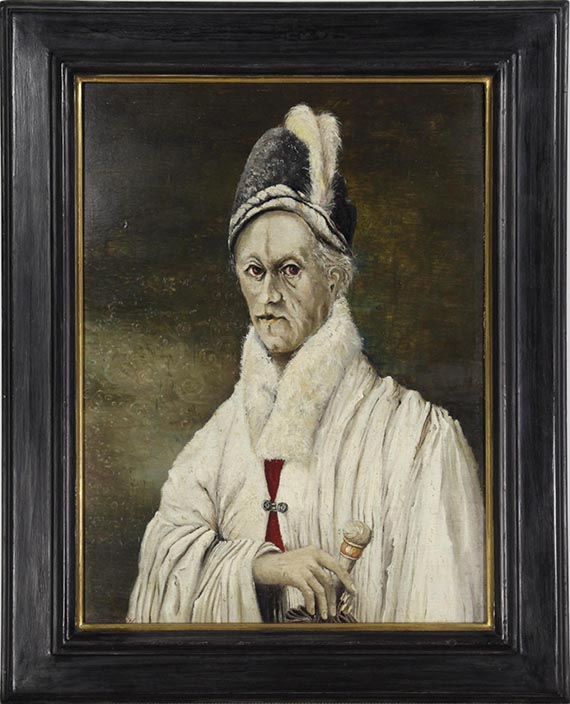
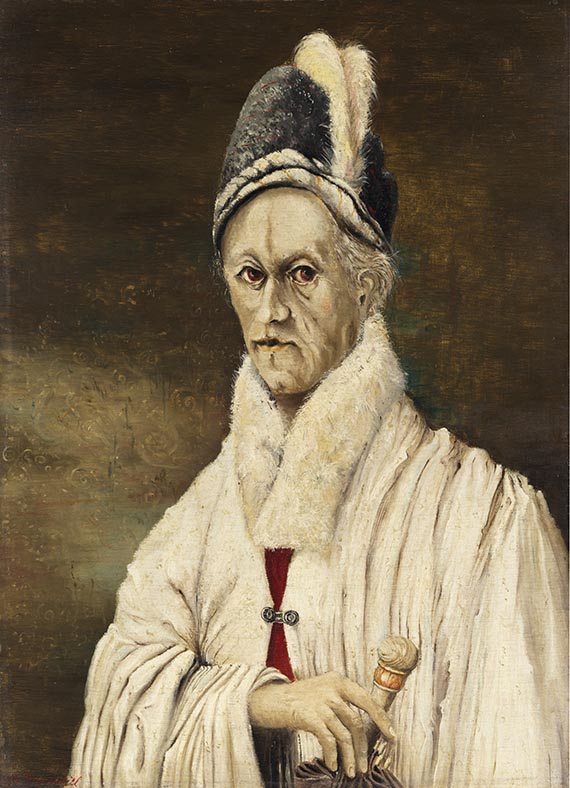
Frau mit weißem Umhang. 1927.
Oil on panel.
Signed in the lower left. 57.5 x 42 cm (22.6 x 16.5 in) [KA].
• Rare work of New Objectivity from Radziwill's early surrealist period.
• First exhibited in 1928.
• With her draped cloak, feathered hat, and mysterious gaze, “Frau mit weißem Umhang” (Woman with White Cloak) combines the tradition of royal portraits with the dawn of a pioneering new painting style.
• Created during his studies at the Art Academy in Dresden.
• Influences of the Old Masters: Inspired by artists such as Caspar David Friedrich, Radziwill developed a unique, surreal visual language that contains profound symbolism and allusions to transience.
• Most recently shown in the exhibition “Schneeweiß und Nachtschwarz” at the Franz Radziwill House, Dangast, 2016/17.
We are grateful to Prof. Dr. Dr. Gerd Presler for his kind expert advice.
PROVENANCE: Galleria del Levante, Milan/Munich (directly from the artist, until 1981, with the label on the reverse).
Private collection, Milan (from the above, 1981- ca. 1983).
Private collection, South Germany (since ca. 1983).
EXHIBITION: Franz Radziwill, Kunsthütte Chemnitz, January/February 1928, no number.
Retrospektiv-Ausstellung Franz Radziwill. Ölgemälde, Aquarelle, Baukunst Architekturgesellschaft, Cologne, September 11–November 9, 1968, cat. no. 28.
Franz Radziwill, Galleria d'Arte Stivani, Bologna, November 18–December 18, 1972, cat. no. 7 (illustrated)
Europa due tra sogno e impegno, Pinacoteca Comunale, Ravenna, July 26–September 15, 1973, cat. no. 119
Neue Sachlichkeit and German Realism of the Twenties, Hayward Gallery, London, November 11, 1978–January 14, 1979, cat. no. 201.
Franz Radziwill, Staatliche Kunsthalle, Berlin, November 23, 1981–January 3, 1982; Landesmuseum Oldenburg, January 15–February 15, 1982; Kunstverein Hanover, February 21–April 12, 1982, cat. no. 39.
Messerscharf und detailverliebt. Werke der Neuen Sachlichkeit, Kunstforum Ostdeutsche Galerie Regensburg, October 31, 2015–January 31, 2016; Landesgalerie Linz des Oberösterreichischen Landesmuseums, March 10–June 5, 2016, pp. 75–76, cat. no. 40 (illustrated)
Schneeweiß und Nachtschwarz, Franz Radziwill House and Archive, Varel-Dangast, March 13, 2016–January 8, 2017, cat. no. 9 (illustrated).
LITERATURE: Andrea Firmenich, Rainer W. Schulze, Franz Radziwill. 1895-1983. Monograph and catalogue raisonné, Cologne 1995, cat. no. 285 (illustrated)
Radziwill list 4, no. 80 (inscribed on the reverse)
-
Wilfried Seeba, Franz Radziwill (1895-1983). Catalogue raisonné of watercolors, drawings, and painted postcards, Isensee 2006, p. 67: Study of an old woman for “Woman with White Cloak.”
Olaf Peters, Im Lichte der Staatsideen: Franz Radziwill's Gemälde “Revolution/Demons,” in: Uwe Fleckner (ed.), Das verfemte Meisterwerk: Schicksalswege moderner Kunst im “Dritten Reich,” Berlin 2009, pp. 365–382, here pp. 376, 382: Studio photograph from ca. 1936 showing the present work.
Oil on panel.
Signed in the lower left. 57.5 x 42 cm (22.6 x 16.5 in) [KA].
• Rare work of New Objectivity from Radziwill's early surrealist period.
• First exhibited in 1928.
• With her draped cloak, feathered hat, and mysterious gaze, “Frau mit weißem Umhang” (Woman with White Cloak) combines the tradition of royal portraits with the dawn of a pioneering new painting style.
• Created during his studies at the Art Academy in Dresden.
• Influences of the Old Masters: Inspired by artists such as Caspar David Friedrich, Radziwill developed a unique, surreal visual language that contains profound symbolism and allusions to transience.
• Most recently shown in the exhibition “Schneeweiß und Nachtschwarz” at the Franz Radziwill House, Dangast, 2016/17.
We are grateful to Prof. Dr. Dr. Gerd Presler for his kind expert advice.
PROVENANCE: Galleria del Levante, Milan/Munich (directly from the artist, until 1981, with the label on the reverse).
Private collection, Milan (from the above, 1981- ca. 1983).
Private collection, South Germany (since ca. 1983).
EXHIBITION: Franz Radziwill, Kunsthütte Chemnitz, January/February 1928, no number.
Retrospektiv-Ausstellung Franz Radziwill. Ölgemälde, Aquarelle, Baukunst Architekturgesellschaft, Cologne, September 11–November 9, 1968, cat. no. 28.
Franz Radziwill, Galleria d'Arte Stivani, Bologna, November 18–December 18, 1972, cat. no. 7 (illustrated)
Europa due tra sogno e impegno, Pinacoteca Comunale, Ravenna, July 26–September 15, 1973, cat. no. 119
Neue Sachlichkeit and German Realism of the Twenties, Hayward Gallery, London, November 11, 1978–January 14, 1979, cat. no. 201.
Franz Radziwill, Staatliche Kunsthalle, Berlin, November 23, 1981–January 3, 1982; Landesmuseum Oldenburg, January 15–February 15, 1982; Kunstverein Hanover, February 21–April 12, 1982, cat. no. 39.
Messerscharf und detailverliebt. Werke der Neuen Sachlichkeit, Kunstforum Ostdeutsche Galerie Regensburg, October 31, 2015–January 31, 2016; Landesgalerie Linz des Oberösterreichischen Landesmuseums, March 10–June 5, 2016, pp. 75–76, cat. no. 40 (illustrated)
Schneeweiß und Nachtschwarz, Franz Radziwill House and Archive, Varel-Dangast, March 13, 2016–January 8, 2017, cat. no. 9 (illustrated).
LITERATURE: Andrea Firmenich, Rainer W. Schulze, Franz Radziwill. 1895-1983. Monograph and catalogue raisonné, Cologne 1995, cat. no. 285 (illustrated)
Radziwill list 4, no. 80 (inscribed on the reverse)
-
Wilfried Seeba, Franz Radziwill (1895-1983). Catalogue raisonné of watercolors, drawings, and painted postcards, Isensee 2006, p. 67: Study of an old woman for “Woman with White Cloak.”
Olaf Peters, Im Lichte der Staatsideen: Franz Radziwill's Gemälde “Revolution/Demons,” in: Uwe Fleckner (ed.), Das verfemte Meisterwerk: Schicksalswege moderner Kunst im “Dritten Reich,” Berlin 2009, pp. 365–382, here pp. 376, 382: Studio photograph from ca. 1936 showing the present work.
“Who is this Franz Radziwill? A monstrous painter or a painting monster?” asked Hamburg artist Tom Hops (1906–1976). He sensed what was boiling inside his fellow artist: a painter and a magician in one.
The painting “Frau mit weißem Umhang” (Woman with White Cloak) is a product of this idea. Prepared in an ink drawing (illustrated), just a few colors unfold tremendous power: a red undergarment and a gray hat. Complemented by dark brown eyes that stare at the viewer with cold and inescapable intensity.
Another special feature: there are hardly any photographs of Franz Radziwill “at work.” Here: a “glimpse into the studio”: the painter at his easel. Leaning against it: his enigmatic, inscrutable portrait “Frau mit weißem Umhang.”
Prof. Dr. Dr. Gerd Presler
The painting “Frau mit weißem Umhang” (Woman with White Cloak) is a product of this idea. Prepared in an ink drawing (illustrated), just a few colors unfold tremendous power: a red undergarment and a gray hat. Complemented by dark brown eyes that stare at the viewer with cold and inescapable intensity.
Another special feature: there are hardly any photographs of Franz Radziwill “at work.” Here: a “glimpse into the studio”: the painter at his easel. Leaning against it: his enigmatic, inscrutable portrait “Frau mit weißem Umhang.”
Prof. Dr. Dr. Gerd Presler
166
Franz Radziwill
Frau mit weißem Umhang, 1927.
Oil on panel
Prix d´après-vente: € 30,000 / $ 35,400
Commission, taxes et droit de suite
Cet objet est offert avec imposition régulière ou avec imposition différentielle.
Calcul en cas d'imposition différentielle:
Prix d’adjudication jusqu’à 800 000 euros : frais de vente 32 %.
Des frais de vente de 27% sont facturés sur la partie du prix d’adjudication dépassant 800 000 euros. Ils sont additionnés aux frais de vente dus pour la partie du prix d’adjudication allant jusqu’à 800 000 euros.
Des frais de vente de 22% sont facturés sur la partie du prix d’adjudication dépassant 4 000 000 euros. Ils sont additionnés aux frais de vente dus pour la partie du prix d’adjudication allant jusqu’à 4 000 000 euros.
La commission comprend la TVA, mais celle-ci n'est pas indiquée.
Calcul en cas d'imposition régulière:
Prix d'adjudication jusqu'à 800 000 € : 27 % de commission.
Prix d'adjudication supérieur à 800 000 € : montants partiels jusqu'à 800 000 € 27 % de commission, montants partiels supérieurs à 800 000 € : 21 % de commission.
Prix d'adjudication supérieur à 4.000 000 € : montants partiels supérieurs à 4.000 000 € : 15 % de commission.
La TVA légale de 7 % est prélevée sur la somme du prix d'adjudication et de la commission.
Si vous souhaitez appliquer l'imposition régulière, merci de bien vouloir le communiquer par écrit avant la facturation.
Calcul en cas de droit de suite:
Pour les œuvres originales d’arts plastiques et de photographie d’artistes vivants ou d’artistes décédés il y a moins de 70 ans, soumises au droit de suite, une rémunération au titre du droit de suite à hauteur des pourcentages indiqués au § 26, al. 2 de la loi allemande sur les droits d’auteur (UrhG) est facturée en sus pour compenser la rémunération liée au droit de suite due par le commissaire-priseur conformément au § 26 UrhG. À ce jour, elle est calculée comme suit :
4 pour cent pour la part du produit de la vente à partir de 400,00 euros et jusqu’à 50 000 euros,
3 pour cent supplémentaires pour la part du produit de la vente entre 50 000,01 et 200 000 euros,
1 pour cent supplémentaire pour la part entre 200 000,01 et 350 000 euros,
0,5 pour cent supplémentaire pour la part entre 350 000,01 et 500 000 euros et
0,25 pour cent supplémentaire pour la part au-delà de 500 000 euros.
Le total de la rémunération au titre du droit de suite pour une revente s’élève au maximum à 12 500 euros.
Calcul en cas d'imposition différentielle:
Prix d’adjudication jusqu’à 800 000 euros : frais de vente 32 %.
Des frais de vente de 27% sont facturés sur la partie du prix d’adjudication dépassant 800 000 euros. Ils sont additionnés aux frais de vente dus pour la partie du prix d’adjudication allant jusqu’à 800 000 euros.
Des frais de vente de 22% sont facturés sur la partie du prix d’adjudication dépassant 4 000 000 euros. Ils sont additionnés aux frais de vente dus pour la partie du prix d’adjudication allant jusqu’à 4 000 000 euros.
La commission comprend la TVA, mais celle-ci n'est pas indiquée.
Calcul en cas d'imposition régulière:
Prix d'adjudication jusqu'à 800 000 € : 27 % de commission.
Prix d'adjudication supérieur à 800 000 € : montants partiels jusqu'à 800 000 € 27 % de commission, montants partiels supérieurs à 800 000 € : 21 % de commission.
Prix d'adjudication supérieur à 4.000 000 € : montants partiels supérieurs à 4.000 000 € : 15 % de commission.
La TVA légale de 7 % est prélevée sur la somme du prix d'adjudication et de la commission.
Si vous souhaitez appliquer l'imposition régulière, merci de bien vouloir le communiquer par écrit avant la facturation.
Calcul en cas de droit de suite:
Pour les œuvres originales d’arts plastiques et de photographie d’artistes vivants ou d’artistes décédés il y a moins de 70 ans, soumises au droit de suite, une rémunération au titre du droit de suite à hauteur des pourcentages indiqués au § 26, al. 2 de la loi allemande sur les droits d’auteur (UrhG) est facturée en sus pour compenser la rémunération liée au droit de suite due par le commissaire-priseur conformément au § 26 UrhG. À ce jour, elle est calculée comme suit :
4 pour cent pour la part du produit de la vente à partir de 400,00 euros et jusqu’à 50 000 euros,
3 pour cent supplémentaires pour la part du produit de la vente entre 50 000,01 et 200 000 euros,
1 pour cent supplémentaire pour la part entre 200 000,01 et 350 000 euros,
0,5 pour cent supplémentaire pour la part entre 350 000,01 et 500 000 euros et
0,25 pour cent supplémentaire pour la part au-delà de 500 000 euros.
Le total de la rémunération au titre du droit de suite pour une revente s’élève au maximum à 12 500 euros.