


Vente: 612 / Evening Sale 04 décembre 2026 à Munich → Lot 126000942
Raumbeispiel
126000942
Fernand Léger
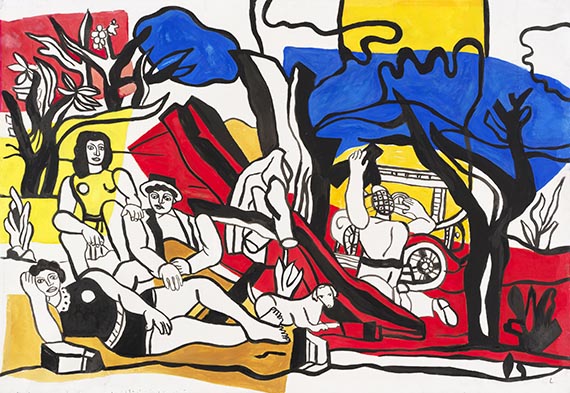
La partie de campagne, 1953.
Gouache on paper
Estimation: € 400,000 / $ 464,000
Les informations sur la commission d´achat, les taxes et le droit de suite sont disponibles quatre semaines avant la vente.
126000942
Fernand Léger
La partie de campagne, 1953.
Gouache on paper
Estimation: € 400,000 / $ 464,000
Les informations sur la commission d´achat, les taxes et le droit de suite sont disponibles quatre semaines avant la vente.
Fernand Léger
1881 - 1955
La partie de campagne. 1953.
Gouache on paper.
Monogrammed in the lower right. With a hand-written Certificate of Authenticity by Nadja Léger on the reverse, also dated, titled, and inscribed with the work number “H.X.N 55-L”. 54.5 x 79 cm (21.4 x 31.1 in), the full sheet. [JS].
• RARITY Léger’s large-format gouaches with many figures are extremely rare on the international auction market.
• MAIN MOTIF “La Partie de Campagne” and “La grande Parade” are the central themes of his late work.
• PAINTING VERSIONS Famous versions of this painting are held at the Centre Pompidou, Paris (1953), and at the Fondation Maeght (1954).
• MUSEUM QUALITY Gouaches from this group are at, among others, the Centre Pompidou, Paris; the Musée National Fernand Léger, Biot; and the Städel Museum, Frankfurt am Main.
• INSPIRATION MANET “La partie de campagne” is a reference to Manet’s scandalous “Le Déjeuner sur l’herbe” (1863).
• PROVENANCE: Part of a German private collection for over 40 years.
PROVENANCE: From the artist’s estate.
Galerie Felix Vercel, Paris (1981).
Galerie Salis, Salzburg, Austria (from the above)
Private collection, Germany (acquired from the above in 1982).
In the family’s possession ever since.
EXHIBITION: Fernand Léger, Galerie Felix Vercel, Paris, May–June 1981, cat. no. 7 (with illustration; with a label on the back of the frame).
Fernand Léger. Zeichnungen, Gouachen, Ölgemälde, Festspielausstellung, Galerie Salis, Salzburg, July 23–September 19, 1982.
Fernand Léger. Gouachen, Aquarelle, Zeichnungen, Kunstverein Hamburg, Oct. 29, 1983–Jan. 1, 1984, cat. no. 112 (with a label on the back of the frame).
Kunst des 20. Jahrhunderts aus privaten Sammlungen im Lande Bremen, Kunsthalle Bremen, June 30–September 15, 1985, no. 103 (not in the catalog; with the shipping label on the back of the frame).
Fernand Léger. The Later Years, Staatsgalerie Stuttgart, March 26–June 19, 1988, cat. no. 112 (illustrated; with the shipping label on the back of the frame).
Press release from the Museum of Modern Art, New York, on the occasion of the Léger retrospective, February 1998, quoted from: moma.org
Fernand Léger (1888–1955) – Master of Cubism and Creator of the “Heroism of Modern Life”
Pablo Picasso, Fernand Léger, and Georges Braque are recognized as the masters of Cubism and postwar Modernism in France. However, the defining characteristic of Léger’s art—which clearly distinguishes his work from the other two—is his deep fascination with modern life. While Léger’s early Cubist works, such as the painting “Contraste de formes” (1914, Beyeler Collection, Basel), are widely regarded as the first entirely abstract Cubist paintings, featuring seemingly infinitely stacked cylindrical forms within a technological setting to mirror modern life, Léger revisited the human figure around 1920. Henceforth, Léger created a radical new style that captivates through the extraordinary modernity of its scenes and its visual language of sharply defined, almost monochromatic color fields. There is, for example, the smoking, muscular mechanic in a tank top with rings and a tattoo (“Le Mécanicien,” 1920, National Gallery of Canada, Ottawa) or the three naked women—massive in their physicality yet reclining casually—with coffee, fruit, a book, and cards in his famous “Le Grand déjeuner” (1921–22, Museum of Modern Art, New York). While Picasso continued to explore classical themes like bathers, mother and child, and scenes from ancient mythology with equally monumental female figures during his concurrent neoclassical period, Léger’s painting is devoted entirely to the here and now. Not only in terms of subject matter, but also stylistically, Léger appears to have anticipated key elements of later Pop Art from that point on; however, Léger’s art celebrates neither stars nor celebrities, but workers and ordinary people. The press release for the major Léger retrospective at the Museum of Modern Art in New York states: “The only major modern artist to choose modernity itself as his subject, Léger’s unique ability to capture the epic quality of everyday experience has earned him recognition as the painter of the ‘heroism of modern life.’ […] As he increasingly felt the need for an art that would speak to the general public, he extended the formal language of modernism to subjects such as construction workers and popular recreation. The artist’s last great masterpiece, *La grande Parade, état définitif* […], 1954, depicts circus performers moving in and out of free-floating arcs of green, red, and blue—derived from a theory of color inspired by the flashing lights of Broadway.” (Press release from the Museum of Modern Art, New York, February 1998, cited from: moma.org).
“La partie de campagne,” “Les constructeurs,” and “La grande parade”—The Major Themes of His Late Work
Building on “Les Plongeurs”, a series of divers created in Marseille, Léger arrived at the complex, multi-figure compositions typical of his late work in the 1940s. Compositions that Léger skillfully varied in multiple versions across various pictorial themes and diverse artistic techniques. Taking his cue from “Les Constructeurs”, the famous depiction of construction workers interwoven on a scaffold in an almost blind choreography of everyday life, Léger attained the two central themes of his mature work with “La Partie de Campagne”, his modern interpretation of a country outing, and the thematic complex “La grande Parade”, which playfully combines figures from the world of the circus, acrobats, clowns, and performers, two years before his sudden death in 1955, establishing them as the two central themes of his mature work. “La Partie de campagne” alludes to Édouard Manet’s scandalous painting “Le Déjeuner sur l’herbe” (1863, Musée d’Orsay, Paris), which was rejected by the Paris Salon in 1863 due to its bold break with academic traditions. The painting brings the motif of a country outing into the modern era by elevating the Sunday trips of workers in postwar society to a subject worthy of artistic representation—a depiction in which the automobile, symbolizing the era’s promising economic upswing, is, of course, an indispensable element. At the time, Léger’s time in America was a key artistic influence: After the outbreak of World War II, the artist—who had already publicly opposed fascism before the war—fled to New York, where he encountered a visual dynamism that would continue to shape his painting decisively even after he returned to Paris in 1945. In both “La Partie de Campagne” and “La Grande Parade”, Léger combines everyday subjects with imagery inspired by the lights of New York, foreshadowing key elements of American Pop Art: bold contours, vibrant swaths of color, and clearly defined forms. Léger’s style—complex, ornamental, striking, and utterly novel—remains an outstanding contribution to European Modernism. Léger, the painter of the “heroism of modern life”, created works of art-historical significance through the major themes of his late work. Large-format gouaches from these important groups of works are rarely offered on the international auction market; we are therefore all the more pleased that this gouache—after having been part of an important German private collection for nearly half a century—is now on public display again as part of our Evening Sale. [JS]