


 Lot 76
Image du cadre
76
Heinrich Campendonk
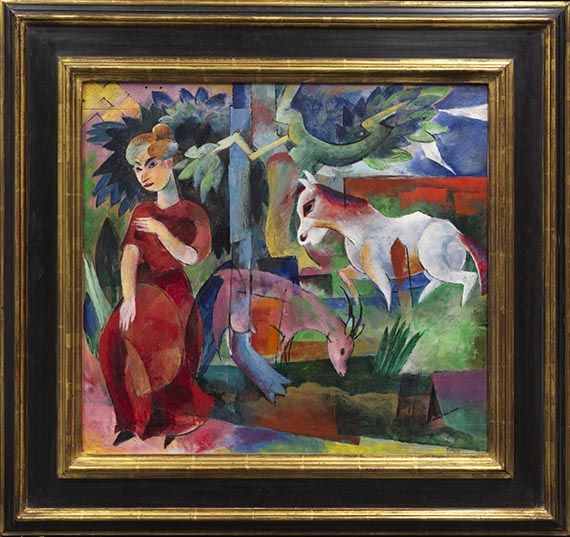
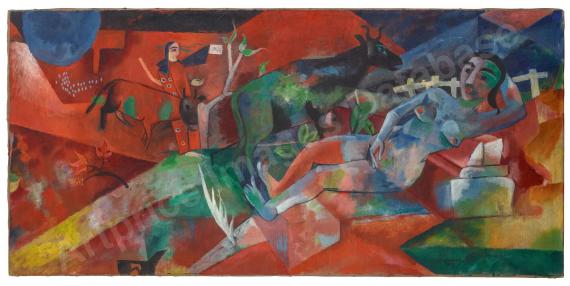
Im Garten - Frau, Pferd, Ziege (Gartenbild I), 1915.
Oil on panel (door element)
Estimation: € 600,000 / $ 696,000
Heinrich Campendonk
1889 - 1957
Im Garten - Frau, Pferd, Ziege (Gartenbild I). 1915.
Oil on panel (door element).
Signed and dated on the reverse. 54.6 x 59.7 cm (21.4 x 23.5 in).
Documented in Heinrich Campendonk's handwritten picture list. [CH].
• Declaration of love in the face of World War I: With bold colors and life-affirming vitality, the young Campendonk makes his wife, Adda, the protagonist of his painting.
• First exhibited in 1916 (Der Sturm, Herwarth Walden, Berlin).
• As a result of his artistic emancipation from the ‘Blue Rider’, Campendonk created masterfully staged compositions during these years.
• The paintings from between 1914 and 1918 are among the artist's most sought-after works on the international auction market.
• Very few of his works in oil and tempera have survived, particularly those from 1915 and 1916 (CR Firmenich, p. 134).
PROVENANCE: Private collection, Germany.
Private collection, North Carolina (inherited from the above).
Achim Moeller Fine Art, New York (acquired from the above in 2002).
Triton Foundation, Netherlands (acquired from the above in 2003).
Private collection, Cologne (acquired from the above in 2023).
EXHIBITION: Campendonk. Gemälde und Aquarelle. Zeichnungen / Holzschnitte, Der Sturm, Berlin, October 1916, cat. no. 7 (titled “Gartenbild I”, with a handwritten gallery label on the reverse).
Rausch und Reduktion. Heinrich Campendonk 1889-1957, Stadtmuseum Penzberg, September 13-November 18, 2007, p. 172 (with ill., p. 55).
More than Color. Fauvism and Expressionism from the Collection of the Triton Foundation / Meer dan kleur. Fauvisme en expressionisme uit de collectie van de Triton Foundation, Gemeentemuseum, The Hague, April 11–September 6, 2009, pp. 24f. (with illu. on p. 24).
Kandinsky en Der Blaue Reiter, Gemeentemuseum, The Hague, February 6–May 24, 2010, pp. 192 and 231, cat. no. 73 (with illu. on p. 192).
Avant-gardes 1870 to the present. The Collection of the Triton Foundation, Kunsthal, Rotterdam, October 7, 2012–January 20, 2013, pp. 16, 193, 196, 214, and 541 (with illu. on pp. 16 and 215, and with detail illu. on pp. 194f.).
LITERATURE: Andrea Firmenich, Heinrich Campendonk 1889-1957. Leben und expressionistisches Werk, mit Werkkatalog des malerischen Œuvres, Recklinghausen 1989, CR no. 510.
Called up: December 5, 2025 - ca. 19.30 h +/- 20 min.
1889 - 1957
Im Garten - Frau, Pferd, Ziege (Gartenbild I). 1915.
Oil on panel (door element).
Signed and dated on the reverse. 54.6 x 59.7 cm (21.4 x 23.5 in).
Documented in Heinrich Campendonk's handwritten picture list. [CH].
• Declaration of love in the face of World War I: With bold colors and life-affirming vitality, the young Campendonk makes his wife, Adda, the protagonist of his painting.
• First exhibited in 1916 (Der Sturm, Herwarth Walden, Berlin).
• As a result of his artistic emancipation from the ‘Blue Rider’, Campendonk created masterfully staged compositions during these years.
• The paintings from between 1914 and 1918 are among the artist's most sought-after works on the international auction market.
• Very few of his works in oil and tempera have survived, particularly those from 1915 and 1916 (CR Firmenich, p. 134).
PROVENANCE: Private collection, Germany.
Private collection, North Carolina (inherited from the above).
Achim Moeller Fine Art, New York (acquired from the above in 2002).
Triton Foundation, Netherlands (acquired from the above in 2003).
Private collection, Cologne (acquired from the above in 2023).
EXHIBITION: Campendonk. Gemälde und Aquarelle. Zeichnungen / Holzschnitte, Der Sturm, Berlin, October 1916, cat. no. 7 (titled “Gartenbild I”, with a handwritten gallery label on the reverse).
Rausch und Reduktion. Heinrich Campendonk 1889-1957, Stadtmuseum Penzberg, September 13-November 18, 2007, p. 172 (with ill., p. 55).
More than Color. Fauvism and Expressionism from the Collection of the Triton Foundation / Meer dan kleur. Fauvisme en expressionisme uit de collectie van de Triton Foundation, Gemeentemuseum, The Hague, April 11–September 6, 2009, pp. 24f. (with illu. on p. 24).
Kandinsky en Der Blaue Reiter, Gemeentemuseum, The Hague, February 6–May 24, 2010, pp. 192 and 231, cat. no. 73 (with illu. on p. 192).
Avant-gardes 1870 to the present. The Collection of the Triton Foundation, Kunsthal, Rotterdam, October 7, 2012–January 20, 2013, pp. 16, 193, 196, 214, and 541 (with illu. on pp. 16 and 215, and with detail illu. on pp. 194f.).
LITERATURE: Andrea Firmenich, Heinrich Campendonk 1889-1957. Leben und expressionistisches Werk, mit Werkkatalog des malerischen Œuvres, Recklinghausen 1989, CR no. 510.
Called up: December 5, 2025 - ca. 19.30 h +/- 20 min.
Heinrich Campendonk and the "Blaue Reiter"
In 1905, the young Heinrich Campendonk began his studies at the newly founded progressive School of Applied Arts in Krefeld, where he was introduced not only to conventional academic training but also to new ideas in art education and to a style of visual design independent of naturalistic concepts. For financial reasons, Campendonk had to discontinue his education prematurely, but he did not abandon his plan to become an independent artist.
In October 1911, he accepted an invitation from Franz Marc and traveled to Munich, where he met the protagonists of 'Der Blaue Reiter' (The Blue Rider), Alexej von Jawlensky, Wassily Kandinsky, Paul Klee, August Macke, and Gabriele Münter. He eventually moved to Sindelsdorf in Upper Bavaria, where Macke and Marc also lived with their partners. In 1911 and 1912, he participated in the first and second exhibitions of the “Blaue Reiter” at Galerie Thannhauser in Munich and Cologne, and later in other key exhibitions of modern art before World War I, including the “First German Autumn Salon” at Herwarth Walden’s gallery “Der Sturm” in Berlin in 1913.
![Illustration for: Maria and Franz Marc, Bernhard Koehler, Heinrich Campendonk, Thomas von Hartmann and Wassily Kandinsky (seated), after the opening of the exhibition of the ”Blauer Reiter [The Blue Rider]“, ca. December 20, 1911.](/still/kunst/pic570/600/vergleich/125001271_VGL6.jpg)
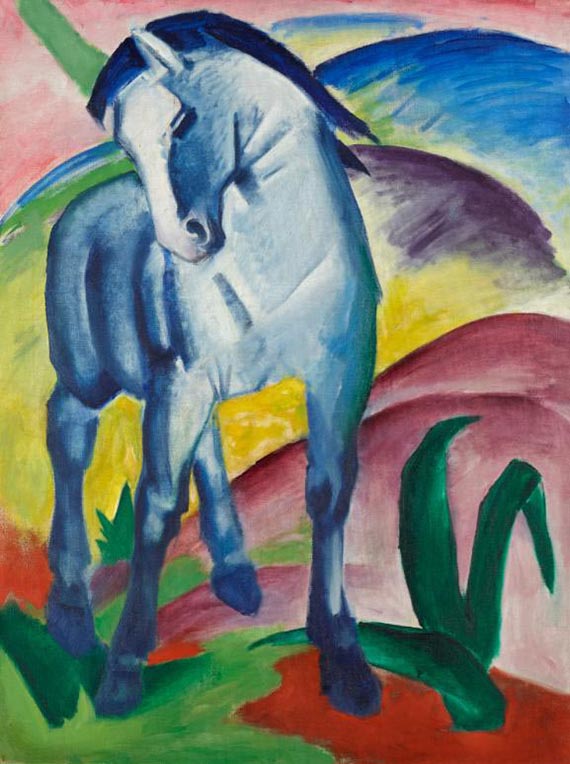
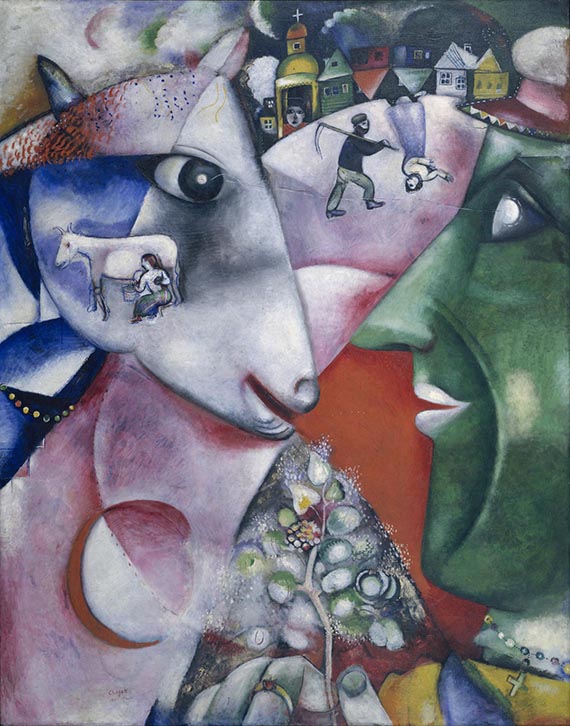
Through close artistic collaboration with his fellow artists in the “Blaue Reiter,” Campendonk’s work underwent a significant stylistic shift. He was particularly inspired by the imagery of Franz Marc, with whom he also shared artistic views and forms of expression. He drew additional artistic inspiration from the paintings of Marc Chagall, which he most likely encountered during his stays in Berlin and, certainly, also through photographs. The strangely mystical and magical qualities of these paintings can also be observed in Heinrich Campendonk's works, along with isolated cubist-expressive geometric forms reminiscent of Franz Marc, which also fill the background of the present painting.
Between dream world and the history of creation: Campendonk's enigmatic pictorial puzzles
In his bold endeavor to find new means of expression for a radically new view of reality, Campendonk created flat, constructive, bizarre, dreamlike scenes of animals and landscapes in intense, radiant colors, with lyrical, almost fairy-tale-like undertones.
Oscillating between figuration and abstraction, he created compositions with recurring, highly symbolic motifs that are difficult to decipher. Numerous animals populate these mysterious, enigmatic scenes, including horses, goats, cows, deer, and roosters—mostly alongside humans and surrounded by stylized plants, as well as architectural and abstract forms. The artist arranges the individual pictorial elements with almost no spatial depth and only a loose compositional connection, avoiding any narrative components.
In our picture, too, he places two animal figures alongside the female figure, taking up the left half of the image. The center of the picture is occupied by a tree-like plant that divides the composition into two. The animals and the female figure form a trio, but populate the composition as individual, unrelated elements: each creature looks and moves in a different direction. "These are not figures of a romantic fairy-tale world, nor are they spiritualized incarnations of animals, as in Franz Marc's work; they are elementary and, in their nature and appearance, phenomenal and meaningful individualizations of nature and life. In connection with humans [...] they have, so to speak, the character of attributes that symbolically illustrate the natural connection of creation." (Mathias T. Engels, Campendonk. Holzschnitte (Werkverzeichnis), Stuttgart 1959, p. 9ff., quoted from: Die Rheinischen Expressionisten, Recklinghausen 1980, p. 96)
The animals thus serve as prominent companions for the isolated female protagonist, visualizing and symbolizing, without any narrative component, the image theme that underlies most of his work: the eternal cycle of becoming and perishing, the entire creation.
1915: Threats of war and deep longing
The outbreak of World War I heralded the end of the artist group, as Wassily Kandinsky and Alexej von Jawlensky were soon forced to leave Germany due to their Russian backgrounds. August Macke fell in combat in the Champagne region in 1914, and Franz Marc at Verdun two years later. The loss of his friends and fellow artists deeply affected Campendonk. Contrary to Franz Marc, who initially saw the war as an opportunity for change and renewal, Campendonk viewed it as a significant threat.
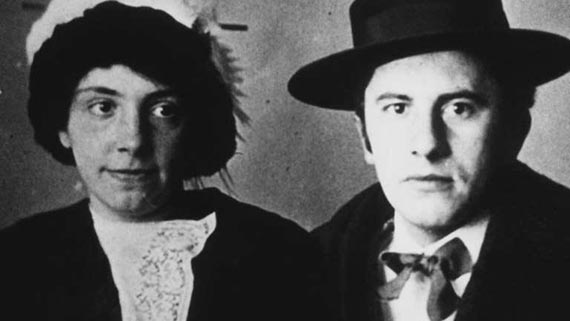
In 1913, he married his companion and closest confidante, Adelheid “Adda” Deichmann, who had already moved to Sindelsdorf to live with him in 1912. In February 1915, the year this painting was created, their first son was born. Shortly thereafter, Campendonk was drafted for basic military training and was occasionally called up for military service. He lived in uncertainty as to whether and when he would be drafted to serve in the war. Documents and drawings from this period attest to the artist's desperate state of mind. One of his self-drawn postcards from 1915 shows a white horse and, presumably, a tiger, with a heart and the dedication “To my Adda” beneath. Another card shows Adda's face in profile with the note “1915 – I love Adda.” On a second postcard, the counterpart, his own portrait, is emblazoned with the comment “Sept. 7, 1915 – I pray to see you again” (see CR no. 548 Po and no. 551 Po).
Campendonk counters this constant fear and threat, this grief and despair, with magical color worlds and a dreamlike, contemplative isolation, possibly an expression of a longing for peace and a return to harmony between man and nature.
Arrival: Idyllic Seeshaupt
In April, Campendonk suffered a breakdown and was subsequently declared to be unfit for service and dismissed, which may have saved his life and allowed him to return to his family for a specific period of time. Faced with the great tragedies and horrors of war, the artist retreated with his family to Seeshaupt on Lake Starnberg in 1916, where they occupied two floors of a farmhouse surrounded by meadows and fruit trees. The artist was finally exempted from military service and, together with his family, found refuge, harmony, and inner peace in the idyllic setting of this rural, secluded environment.
In October 1916, the present painting “Gartenbild I” (Garden Picture I) was exhibited in a solo exhibition at the renowned gallery “Der Sturm” in Berlin. The Berlin paper 'Börsenkurier' wrote in its review: “Campendonk stands in line of the leading Expressionists: one can already speak of a modern tradition in his work. The ghostliness of an Odilon Redon, the tropical splendor of Gauguin, the colorful eye of a Chagall, the animal secrets of Marc, here and there even the color storm of Kandinsky [...] find their way into his highly personal overall expression." (Theodor Däubler, exhibition at “Der Sturm,” in: Berliner Börsenkurier, October 4, 1916, quoted from: Die Rheinischen Expressionisten, Recklinghausen 1980, p. 111) [CH]
In 1905, the young Heinrich Campendonk began his studies at the newly founded progressive School of Applied Arts in Krefeld, where he was introduced not only to conventional academic training but also to new ideas in art education and to a style of visual design independent of naturalistic concepts. For financial reasons, Campendonk had to discontinue his education prematurely, but he did not abandon his plan to become an independent artist.
In October 1911, he accepted an invitation from Franz Marc and traveled to Munich, where he met the protagonists of 'Der Blaue Reiter' (The Blue Rider), Alexej von Jawlensky, Wassily Kandinsky, Paul Klee, August Macke, and Gabriele Münter. He eventually moved to Sindelsdorf in Upper Bavaria, where Macke and Marc also lived with their partners. In 1911 and 1912, he participated in the first and second exhibitions of the “Blaue Reiter” at Galerie Thannhauser in Munich and Cologne, and later in other key exhibitions of modern art before World War I, including the “First German Autumn Salon” at Herwarth Walden’s gallery “Der Sturm” in Berlin in 1913.
Maria and Franz Marc, Bernhard Koehler, Heinrich Campendonk, Thomas von Hartmann and Wassily Kandinsky (seated), after the opening of the exhibition of the ”Blauer Reiter [The Blue Rider]“, ca. December 20, 1911.
Through close artistic collaboration with his fellow artists in the “Blaue Reiter,” Campendonk’s work underwent a significant stylistic shift. He was particularly inspired by the imagery of Franz Marc, with whom he also shared artistic views and forms of expression. He drew additional artistic inspiration from the paintings of Marc Chagall, which he most likely encountered during his stays in Berlin and, certainly, also through photographs. The strangely mystical and magical qualities of these paintings can also be observed in Heinrich Campendonk's works, along with isolated cubist-expressive geometric forms reminiscent of Franz Marc, which also fill the background of the present painting.
Franz Marc, Blaues Pferd I, 1911, oil on canvas, Städtische Galerie im Lenbachhaus, Munich.
Marc Chagall, I and the Village, 1911, oil on canvas, Museum of Modern Art, New York.
© VG Bild-Kunst, Bonn 2025
© VG Bild-Kunst, Bonn 2025
Between dream world and the history of creation: Campendonk's enigmatic pictorial puzzles
In his bold endeavor to find new means of expression for a radically new view of reality, Campendonk created flat, constructive, bizarre, dreamlike scenes of animals and landscapes in intense, radiant colors, with lyrical, almost fairy-tale-like undertones.
Oscillating between figuration and abstraction, he created compositions with recurring, highly symbolic motifs that are difficult to decipher. Numerous animals populate these mysterious, enigmatic scenes, including horses, goats, cows, deer, and roosters—mostly alongside humans and surrounded by stylized plants, as well as architectural and abstract forms. The artist arranges the individual pictorial elements with almost no spatial depth and only a loose compositional connection, avoiding any narrative components.
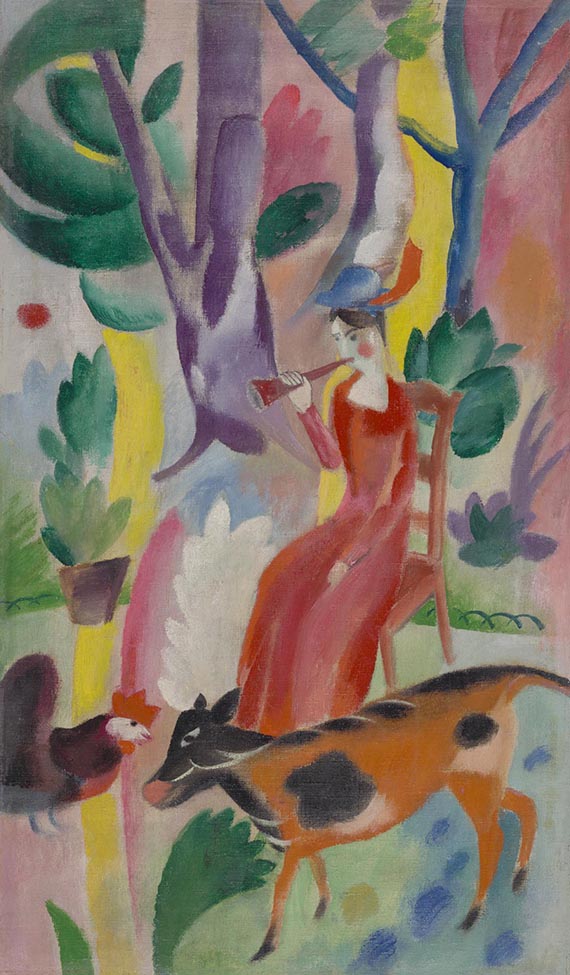
Heinrich Campendonk, Schalmeibläserin, 1914, oil on canvas on cardboard, Städtische Galerie im Lenbachhaus, Munich.
© VG Bild-Kunst, Bonn 2025
© VG Bild-Kunst, Bonn 2025
In our picture, too, he places two animal figures alongside the female figure, taking up the left half of the image. The center of the picture is occupied by a tree-like plant that divides the composition into two. The animals and the female figure form a trio, but populate the composition as individual, unrelated elements: each creature looks and moves in a different direction. "These are not figures of a romantic fairy-tale world, nor are they spiritualized incarnations of animals, as in Franz Marc's work; they are elementary and, in their nature and appearance, phenomenal and meaningful individualizations of nature and life. In connection with humans [...] they have, so to speak, the character of attributes that symbolically illustrate the natural connection of creation." (Mathias T. Engels, Campendonk. Holzschnitte (Werkverzeichnis), Stuttgart 1959, p. 9ff., quoted from: Die Rheinischen Expressionisten, Recklinghausen 1980, p. 96)
The animals thus serve as prominent companions for the isolated female protagonist, visualizing and symbolizing, without any narrative component, the image theme that underlies most of his work: the eternal cycle of becoming and perishing, the entire creation.
1915: Threats of war and deep longing
The outbreak of World War I heralded the end of the artist group, as Wassily Kandinsky and Alexej von Jawlensky were soon forced to leave Germany due to their Russian backgrounds. August Macke fell in combat in the Champagne region in 1914, and Franz Marc at Verdun two years later. The loss of his friends and fellow artists deeply affected Campendonk. Contrary to Franz Marc, who initially saw the war as an opportunity for change and renewal, Campendonk viewed it as a significant threat.
Wedding picture: Heinrich und Adda Campendonk, June 17, 1913.
© Nachlass Heinrich Campendonk /VG Bild-Kunst, Bonn 2025
© Nachlass Heinrich Campendonk /VG Bild-Kunst, Bonn 2025
In 1913, he married his companion and closest confidante, Adelheid “Adda” Deichmann, who had already moved to Sindelsdorf to live with him in 1912. In February 1915, the year this painting was created, their first son was born. Shortly thereafter, Campendonk was drafted for basic military training and was occasionally called up for military service. He lived in uncertainty as to whether and when he would be drafted to serve in the war. Documents and drawings from this period attest to the artist's desperate state of mind. One of his self-drawn postcards from 1915 shows a white horse and, presumably, a tiger, with a heart and the dedication “To my Adda” beneath. Another card shows Adda's face in profile with the note “1915 – I love Adda.” On a second postcard, the counterpart, his own portrait, is emblazoned with the comment “Sept. 7, 1915 – I pray to see you again” (see CR no. 548 Po and no. 551 Po).
Campendonk counters this constant fear and threat, this grief and despair, with magical color worlds and a dreamlike, contemplative isolation, possibly an expression of a longing for peace and a return to harmony between man and nature.
Arrival: Idyllic Seeshaupt
In April, Campendonk suffered a breakdown and was subsequently declared to be unfit for service and dismissed, which may have saved his life and allowed him to return to his family for a specific period of time. Faced with the great tragedies and horrors of war, the artist retreated with his family to Seeshaupt on Lake Starnberg in 1916, where they occupied two floors of a farmhouse surrounded by meadows and fruit trees. The artist was finally exempted from military service and, together with his family, found refuge, harmony, and inner peace in the idyllic setting of this rural, secluded environment.
In October 1916, the present painting “Gartenbild I” (Garden Picture I) was exhibited in a solo exhibition at the renowned gallery “Der Sturm” in Berlin. The Berlin paper 'Börsenkurier' wrote in its review: “Campendonk stands in line of the leading Expressionists: one can already speak of a modern tradition in his work. The ghostliness of an Odilon Redon, the tropical splendor of Gauguin, the colorful eye of a Chagall, the animal secrets of Marc, here and there even the color storm of Kandinsky [...] find their way into his highly personal overall expression." (Theodor Däubler, exhibition at “Der Sturm,” in: Berliner Börsenkurier, October 4, 1916, quoted from: Die Rheinischen Expressionisten, Recklinghausen 1980, p. 111) [CH]
76
Heinrich Campendonk
Im Garten - Frau, Pferd, Ziege (Gartenbild I), 1915.
Oil on panel (door element)
Estimation: € 600,000 / $ 696,000
Commission, taxes et droit de suite
Cet objet est offert avec imposition régulière ou avec imposition différentielle.
Calcul en cas d'imposition différentielle:
Prix d’adjudication jusqu’à 1 000 000 euros : frais de vente 34 %.
Des frais de vente de 29% sont facturés sur la partie du prix d’adjudication dépassant 1 000 000 euros. Ils sont additionnés aux frais de vente dus pour la partie du prix d’adjudication allant jusqu’à 1 000 000 euros.
Des frais de vente de 22% sont facturés sur la partie du prix d’adjudication dépassant 4 000 000 euros. Ils sont additionnés aux frais de vente dus pour la partie du prix d’adjudication allant jusqu’à 4 000 000 euros.
La commission comprend la TVA, mais celle-ci n'est pas indiquée.
Calcul en cas d'imposition régulière:
Prix d'adjudication jusqu'à 1 000 000 € : 29 % de commission.
Prix d'adjudication supérieur à 1 000 000 € : montants partiels jusqu'à 1 000 000 € 29 % de commission, montants partiels supérieurs à 1 000 000 € : 23 % de commission.
Prix d'adjudication supérieur à 4.000 000 € : montants partiels supérieurs à 4.000 000 € : 15 % de commission.
La TVA légale de 7 % est prélevée sur la somme du prix d'adjudication et de la commission.
Si vous souhaitez appliquer l'imposition régulière, merci de bien vouloir le communiquer par écrit avant la facturation.
Calcul en cas de droit de suite:
Pour les œuvres originales d’arts plastiques et de photographie d’artistes vivants ou d’artistes décédés il y a moins de 70 ans, soumises au droit de suite, une rémunération au titre du droit de suite à hauteur des pourcentages indiqués au § 26, al. 2 de la loi allemande sur les droits d’auteur (UrhG) est facturée en sus pour compenser la rémunération liée au droit de suite due par le commissaire-priseur conformément au § 26 UrhG. À ce jour, elle est calculée comme suit :
4 pour cent pour la part du produit de la vente à partir de 400,00 euros et jusqu’à 50 000 euros,
3 pour cent supplémentaires pour la part du produit de la vente entre 50 000,01 et 200 000 euros,
1 pour cent supplémentaire pour la part entre 200 000,01 et 350 000 euros,
0,5 pour cent supplémentaire pour la part entre 350 000,01 et 500 000 euros et
0,25 pour cent supplémentaire pour la part au-delà de 500 000 euros.
Le total de la rémunération au titre du droit de suite pour une revente s’élève au maximum à 12 500 euros.
Calcul en cas d'imposition différentielle:
Prix d’adjudication jusqu’à 1 000 000 euros : frais de vente 34 %.
Des frais de vente de 29% sont facturés sur la partie du prix d’adjudication dépassant 1 000 000 euros. Ils sont additionnés aux frais de vente dus pour la partie du prix d’adjudication allant jusqu’à 1 000 000 euros.
Des frais de vente de 22% sont facturés sur la partie du prix d’adjudication dépassant 4 000 000 euros. Ils sont additionnés aux frais de vente dus pour la partie du prix d’adjudication allant jusqu’à 4 000 000 euros.
La commission comprend la TVA, mais celle-ci n'est pas indiquée.
Calcul en cas d'imposition régulière:
Prix d'adjudication jusqu'à 1 000 000 € : 29 % de commission.
Prix d'adjudication supérieur à 1 000 000 € : montants partiels jusqu'à 1 000 000 € 29 % de commission, montants partiels supérieurs à 1 000 000 € : 23 % de commission.
Prix d'adjudication supérieur à 4.000 000 € : montants partiels supérieurs à 4.000 000 € : 15 % de commission.
La TVA légale de 7 % est prélevée sur la somme du prix d'adjudication et de la commission.
Si vous souhaitez appliquer l'imposition régulière, merci de bien vouloir le communiquer par écrit avant la facturation.
Calcul en cas de droit de suite:
Pour les œuvres originales d’arts plastiques et de photographie d’artistes vivants ou d’artistes décédés il y a moins de 70 ans, soumises au droit de suite, une rémunération au titre du droit de suite à hauteur des pourcentages indiqués au § 26, al. 2 de la loi allemande sur les droits d’auteur (UrhG) est facturée en sus pour compenser la rémunération liée au droit de suite due par le commissaire-priseur conformément au § 26 UrhG. À ce jour, elle est calculée comme suit :
4 pour cent pour la part du produit de la vente à partir de 400,00 euros et jusqu’à 50 000 euros,
3 pour cent supplémentaires pour la part du produit de la vente entre 50 000,01 et 200 000 euros,
1 pour cent supplémentaire pour la part entre 200 000,01 et 350 000 euros,
0,5 pour cent supplémentaire pour la part entre 350 000,01 et 500 000 euros et
0,25 pour cent supplémentaire pour la part au-delà de 500 000 euros.
Le total de la rémunération au titre du droit de suite pour une revente s’élève au maximum à 12 500 euros.