


Video
Autre image
Autre image
Autre image
Autre image
Autre image
Autre image
Autre image
Autre image
Autre image
47
Thomas Schütte
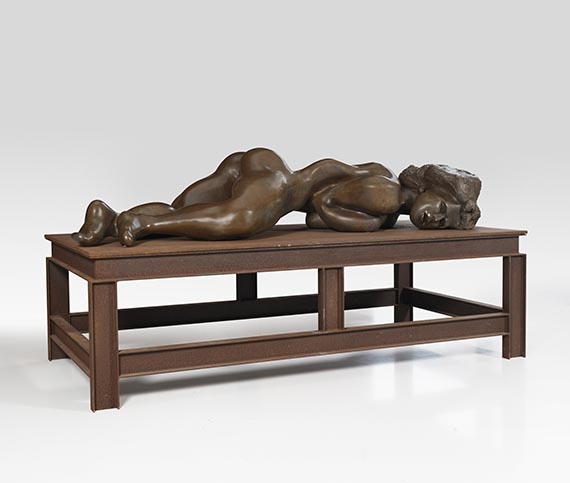
Bronzefrau Nr. 12, 2003.
Bronze patina, on a steel table
Estimation:
€ 1,000,000 / $ 1,160,000 Résultat:
€ 1,536,000 / $ 1,781,759 ( frais d'adjudication compris)
47
Thomas Schütte
Bronzefrau Nr. 12, 2003.
Bronze patina, on a steel table
Estimation:
€ 1,000,000 / $ 1,160,000 Résultat:
€ 1,536,000 / $ 1,781,759 ( frais d'adjudication compris)
Thomas Schütte
1954
Bronzefrau Nr. 12. 2003.
Bronze patina, on a steel table.
Signed, dated, and with the foundry mark “Kayser & Klippel Düsseldorf” on the left foot. Unique work. 130 x 125 x 251 cm (51.1 x 49.2 x 98.8 in).
• Unique work.
• Monumental, vulnerable, existential: Thomas Schütte reflects on existential forms of femininity.
• His series “Bronzefrauen” (Bronze Women) is a key contribution to contemporary figurative sculpture.
• Until November 2025, the Pinault Collection at Punta della Dogana in Venice dedicates a comprehensive exhibition to Thomas Schütte.
• The “Bronze Women” are among the artist's most sought-after works on the international auction market.
• The MoMA in New York recently presented a comprehensive retrospective (2024/2025).
PROVENANCE: Private collection, London.
LITERATURE: https://thomas-schuette.de/main.php?kat=2.08.10.089 (October 1, 2025 at 5:48 pm).
"Without a doubt, Thomas Schütte is one of the most important contemporary artists, but also one of the most idiosyncratic. He has never followed any trends."
Camille Morineau (curator of the 2025 Thomas Schütte exhibition at Punta della Dogana, Venice, Pinault Collection)
“You can't really make art. It just happens, sometimes.”
Thomas Schütte
1954
Bronzefrau Nr. 12. 2003.
Bronze patina, on a steel table.
Signed, dated, and with the foundry mark “Kayser & Klippel Düsseldorf” on the left foot. Unique work. 130 x 125 x 251 cm (51.1 x 49.2 x 98.8 in).
• Unique work.
• Monumental, vulnerable, existential: Thomas Schütte reflects on existential forms of femininity.
• His series “Bronzefrauen” (Bronze Women) is a key contribution to contemporary figurative sculpture.
• Until November 2025, the Pinault Collection at Punta della Dogana in Venice dedicates a comprehensive exhibition to Thomas Schütte.
• The “Bronze Women” are among the artist's most sought-after works on the international auction market.
• The MoMA in New York recently presented a comprehensive retrospective (2024/2025).
PROVENANCE: Private collection, London.
LITERATURE: https://thomas-schuette.de/main.php?kat=2.08.10.089 (October 1, 2025 at 5:48 pm).
"Without a doubt, Thomas Schütte is one of the most important contemporary artists, but also one of the most idiosyncratic. He has never followed any trends."
Camille Morineau (curator of the 2025 Thomas Schütte exhibition at Punta della Dogana, Venice, Pinault Collection)
“You can't really make art. It just happens, sometimes.”
Thomas Schütte
Thomas Schütte's series “Frauen” (Women, 1998–2006) represents one of the most pivotal contributions to contemporary figurative sculpture. Since the late 1990s, Schütte has been exploring the theme that has become a fundamental aspect of his sculptural practice. The series comprises 18 large-scale sculptures. His “Frauen” are neither muses nor models. The female body—for centuries a projection screen for ideals, myths, and power—becomes a realm of inquiry for Schütte.
Material as a form of expression
Each of these large sculptures originated as a small ceramic sculpture, in which the female figures are formed from a single piece of clay; they are not assembled from several pieces but are completely modeled from a single piece and grow out of the base plate. He describes them as “ceramic effusions,” which were created without preliminary sketches or models. In the next step, these small figures are scaled up to monumental polystyrene figures in the foundry. In a final step, the cast sculptures are executed.
There are bronze, Corten steel, and aluminum versions of each figure. Due to the special surface treatment, each of them is a unique piece.
The present “Bronze Woman No. 12” also exists in a version with black-green patina. The individual figures, with appearances determined by their material and form, become the antithesis of the uniform surface of our visual culture: some of the “women” are raw and agitated, some seem powerful, and some are pensive and at peace with themselves. The respective surface has a decisive influence on the impression made.
The consistent differentiation and implementation across these three materials exemplify the outstanding relevance of the individual materials to Thomas Schütte: cool, smooth aluminum; sturdy, massive Corten steel; and elegant, soft bronze. Schütte's approach to his work resembles an ongoing dialog with the history of sculpting. He is familiar with its conventions, its hierarchies, its image types—and he circumvents them by slowing down and condensing their language. Where classical figures sought harmony, Schütte seeks breaks. Where others strove for smoothness, he leaves traces and wounds visible. His “women” are not images, but states—moments between creation and transience. They embody a form of existence that does not aim for permanence, but for presence.
“Bronze Woman No. 12” – Physicality beyond classical ideals
Elegant, sublime, and intimate, the figure reclines on a raw steel table that serves as a pedestal. From one angle, she may appear vulnerable, while from another perspective, she seems peaceful and at rest. “Bronze Woman No. 12” reveals how the artist draws on the long history of the female nude while simultaneously taking a critical approach: the body is on a table, not a pedestal. This table is both a workbench and a resting place.
What was initially created from clay is thus transformed into a heavy, permanent sculpture with deliberate references to the tradition of traditional sculpture. As the artist explains, he focuses less on the weight of history and more on the future: what matters is that the works are physically present and encourage fundamental questions.
“Bronze Woman No. 12” is a figure presented on a high steel pedestal, its physicality both familiar and alienating; sculpted, powerful forms correspond with a tender, loving posture; it is at rest, yet powerful and agile. With his distinctive forms, Schütte undermines the longstanding tradition of the idealized female body, which served as a field of experimentation for abstraction and figuration from Aristide Maillol to Henry Moore. Instead of harmonious perfection, Thomas Schütte models a body that reveals contradictions.
“Bronze Woman No. 12” is not a representation, but an exploration of sculpture itself: its materiality, its history, its openness to interpretation.
This multitude of possible meanings characterizes all of the female figures in the series: the conceptual space between idol and victim, between monumentality and fragility, is essential to the reception of the works. The bodies are both powerful and hurt, heroic and broken. Schütte refers to the figures as exclamation marks or question marks: they mark positions without providing definitive explanations. This openness is the true strength of the series.
The choice of pedestal also reflects this understanding. Schütte replaces the traditional, closed block with a steel table with angular, functional legs. This has the effect of a workbench or tribunal: it refers to the manufacturing process, but also emphasizes the presentation situation as part of the work. The “women” are thus exposed and isolated at the same time, creating an ambivalent effect: they appear monumental and strong, yet also vulnerable, helpless, and lonely.
“Women” and the tradition of the female nude
In the “Women” series, Thomas Schütte addresses one of the oldest themes in art: the depiction of the unclothed female. Representations of the naked female body have been part of art since its beginnings. From the Venus of Willendorf, symbol of fertility and abundance, to the idealized Aphrodites of ancient Greece, to the Renaissance masters Botticelli and Giorgione, who revived the ideal of divine love in the nude figure, the female body has always reflected the values of its time.
With Titian, this ideal changed: his “Venus of Urbino” (1538) elevated the female nude to an expression of sensual self-determination. Later, Ingres elongated the body of his figure in “The Grand Odalisque” (1814) to increase her erotic appeal, while Manet's “Olympia” (1865) exposed the social hypocrisy of his time.
In the 20th century, the female body became a field of experimentation for Modernism: Picasso and the Cubists used it as a starting point for abstract studies of form, while Henry Moore transformed it into a landscape of soft hills.
Thomas Schütte's series “Women” ties into this long history of the female nude and, at the same time, questions its contemporary significance.
Moreover, the series must also be understood in the context of German post-war art. After the abuse of figurative representations by the fascist regime, the question arose as to whether it was even possible to continue making figurative art. Schütte succeeds in neither denying this tradition nor transforming it into a new, critical form. His sculptures are not purely conservative nor merely destructive, but open up a terrain on which the potential of figurative art can be renegotiated.
“Bronze Woman No. 12” is therefore not only a representation of the female body, but also a space for reflection on sculpture itself: on material, scale, presentation, and historical references. Schütte’s art does not claim to provide definitive answers—it poses questions that remain open, thereby creating a space in which the past, present, and future of sculpture are reconnecting. [EH]
“Women” in exhibitions
With the “Women” series, a key work within his oeuvre, Thomas Schütte has set new standards in major solo exhibitions around the world in recent years.
2025: Gagosian Gallery, New York.
2024/25: The Museum of Modern Art, New York.
2019 Kunsthaus Bregenz.
2016: Moderna Museet, Stockholm.
2013: Fondation Beyeler, Riehen/Basel.
2014: Museum Folkwang, Essen.
2013/14: me Collectors Room Berlin / Foundation Olbricht.
2013: Sara Hildén Art Museum, Tampere.
2012: Castello di Rivoli, Turin.
2010: Museo Nacional Centro de Arte Reina Sofía, Madrid.
2009: Haus der Kunst, Munich.
Material as a form of expression
Each of these large sculptures originated as a small ceramic sculpture, in which the female figures are formed from a single piece of clay; they are not assembled from several pieces but are completely modeled from a single piece and grow out of the base plate. He describes them as “ceramic effusions,” which were created without preliminary sketches or models. In the next step, these small figures are scaled up to monumental polystyrene figures in the foundry. In a final step, the cast sculptures are executed.
There are bronze, Corten steel, and aluminum versions of each figure. Due to the special surface treatment, each of them is a unique piece.
The present “Bronze Woman No. 12” also exists in a version with black-green patina. The individual figures, with appearances determined by their material and form, become the antithesis of the uniform surface of our visual culture: some of the “women” are raw and agitated, some seem powerful, and some are pensive and at peace with themselves. The respective surface has a decisive influence on the impression made.
The consistent differentiation and implementation across these three materials exemplify the outstanding relevance of the individual materials to Thomas Schütte: cool, smooth aluminum; sturdy, massive Corten steel; and elegant, soft bronze. Schütte's approach to his work resembles an ongoing dialog with the history of sculpting. He is familiar with its conventions, its hierarchies, its image types—and he circumvents them by slowing down and condensing their language. Where classical figures sought harmony, Schütte seeks breaks. Where others strove for smoothness, he leaves traces and wounds visible. His “women” are not images, but states—moments between creation and transience. They embody a form of existence that does not aim for permanence, but for presence.
“Bronze Woman No. 12” – Physicality beyond classical ideals
Elegant, sublime, and intimate, the figure reclines on a raw steel table that serves as a pedestal. From one angle, she may appear vulnerable, while from another perspective, she seems peaceful and at rest. “Bronze Woman No. 12” reveals how the artist draws on the long history of the female nude while simultaneously taking a critical approach: the body is on a table, not a pedestal. This table is both a workbench and a resting place.
What was initially created from clay is thus transformed into a heavy, permanent sculpture with deliberate references to the tradition of traditional sculpture. As the artist explains, he focuses less on the weight of history and more on the future: what matters is that the works are physically present and encourage fundamental questions.
“Bronze Woman No. 12” is a figure presented on a high steel pedestal, its physicality both familiar and alienating; sculpted, powerful forms correspond with a tender, loving posture; it is at rest, yet powerful and agile. With his distinctive forms, Schütte undermines the longstanding tradition of the idealized female body, which served as a field of experimentation for abstraction and figuration from Aristide Maillol to Henry Moore. Instead of harmonious perfection, Thomas Schütte models a body that reveals contradictions.
“Bronze Woman No. 12” is not a representation, but an exploration of sculpture itself: its materiality, its history, its openness to interpretation.
This multitude of possible meanings characterizes all of the female figures in the series: the conceptual space between idol and victim, between monumentality and fragility, is essential to the reception of the works. The bodies are both powerful and hurt, heroic and broken. Schütte refers to the figures as exclamation marks or question marks: they mark positions without providing definitive explanations. This openness is the true strength of the series.
The choice of pedestal also reflects this understanding. Schütte replaces the traditional, closed block with a steel table with angular, functional legs. This has the effect of a workbench or tribunal: it refers to the manufacturing process, but also emphasizes the presentation situation as part of the work. The “women” are thus exposed and isolated at the same time, creating an ambivalent effect: they appear monumental and strong, yet also vulnerable, helpless, and lonely.
“Women” and the tradition of the female nude
In the “Women” series, Thomas Schütte addresses one of the oldest themes in art: the depiction of the unclothed female. Representations of the naked female body have been part of art since its beginnings. From the Venus of Willendorf, symbol of fertility and abundance, to the idealized Aphrodites of ancient Greece, to the Renaissance masters Botticelli and Giorgione, who revived the ideal of divine love in the nude figure, the female body has always reflected the values of its time.
With Titian, this ideal changed: his “Venus of Urbino” (1538) elevated the female nude to an expression of sensual self-determination. Later, Ingres elongated the body of his figure in “The Grand Odalisque” (1814) to increase her erotic appeal, while Manet's “Olympia” (1865) exposed the social hypocrisy of his time.
In the 20th century, the female body became a field of experimentation for Modernism: Picasso and the Cubists used it as a starting point for abstract studies of form, while Henry Moore transformed it into a landscape of soft hills.
Thomas Schütte's series “Women” ties into this long history of the female nude and, at the same time, questions its contemporary significance.
Moreover, the series must also be understood in the context of German post-war art. After the abuse of figurative representations by the fascist regime, the question arose as to whether it was even possible to continue making figurative art. Schütte succeeds in neither denying this tradition nor transforming it into a new, critical form. His sculptures are not purely conservative nor merely destructive, but open up a terrain on which the potential of figurative art can be renegotiated.
“Bronze Woman No. 12” is therefore not only a representation of the female body, but also a space for reflection on sculpture itself: on material, scale, presentation, and historical references. Schütte’s art does not claim to provide definitive answers—it poses questions that remain open, thereby creating a space in which the past, present, and future of sculpture are reconnecting. [EH]
“Women” in exhibitions
With the “Women” series, a key work within his oeuvre, Thomas Schütte has set new standards in major solo exhibitions around the world in recent years.
2025: Gagosian Gallery, New York.
2024/25: The Museum of Modern Art, New York.
2019 Kunsthaus Bregenz.
2016: Moderna Museet, Stockholm.
2013: Fondation Beyeler, Riehen/Basel.
2014: Museum Folkwang, Essen.
2013/14: me Collectors Room Berlin / Foundation Olbricht.
2013: Sara Hildén Art Museum, Tampere.
2012: Castello di Rivoli, Turin.
2010: Museo Nacional Centro de Arte Reina Sofía, Madrid.
2009: Haus der Kunst, Munich.