


9
Tony Cragg
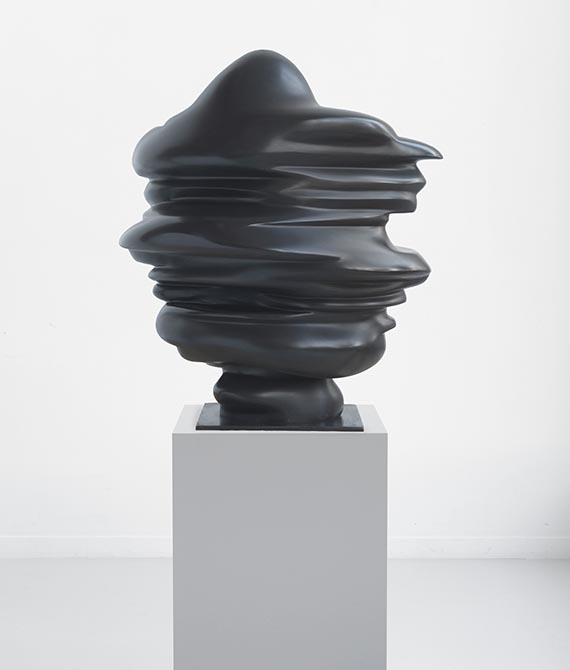
Bad Guys, 2010.
Bronze
Estimation: € 120,000 / $ 134,400
Tony Cragg
1949
Bad Guys. 2010.
Bronze.
Signed by the artist at the bottom on the side, with the stamped date and the foundry mark. Approximately 95 x 80 x 80 cm (37.4 x 31.4 x 31.4 in).
Cast by the Kayser Art Foundry, Düsseldorf. [CH].
• ALL-AROUND VIEW Every angle reveals a different perspective on this elegant bronze.
• PRESENCE The symbiosis of captivating materiality and layered round forms results in an impressive sculptural presence.
• VERSATILE Abstraction and figurative suggestion, stability and movement, dark coloring and a glossy surface.
• POSITION Tony Cragg is one of the most successful contemporary sculptors.
• WORLDWIDE His works are in major museum collections, including the Museum Ludwig, Cologne; the Museo Nacional Centro de Arte Reina Sofía, Madrid; the Museum of Contemporary Art, Los Angeles; and the Tate Gallery, London.
PROVENANCE: Galerie Klüser, Munich.
Private collection, Switzerland (acquired from the above in 2014).
"The traditional idea of sculpture that you make something that [already] exists in another material, it doesn't seem to make any sense to me. I am more interested in what I can make the material do and what sort of ideas and emotions I have while I am making it and after when it's finished. So that's really what drives me on."
Tony Cragg in a conversation with Ed Behrens, Apollo Magazine, TEFAF Talks, 2026.
Called up: December 4, 2026 - ca. 17.16 h +/- 20 min.
In Tony Cragg’s dynamic works, the material takes on entirely new forms. Through overlapping layers and curves, he creates structures that oscillate between figuration and abstraction, giving static sculptural forms a surprising sense of vitality. In “Bad Guys,” archaic, elemental abstraction meets a technically flawless surface.
Since the 1970s, Cragg has developed these forms through many sketches, using paper stencils and plywood models. Only the spectacular all-around view offers a glimpse of this process, while the technical perfection of the execution reveals the work of a meticulous, subtle artisan. The bronze's mass dominates the surrounding space, yet it stands in striking contrast to the form’s vibrant appearance. The surrounding space is incorporated into the composition as a creative element. This also echoes Cragg’s scientific beginnings as a laboratory assistant in the 1960s.
After studying at Gloucester College of Art and Design and the Royal College of Art in London, Cragg quickly gained international recognition. His work was exhibited at documenta (1982, 1987) and the Venice Biennale (1986, 1993). In 1988, he received the Turner Prize and was appointed to the Düsseldorf Academy of Fine Arts. As one of the leading figures of “New British Sculpture,” Cragg—a recipient of the Praemium Imperiale for Sculpture and a member of the Royal Academy in London—ranks among the most significant contemporary sculptors.
When Cragg's sculptures reveal faces or the titles of the works, as with “Bad Guys,” imply narrative connotations, the artist is less concerned with a trivial play on pareidolia. More than anything, these subtle accents emerge alongside the work's formal qualities. At the heart of these sculptures lies the observation of the momentary and the transitory. What an individual may discover in them remains always an approximation, never the conclusive, sole valid answer, for the sculpture invites the viewer to walk around it, revealing a wealth of different perspectives, so that no unambiguous image can take root in their memory. Each sculpture is intended to pull the viewer out of their accustomed passive state and open them up to literary, metaphorical, spiritual, poetic, and—not least—metaphysical interpretations. [EB]


Commission, taxes et droit de suite
Cet objet est offert avec imposition régulière.
Calcul en cas d'imposition régulière:
Prix d’adjudication jusqu’à 1 000 000 euros : frais de vente 29%.
Des frais de vente de 23% sont facturés sur la partie du prix d’adjudication dépassant 1 000 000 euros. Ils sont additionnés aux frais de vente dus pour la partie du prix d’adjudication allant jusqu’à 1 000 000 euros.
Des frais de vente de 15 % sont facturés sur la partie du prix d’adjudication dépassant 4 000 000 euros. Ils sont additionnés aux frais de vente dus pour la partie du prix d’adjudication allant jusqu’à 4 000 000 euros.
La taxe sur la valeur ajoutée allemande, actuellement de 7 %, est perçue sur la somme du prix d’adjudication et des frais de vente.
Pour les entreprises habilitées à déduire la TVA, le régime fiscal général peut être appliqué.
Calcul en cas de droit de suite:
Pour les œuvres originales d’arts plastiques et de photographie d’artistes vivants ou d’artistes décédés il y a moins de 70 ans, soumises au droit de suite, une rémunération au titre du droit de suite à hauteur des pourcentages indiqués au § 26, al. 2 de la loi allemande sur les droits d’auteur (UrhG) est facturée en sus pour compenser la rémunération liée au droit de suite due par le commissaire-priseur conformément au § 26 UrhG. À ce jour, elle est calculée comme suit :
4 pour cent pour la part du produit de la vente à partir de 400,00 euros et jusqu’à 50 000 euros,
3 pour cent supplémentaires pour la part du produit de la vente entre 50 000,01 et 200 000 euros,
1 pour cent supplémentaire pour la part entre 200 000,01 et 350 000 euros,
0,5 pour cent supplémentaire pour la part entre 350 000,01 et 500 000 euros et
0,25 pour cent supplémentaire pour la part au-delà de 500 000 euros.
Le total de la rémunération au titre du droit de suite pour une revente s’élève au maximum à 12 500 euros.