


21
Daniel Richter
Gestern, von hinten, 2016.
Oil on canvas
Estimation: € 140,000 / $ 156,800
21
Daniel Richter
Gestern, von hinten, 2016.
Oil on canvas
Estimation: € 140,000 / $ 156,800
Daniel Richter
1962
Gestern, von hinten. 2016.
Oil on canvas.
Signed, dated, and titled on the reverse of the canvas. 210 x 160 cm (82.6 x 62.9 in). [AW].
• SUPERSTAR Daniel Richter – One of the most influential painters of the contemporary art scene.
• PROVOCATIVE A painting straddling the line between abstraction and figuration.
• EPHEMERAL Expressive color and shadowy figures oscillate on a monumental canvas.
• RETROSPECTIVE In the year of its creation, the Louisiana Museum of Modern Art in Humlebæk presented “Daniel Richter – Lonely Old Slogans.”
• MUSEUM QUALITY Richter’s works are at, among others, the Kunsthalle Hamburg, the Städel Museum in Frankfurt am Main, the Centre Pompidou in Paris, and the Museum of Modern Art in New York.
PROVENANCE: Galerie Thaddaeus Ropac, Salzburg (with a gallery label on the reverse of the stretcher).
Private collection, Bavaria (acquired from the above in 2016).
Called up: December 4, 2026 - ca. 17.40 h +/- 20 min.
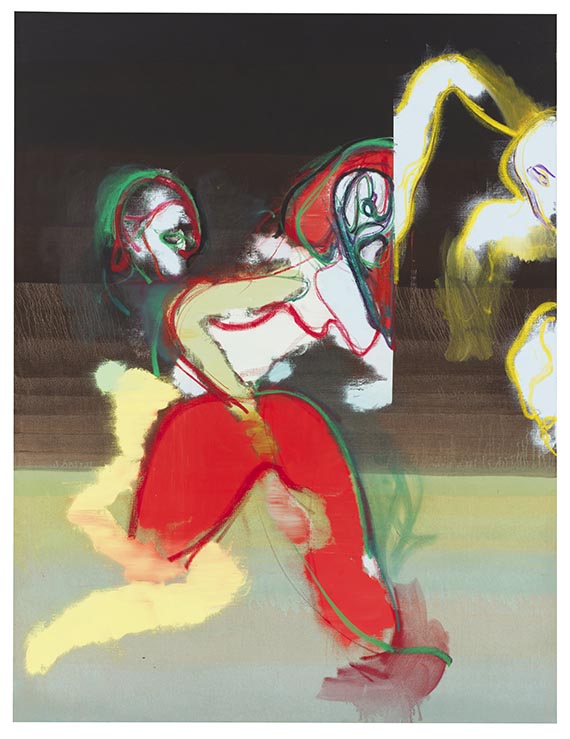
Daniel Richter’s “Gestern, von hinten” (Yesterday, from Behind) from 2016 epitomizes his distinct style: vibrant colors and dynamic lines that envelop his figures in an intense interplay of abstraction and figuration. A wild tangle of limbs intertwines with bold physical forms and elongated streaks of color that stretch across the canvas like electrical impulses, oscillating in a minimalist “non-space” between reality and the dissolution of form. The color red, which catches the eye right away in our work, signals associations with blood, passion, and even political symbols. Richter imbues this work with a provocative, almost inescapable presence. He plays with layers of meaning and leaves the interpretation of possible ambiguities to the viewer. The fragmented figures appear to be captured in a frozen moment as they perform their dance. The figure in the right margin of the painting seems to be gazing at a scene that is hidden from our view. In this manner, the figures oscillate between closeness and distance, fascination and confusion.
The work was created in 2016, at a turning point in Richter’s career. The 2015 retrospective at the Schirn Kunsthalle in Frankfurt was followed by a monographic exhibition at the Louisiana Museum of Modern Art in Humlebæk in 2016, both of which attest to his growing international significance. Richter, born in Eutin in 1962 and a professor at the Vienna Academy of Fine Arts since 2006, turned away from the political works of the 1990s during this period and moved toward an introspective yet critical examination of contemporary subjectivity. His most recent works oscillate between figuration and abstraction: fragmented bodies intertwine to form chaotic compositions against backgrounds of reduced color, of which this work is a particularly striking example. Drawing inspiration from Symbolists such as James Ensor and Edvard Munch, Richter combines motifs from art history, mass media, and pop culture to create idiosyncratic, surreal visual worlds. His work also extends beyond the visual arts: in the 1990s, he made a name for himself in music, designing album covers and posters; since 2005, he has run his own record label.
This body of work is a monumental expression of Daniel Richter’s artistic development. It demonstrates his ability to unite social taboos, political and art-historical symbolism, and human intimacy into a single, overwhelming image. As a result, Daniel Richter remains, without a doubt, one of the most sought-after artists in contemporary painting. [AW]
Commission, taxes et droit de suite
Cet objet est offert avec imposition régulière ou avec imposition différentielle.
Calcul en cas d'imposition différentielle:
Prix d’adjudication jusqu’à 1 000 000 euros : frais de vente 34 %.
Des frais de vente de 29% sont facturés sur la partie du prix d’adjudication dépassant 1 000 000 euros. Ils sont additionnés aux frais de vente dus pour la partie du prix d’adjudication allant jusqu’à 1 000 000 euros.
Des frais de vente de 22% sont facturés sur la partie du prix d’adjudication dépassant 4 000 000 euros. Ils sont additionnés aux frais de vente dus pour la partie du prix d’adjudication allant jusqu’à 4 000 000 euros.
La commission comprend la TVA, mais celle-ci n'est pas indiquée.
Calcul en cas d'imposition régulière:
Prix d'adjudication jusqu'à 1 000 000 € : 29 % de commission.
Prix d'adjudication supérieur à 1 000 000 € : montants partiels jusqu'à 1 000 000 € 29 % de commission, montants partiels supérieurs à 1 000 000 € : 23 % de commission.
Prix d'adjudication supérieur à 4.000 000 € : montants partiels supérieurs à 4.000 000 € : 15 % de commission.
La TVA légale de 7 % est prélevée sur la somme du prix d'adjudication et de la commission.
Si vous souhaitez appliquer l'imposition régulière, merci de bien vouloir le communiquer par écrit avant la facturation.
Calcul en cas de droit de suite:
Pour les œuvres originales d’arts plastiques et de photographie d’artistes vivants ou d’artistes décédés il y a moins de 70 ans, soumises au droit de suite, une rémunération au titre du droit de suite à hauteur des pourcentages indiqués au § 26, al. 2 de la loi allemande sur les droits d’auteur (UrhG) est facturée en sus pour compenser la rémunération liée au droit de suite due par le commissaire-priseur conformément au § 26 UrhG. À ce jour, elle est calculée comme suit :
4 pour cent pour la part du produit de la vente à partir de 400,00 euros et jusqu’à 50 000 euros,
3 pour cent supplémentaires pour la part du produit de la vente entre 50 000,01 et 200 000 euros,
1 pour cent supplémentaire pour la part entre 200 000,01 et 350 000 euros,
0,5 pour cent supplémentaire pour la part entre 350 000,01 et 500 000 euros et
0,25 pour cent supplémentaire pour la part au-delà de 500 000 euros.
Le total de la rémunération au titre du droit de suite pour une revente s’élève au maximum à 12 500 euros.