


Raumbeispiel
53
Emil Nolde
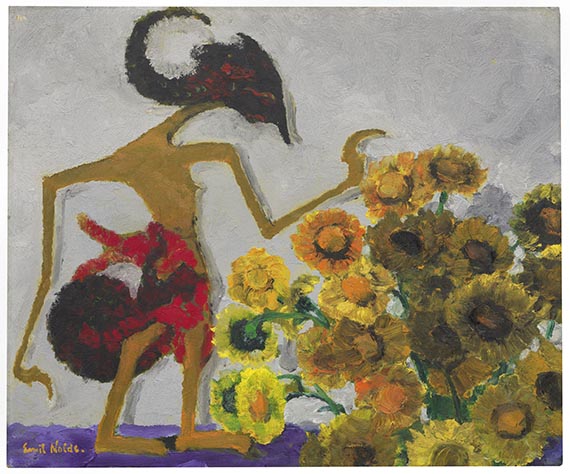
Wajangfigur und Blumen, 1928.
Oil on panel
Estimation: € 400,000 / $ 448,000
53
Emil Nolde
Wajangfigur und Blumen, 1928.
Oil on panel
Estimation: € 400,000 / $ 448,000
Emil Nolde
1867 - 1956
Wajangfigur und Blumen. 1928.
Oil on panel.
Signed in the lower left. Once more signed and titled on the reverse. 73.5 x 88.5 cm (28.9 x 34.8 in). [AW].
• EXPRESSIVE COLORS The vibrant flowers showcase Nolde at the height of his distinctive Expressionist style.
• TWO PASSIONS A rare fusion of his famous floral paintings with his fascination for non-European art.
• PERSONAL The Wayang figure came from Nolde’s collection and lends the still life an extraordinary personal dimension.
• MUSEUM QUALITY Exhibited at Galerie Ferdinand Möller shortly after its creation and most recently on permanent loan to the Brücke Museum in Berlin for twelve years.
• OUTSTANDING PROVENANCE From the artist’s estate, in the family’s possession for decades, and offered on the international auction market for the first time.
The work is listed in the artist’s handwritten inventory as “1928 Wajanfigur und Blumen”.
PROVENANCE: From the artist’s studio.
Jolanthe Nolde Collection, Heidelberg (inherited from the aforementioned in 1956).
In the family’s possession ever since.
EXHIBITION: Galerie Ferdinand Möller, Berlin, Feb.–Mar. 16, 1930, cat. no. 10.
Emil Nolde. Gemälde, Aquarelle, Graphik, Galerie Commeter, Hamburg, April–May 1930.
Emil Nolde. Erste Herbstausstellung, Kunsthaus Schaller, Stuttgart, Oct. 11–Nov. 9, 1930, cat. no. 1734.
Deutsche Kunstausstellung, Glaspalast, Munich, May 30–early Oct. 1930, cat. no. 1735.
Emil Nolde Memorial Exhibition, Kunsthalle zu Kiel, December 9, 1956–January 13, 1957, cat. no. 27 (with illu.).Emil Nolde. Gemälde, Aquarelle, Graphik. Eine Privat-Sammlung, Kunstverein Heidelberg,
May 31–July 31, 1958, cat. no. 10 (with illu.).Emil Nolde. Gemälde aus dem Besitz von Frau Jolanthe Nolde, Kurpfälzisches Museum, Heidelberg, 1969–1974, p. 31 (with color illu.).
Emil Nolde. Figuren in Bildern, BAT-Haus, Hamburg, Jan. 13–Feb. 22, 1970, cat. no. 30 (with color illustration on p. 33).
Emil Nolde. Masken und Figuren, Kunsthalle, Bielefeld, Jan. 7–Feb. 14, 1971, cat. no. 22 (with illustration on p. 18).
Emil Nolde. Gemälde, Aquarelle, Zeichnungen und Druckgraphik, Kunsthalle Cologne, Feb. 10–Apr. 20, 1973, cat. no. 94 (with illustration on plate 77).
Emil Nolde. Puppen, Masken und Idole, Ernst-Barlach-Haus – Hermann F. Reemtsma Foundation, Hamburg, Jan. 22–May 28, 2012; Ahlers Pro Arte/Kestner Pro Arte Foundation, Hanover, July 13–Oct. 21, 2012, p. 160 (with color illustration).
Emil Nolde’s späte Liebe. Das Vermächtnis an seine Frau Jolanthe, Nolde Dependance, Berlin, Nov. 1, 2013–March 30, 2014, cat. no. 14 (pp. 30, 106, with color illustration).
Brücke Museum, Berlin (permanent loan 2014–2026). Emil Nolde. Der Maler, Brücke Museum, Berlin, July 15–October 23, 2016; Kunstmuseum, Ravensburg, Nov. 5, 2016–Feb. 5, 2017, pp. 166ff. (with color illu. on plate 54).50 Jahre Brücke-Museum, Brücke-Museum, Berlin, Sept. 15, 2017–Apr. 15, 2018.
Kirchner en Nolde: Expressionisme. Kolonialisme, Stedelijk Museum, Amsterdam, July 10–October 17, 2021 (exhibition catalog)
Whose Expression? Die Künstler der Brücke im kolonialen Kontext, Brücke Museum, Berlin, December 18, 2021–March 20, 2022.
LITERATURE: Martin Urban, Emil Nolde. Catalogue Raisonné of Paintings, vol. II (1915–1951), Munich 1990, CR no. 1062 (with black-and-white illustration on p. 367).
- -
Briefe von Emil Nolde an Rudolf Probst, October 2, 1931, and September 30, 1936 (copies in the archives of the Nolde Foundation, Seebüll).
Ernst Gosebruch to Carl Hagemann, October 17, 1936, in: Hans Delfs, Mario Andreas von Lüttichau, and Roland Scotti, Kirchner, Schmidt-Rottluff, Nolde, Nay. Briefe an den Sammler und Mäzen Carl Hagemann 1906–1940, Ostfildern 2004, letter 756.
Emil Nolde, Mein Leben, Cologne 1976, p. 342 (with illu.).
Emil Nolde, Mein Leben, Copenhagen 1996, based on p. 288 (with illu. nK6).
Emil Nolde, Mein Leben, Cologne 2008, p. 307 (with illu.).
Manfred Reuther (ed.), Emil Nolde, Cologne 2010, p. 128 (with color illu.).
Bernadette Schoog, Kirchner, Nolde, and the Others: Magdalena M. Moeller and the Brücke Museum Berlin, Munich 2017, p. 122 (with color illu.).
"I particularly enjoyed painting still lifes inspired by the figures and masks in my beloved little collection, grouping and arranging them, often with a few flowers, in a free creative style."
Emil Nolde, quoted from Emil Nolde, Mein Garten voller Blumen, 2010, p. 113.
Called up: December 4, 2026 - ca. 18.44 h +/- 20 min.
The Topos of the Still Life
Emil Nolde’s still lifes are characterized by mysterious, serene, and expressive arrangements in which he unites different objects into a harmonious whole. With a keen eye and a sensitive artistic approach, he finds items from his everyday surroundings and presents them in striking, painterly close-up scenes. His choice of objects allows him to create ever-changing combinations, resulting in ever-evolving compositions.
In connection with his visits to the Ethnological Museum, which began around 1909, and especially his journey to the South Seas, Nolde began to assemble his own collection of objects that would appear in his still lifes. This collection not only expanded the diversity of his visual worlds but also revealed the artist’s connection to the objects he chose. He viewed them in the context of the human condition, highlighted their characteristics, and treated them with equal attention, awakening the viewer’s interest in their origins. At the same time, the depictions offer insights into their cultural meanings and functions, which Nolde conveys through vivid and dynamic compositions.
Two Passions United
The principle of transience, which underlies the long tradition of still-life painting, plays a rather subordinate role in Nolde’s work. Nevertheless, the bright yellow flowers from Emil Nolde’s garden in Seebüll might be understood as vanitas symbols, given their limited remaining time. Emil Nolde painted the work “Wajanfigur und Blumen” (Wayang Figure and Flowers) in 1928. Before and after this, he also created other still lifes featuring flowers and artifacts from his collection. One could speak of a series in which Nolde explores the interplay of objects. In this painting, he stages a Javanese shadow puppet alongside a magnificent bouquet of yellow flowers. These could be sunflowers, though they might also be yellow coneflowers or echinacea. Some of the flower heads reach toward the puppet on the left side of the painting, which in turn appears to reach out to touch them. The puppet is fairly accurately depicted as one of the figures from Nolde’s collection. “Wayang” roughly translates to “divine shadow spirit.” In Indonesian culture, these puppets are understood as a link to the afterlife and are used in ritual puppet plays to summon the spirits of the ancestral world. In this still life, Nolde brings this shadow being to life, forges a connection to the flowers' transience, and lets it interact with the earthen harvests from his garden in an enigmatic way.
Nolde and the Foreign
In 1913–14, Emil Nolde and his wife Ada embarked on a journey to what was then the German colony of New Guinea. Organized by the German Colonial Office, the trip took them through Siberia, Japan, and China to the South Seas. The return journey passed through Ceylon, Burma, and Indonesia, where he most likely acquired the Wayang figure in our work. This expedition left a lasting impression on Nolde and shaped his future work. He discovered artifacts that he integrated into his existing collection of figures, masks, and the like. His interest in the extraordinary, in opposing forces, and in the authentic—together with the flowers from his own garden—enriched his still-life paintings. “The collection contains the most diverse items: […] The large painted Uli figures from New Guinea, bronze and porcelain figurines from China, Korea, and Java, masks, African, Egyptian, Indian, Pre-Columbian, and medieval objects […]. They stood and hung in the Seebüll house and in his Berlin apartment alongside his paintings and among the figurines he had crafted himself. They were part of his life, part of his world, and part of the painter’s experience” (Martin Urban, long-time director of the Ada and Emil Nolde Foundation, quoted from: Exhibition catalog Emil Nolde, Masken und Figuren, Bielefeld 1971, n.p.). In this sense, Nolde’s collection served as a tool and an integral part of his painting practice.
A Glimpse into his Private Life
“Wajanfigur und Blumen” (1928) is a particularly beautiful document of Emil Nolde’s passions. Flowers from his beloved garden in Seebüll—possibly arranged by Ada herself in the green vase on a purple tablecloth—meet the Wayang figure from his collection of artifacts from around the world. As such, this still life offers us a glimpse into Nolde’s everyday life. In this still life, he combined the extraordinary with the personal, transforming it into a colorful, mysterious expression of incredible artistic mastery. [AW]
Emil Nolde’s still lifes are characterized by mysterious, serene, and expressive arrangements in which he unites different objects into a harmonious whole. With a keen eye and a sensitive artistic approach, he finds items from his everyday surroundings and presents them in striking, painterly close-up scenes. His choice of objects allows him to create ever-changing combinations, resulting in ever-evolving compositions.
In connection with his visits to the Ethnological Museum, which began around 1909, and especially his journey to the South Seas, Nolde began to assemble his own collection of objects that would appear in his still lifes. This collection not only expanded the diversity of his visual worlds but also revealed the artist’s connection to the objects he chose. He viewed them in the context of the human condition, highlighted their characteristics, and treated them with equal attention, awakening the viewer’s interest in their origins. At the same time, the depictions offer insights into their cultural meanings and functions, which Nolde conveys through vivid and dynamic compositions.
Two Passions United
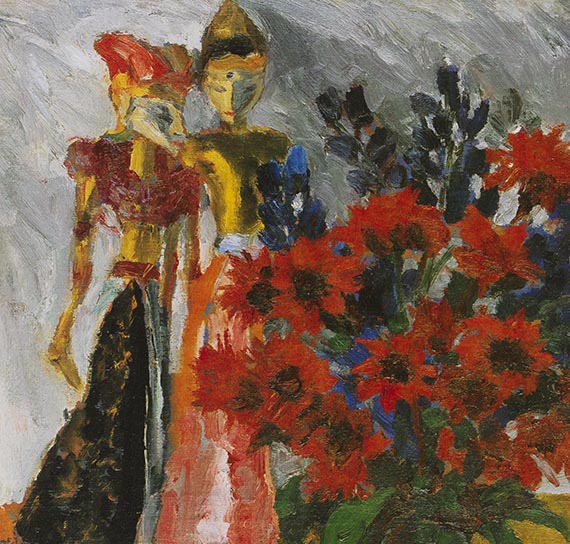
The principle of transience, which underlies the long tradition of still-life painting, plays a rather subordinate role in Nolde’s work. Nevertheless, the bright yellow flowers from Emil Nolde’s garden in Seebüll might be understood as vanitas symbols, given their limited remaining time. Emil Nolde painted the work “Wajanfigur und Blumen” (Wayang Figure and Flowers) in 1928. Before and after this, he also created other still lifes featuring flowers and artifacts from his collection. One could speak of a series in which Nolde explores the interplay of objects. In this painting, he stages a Javanese shadow puppet alongside a magnificent bouquet of yellow flowers. These could be sunflowers, though they might also be yellow coneflowers or echinacea. Some of the flower heads reach toward the puppet on the left side of the painting, which in turn appears to reach out to touch them. The puppet is fairly accurately depicted as one of the figures from Nolde’s collection. “Wayang” roughly translates to “divine shadow spirit.” In Indonesian culture, these puppets are understood as a link to the afterlife and are used in ritual puppet plays to summon the spirits of the ancestral world. In this still life, Nolde brings this shadow being to life, forges a connection to the flowers' transience, and lets it interact with the earthen harvests from his garden in an enigmatic way.
Emil Nolde, Flowers and Wajan Figures, 1928, oil on canvas, Stiftung Seebüll Ada und Emil Nolde, Neukirchen. © Nolde Stiftung Seebüll
Nolde and the Foreign
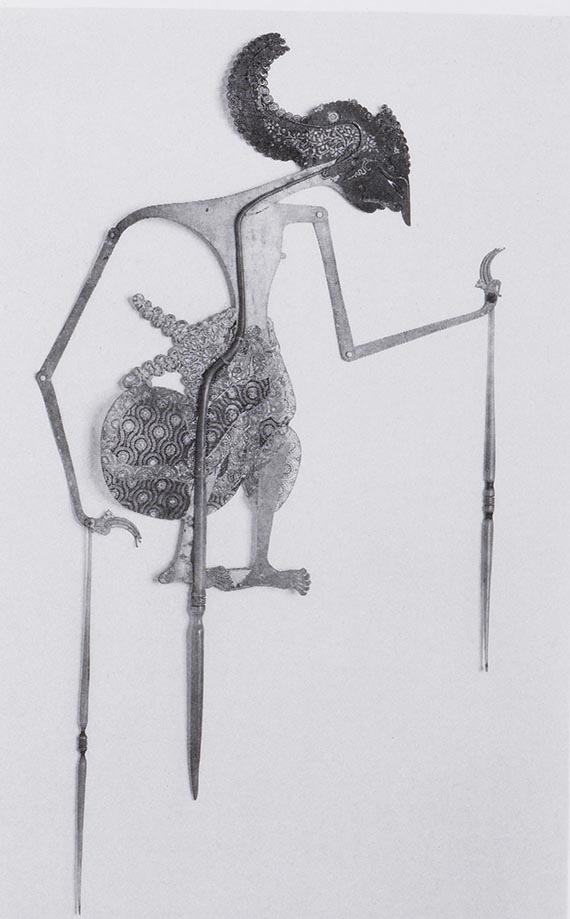
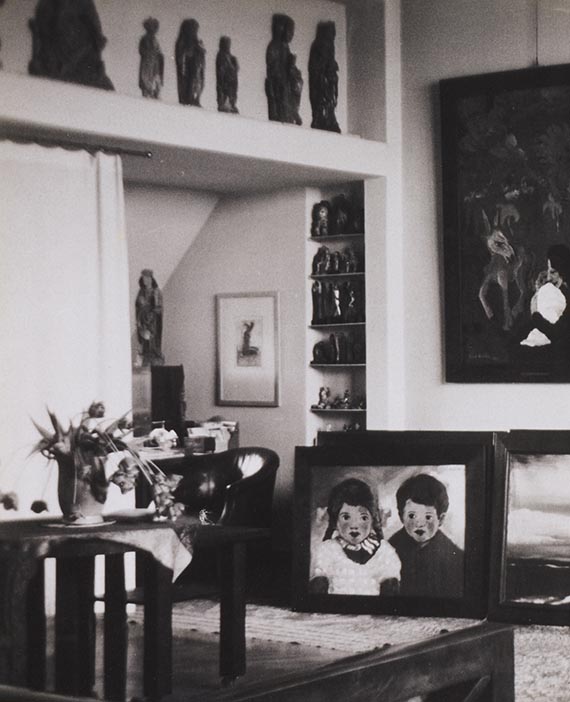
In 1913–14, Emil Nolde and his wife Ada embarked on a journey to what was then the German colony of New Guinea. Organized by the German Colonial Office, the trip took them through Siberia, Japan, and China to the South Seas. The return journey passed through Ceylon, Burma, and Indonesia, where he most likely acquired the Wayang figure in our work. This expedition left a lasting impression on Nolde and shaped his future work. He discovered artifacts that he integrated into his existing collection of figures, masks, and the like. His interest in the extraordinary, in opposing forces, and in the authentic—together with the flowers from his own garden—enriched his still-life paintings. “The collection contains the most diverse items: […] The large painted Uli figures from New Guinea, bronze and porcelain figurines from China, Korea, and Java, masks, African, Egyptian, Indian, Pre-Columbian, and medieval objects […]. They stood and hung in the Seebüll house and in his Berlin apartment alongside his paintings and among the figurines he had crafted himself. They were part of his life, part of his world, and part of the painter’s experience” (Martin Urban, long-time director of the Ada and Emil Nolde Foundation, quoted from: Exhibition catalog Emil Nolde, Masken und Figuren, Bielefeld 1971, n.p.). In this sense, Nolde’s collection served as a tool and an integral part of his painting practice.
Shadow puppet from Emil Nolde’s collection, Java, Stiftung Seebüll Ada und Emil Nolde, Neukirchen. © Nolde Stiftung Seebüll
A Glimpse into his Private Life
“Wajanfigur und Blumen” (1928) is a particularly beautiful document of Emil Nolde’s passions. Flowers from his beloved garden in Seebüll—possibly arranged by Ada herself in the green vase on a purple tablecloth—meet the Wayang figure from his collection of artifacts from around the world. As such, this still life offers us a glimpse into Nolde’s everyday life. In this still life, he combined the extraordinary with the personal, transforming it into a colorful, mysterious expression of incredible artistic mastery. [AW]
A view of Emil Nolde’s Berlin apartment, featuring various artefacts from his collection, ca. 1937/1940, photo: unknown. © Nolde Stiftung Seebüll
Commission, taxes et droit de suite
Cet objet est offert avec imposition régulière ou avec imposition différentielle.
Calcul en cas d'imposition différentielle:
Prix d’adjudication jusqu’à 1 000 000 euros : frais de vente 34 %.
Des frais de vente de 29% sont facturés sur la partie du prix d’adjudication dépassant 1 000 000 euros. Ils sont additionnés aux frais de vente dus pour la partie du prix d’adjudication allant jusqu’à 1 000 000 euros.
Des frais de vente de 22% sont facturés sur la partie du prix d’adjudication dépassant 4 000 000 euros. Ils sont additionnés aux frais de vente dus pour la partie du prix d’adjudication allant jusqu’à 4 000 000 euros.
La commission comprend la TVA, mais celle-ci n'est pas indiquée.
Calcul en cas d'imposition régulière:
Prix d'adjudication jusqu'à 1 000 000 € : 29 % de commission.
Prix d'adjudication supérieur à 1 000 000 € : montants partiels jusqu'à 1 000 000 € 29 % de commission, montants partiels supérieurs à 1 000 000 € : 23 % de commission.
Prix d'adjudication supérieur à 4.000 000 € : montants partiels supérieurs à 4.000 000 € : 15 % de commission.
La TVA légale de 7 % est prélevée sur la somme du prix d'adjudication et de la commission.
Si vous souhaitez appliquer l'imposition régulière, merci de bien vouloir le communiquer par écrit avant la facturation.
Calcul en cas de droit de suite:
Pour les œuvres originales d’arts plastiques et de photographie d’artistes vivants ou d’artistes décédés il y a moins de 70 ans, soumises au droit de suite, une rémunération au titre du droit de suite à hauteur des pourcentages indiqués au § 26, al. 2 de la loi allemande sur les droits d’auteur (UrhG) est facturée en sus pour compenser la rémunération liée au droit de suite due par le commissaire-priseur conformément au § 26 UrhG. À ce jour, elle est calculée comme suit :
4 pour cent pour la part du produit de la vente à partir de 400,00 euros et jusqu’à 50 000 euros,
3 pour cent supplémentaires pour la part du produit de la vente entre 50 000,01 et 200 000 euros,
1 pour cent supplémentaire pour la part entre 200 000,01 et 350 000 euros,
0,5 pour cent supplémentaire pour la part entre 350 000,01 et 500 000 euros et
0,25 pour cent supplémentaire pour la part au-delà de 500 000 euros.
Le total de la rémunération au titre du droit de suite pour une revente s’élève au maximum à 12 500 euros.