


Raumbeispiel
23
Roy Lichtenstein
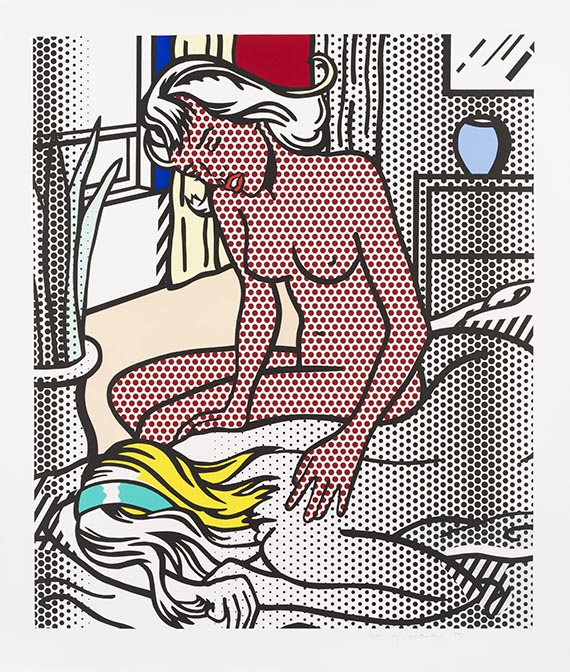
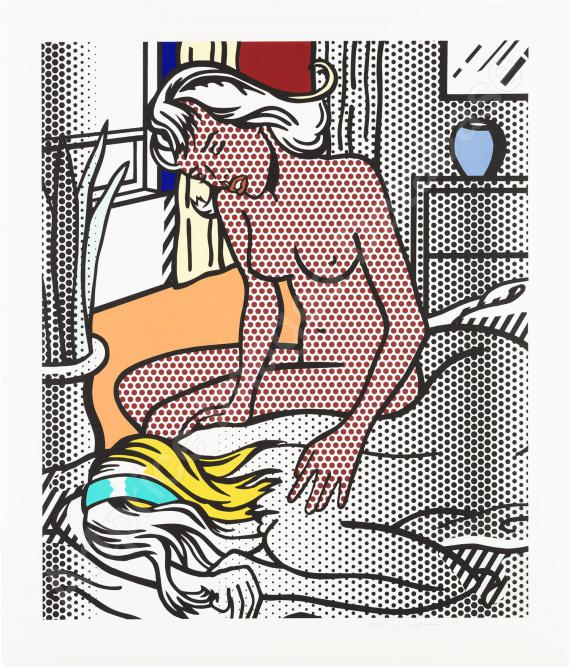
Two Nudes, 1994.
Color relief Print
Estimation: € 150,000 / $ 168,000
23
Roy Lichtenstein
Two Nudes, 1994.
Color relief Print
Estimation: € 150,000 / $ 168,000
Roy Lichtenstein
1923 - 1997
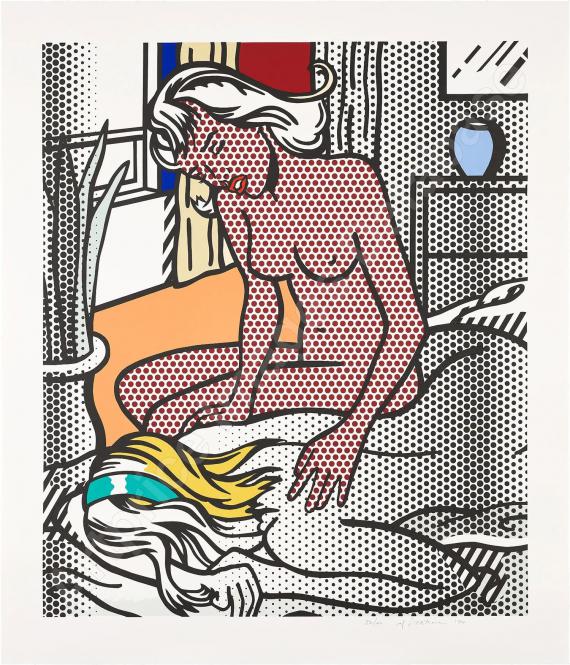
Two Nudes. 1994.
Color relief Print.
Signed, dated, and numbered. Inscribed with the studio number “RL93-3103” by hand on the reverse. From an edition of 40 copies. On firm BFK Rives wove paper (without the watermark). 105.7 x 89 cm (41.6 x 35 in). Sheet: 122 x 104,2 cm (48 x 41 in).
From the series “Nudes”. Printed and published by Tyler Graphics, Mount Kisco, New York (with the blind stamp).
• MAIN WORK Striking masterpiece from Lichtenstein’s later series “Nudes” .
• POP ART Geometric precision, vibrant contrasts, and his signature dots.
• MONUMENTAL A large-format reinterpretation of the traditional nude motif, drawing on characters from the 1963 comic “Girls’ Romances.”
• CONTRAST Sensual body forms in a dynamic interplay with rigid grids, lines, and planes.
• MUSEUM QUALITY Other copies are in renowned museum collections such as the Tate in London, the Whitney Museum, and the San Francisco Museum of Modern Art.
• TOPICALITY The comprehensive exhibition “Roy Lichtenstein: Like New” at the Whitney Museum of American Art, New York (until May 2027).
PROVENANCE: Coskun Fine Art, London.
Private collection, Southern Germany (acquired from the above in 2014).
LITERATURE: Andrea Theil, “Two Nudes, 1994” (RLCR 4328), in: Roy Lichtenstein. A Catalogue Raisonné, Roy Lichtenstein Foundation, New York, www.lichtensteincatalogue.org/catalogue/entry.php?id=3948, different copy (accessed August 28, 2026).
Mary Lee Corlett, The Prints of Roy Lichtenstein. A Catalogue Raisonné 1948–1997, New York 1994, CR no. 284, with color illustration (different copy).
"He was already an accomplished printmaker by the time he came to work with me and the most interesting thing about that is that he was the only Pop artist that was an accomplished printmaker before they started to work with a commercial printer."
Kenneth Tyler, quoted from: Tyler Graphics, Catalogue raisonné, 1986-2001, vol. 1, Parkes, Australia 2025, p. 179.
Called up: December 4, 2026 - ca. 17.44 h +/- 20 min.
Within Roy Lichtenstein’s graphic oeuvre, his 1990s works rank among the most technically sophisticated of his career. “Two Nudes” is a masterful example of the artist’s celebrated late series “Nudes”. Begun shortly after his highly acclaimed retrospective at the Solomon R. Guggenheim Museum in 1993, the series also foreshadowed the “Late Nudes”, which constituted his final group of paintings before Lichtenstein’s death in 1997. In the spring of 1993, Lichtenstein began developing collages for the “Nudes” series in his New York studio. In December of that same year, he personally cut the Rubylith stencils for the relief printing plates of each motif, and in February 1994, he visited Tyler Graphics in Mount Kisco, New York, to begin implementing the project. As with many of his motifs, dating back to the early 1960s, Lichtenstein drew inspiration from comic-strip imagery, taking existing compositions and transforming them through his unmistakable artistic style.
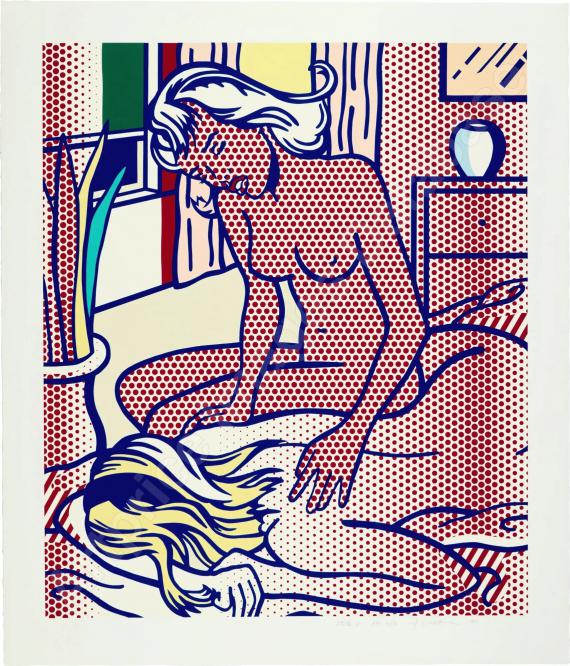
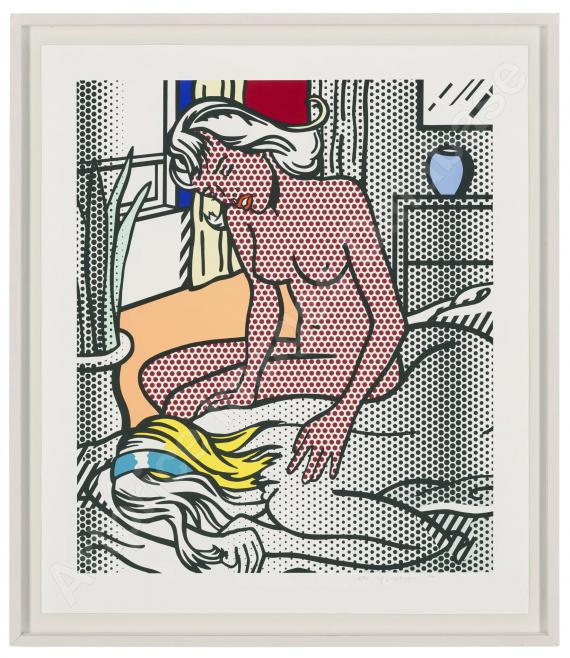
“Two Nudes” draws on characters from the “Girls’ Romances” comic series by DC Comics, which Lichtenstein had already used for iconic 1960s paintings such as “In the Car” (1963) and “Sleeping Girl” (1964). These earlier works often focus on female protagonists in moments of romantic tension or heartbreak. In the “Nudes” series, however, Lichtenstein radically reinvents his archetypal female figure: he strips her bare, thereby drawing on the tradition of the female nude as well as the idealized muses of Western art history. In his most striking iconography, the composition depicts two women, one crying while the other comforts her. Beyond the female motif, the work references earlier works, including the silkscreen print “Mirror” (1990) and the acrylic painting “Interior with Red Wall” (1991). Creating this print requires outstanding technical mastery and benefits greatly from Lichtenstein’s long-standing collaboration with the renowned printer and publisher Kenneth Tyler, with whom he produced his first joint prints at Gemini G.E.L. in Los Angeles as early as 1969. Using large-format stencils, the artist cuts out his motifs with extreme precision. In contrast to earlier phases of his career, he uses his characteristic Ben-Day dots to shade in dialogue with precisely calculated, flat color fields. Three years before his death, Roy Lichtenstein achieved a virtuoso compositional layering and a complex, self-referential narrative with “Two Nudes”, presenting himself at the height of his creative maturity and mastery. [KA]
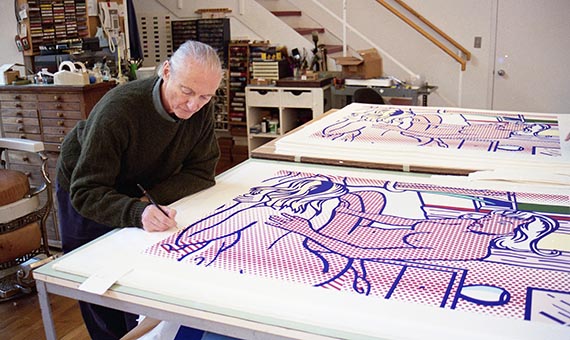
Roy Lichtenstein signing his “Two Nudes State I”, Tyler Graphics, Mount Kisco, New York, 1994, digital file from 35mm colour negative (National Gallery of Australia, Canberra. Gift of Kenneth Tyler 2002), Photo: Marabeth Cohen-Tyler. © National Gallery of Australia
“Two Nudes” draws on characters from the “Girls’ Romances” comic series by DC Comics, which Lichtenstein had already used for iconic 1960s paintings such as “In the Car” (1963) and “Sleeping Girl” (1964). These earlier works often focus on female protagonists in moments of romantic tension or heartbreak. In the “Nudes” series, however, Lichtenstein radically reinvents his archetypal female figure: he strips her bare, thereby drawing on the tradition of the female nude as well as the idealized muses of Western art history. In his most striking iconography, the composition depicts two women, one crying while the other comforts her. Beyond the female motif, the work references earlier works, including the silkscreen print “Mirror” (1990) and the acrylic painting “Interior with Red Wall” (1991). Creating this print requires outstanding technical mastery and benefits greatly from Lichtenstein’s long-standing collaboration with the renowned printer and publisher Kenneth Tyler, with whom he produced his first joint prints at Gemini G.E.L. in Los Angeles as early as 1969. Using large-format stencils, the artist cuts out his motifs with extreme precision. In contrast to earlier phases of his career, he uses his characteristic Ben-Day dots to shade in dialogue with precisely calculated, flat color fields. Three years before his death, Roy Lichtenstein achieved a virtuoso compositional layering and a complex, self-referential narrative with “Two Nudes”, presenting himself at the height of his creative maturity and mastery. [KA]
Commission, taxes et droit de suite
Cet objet est offert avec imposition régulière ou avec imposition différentielle.
Calcul en cas d'imposition différentielle:
Prix d’adjudication jusqu’à 1 000 000 euros : frais de vente 34 %.
Des frais de vente de 29% sont facturés sur la partie du prix d’adjudication dépassant 1 000 000 euros. Ils sont additionnés aux frais de vente dus pour la partie du prix d’adjudication allant jusqu’à 1 000 000 euros.
Des frais de vente de 22% sont facturés sur la partie du prix d’adjudication dépassant 4 000 000 euros. Ils sont additionnés aux frais de vente dus pour la partie du prix d’adjudication allant jusqu’à 4 000 000 euros.
La commission comprend la TVA, mais celle-ci n'est pas indiquée.
Calcul en cas d'imposition régulière:
Prix d'adjudication jusqu'à 1 000 000 € : 29 % de commission.
Prix d'adjudication supérieur à 1 000 000 € : montants partiels jusqu'à 1 000 000 € 29 % de commission, montants partiels supérieurs à 1 000 000 € : 23 % de commission.
Prix d'adjudication supérieur à 4.000 000 € : montants partiels supérieurs à 4.000 000 € : 15 % de commission.
La TVA légale de 19 % est prélevée sur la somme du prix d'adjudication et de la commission.
Si vous souhaitez appliquer l'imposition régulière, merci de bien vouloir le communiquer par écrit avant la facturation.
Calcul en cas de droit de suite:
Pour les œuvres originales d’arts plastiques et de photographie d’artistes vivants ou d’artistes décédés il y a moins de 70 ans, soumises au droit de suite, une rémunération au titre du droit de suite à hauteur des pourcentages indiqués au § 26, al. 2 de la loi allemande sur les droits d’auteur (UrhG) est facturée en sus pour compenser la rémunération liée au droit de suite due par le commissaire-priseur conformément au § 26 UrhG. À ce jour, elle est calculée comme suit :
4 pour cent pour la part du produit de la vente à partir de 400,00 euros et jusqu’à 50 000 euros,
3 pour cent supplémentaires pour la part du produit de la vente entre 50 000,01 et 200 000 euros,
1 pour cent supplémentaire pour la part entre 200 000,01 et 350 000 euros,
0,5 pour cent supplémentaire pour la part entre 350 000,01 et 500 000 euros et
0,25 pour cent supplémentaire pour la part au-delà de 500 000 euros.
Le total de la rémunération au titre du droit de suite pour une revente s’élève au maximum à 12 500 euros.