


Autre image
39
Glenn Ligon
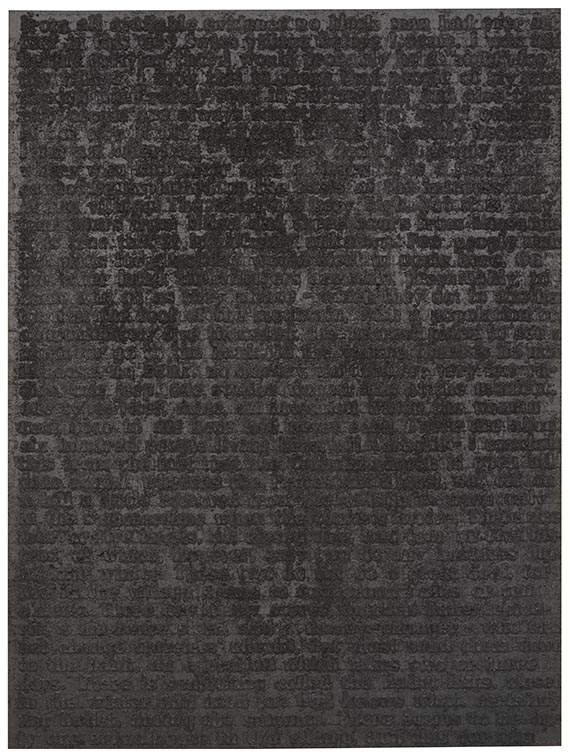
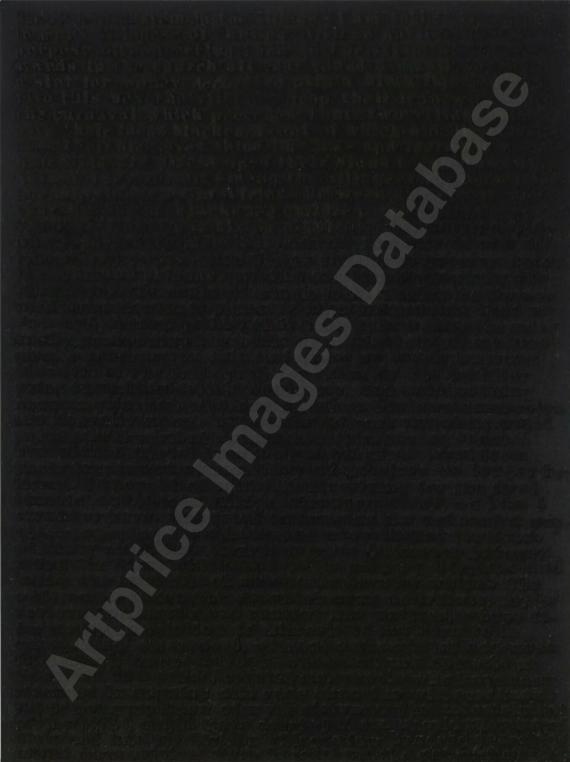
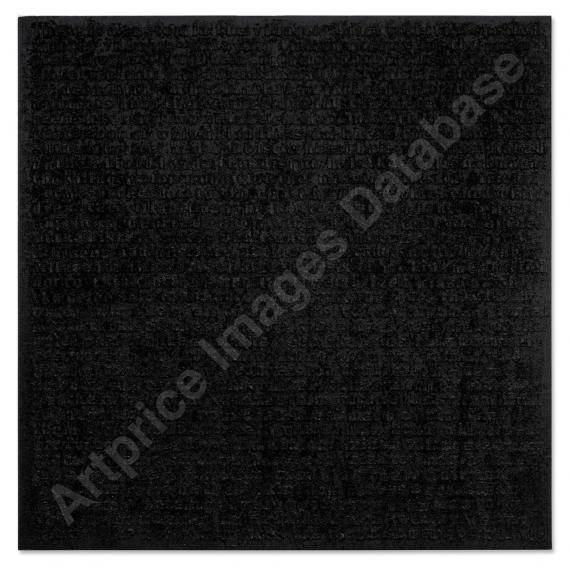
Stranger #71, 2013.
Oil stick and coal dust on canvas
Estimation: € 400,000 / $ 448,000
39
Glenn Ligon
Stranger #71, 2013.
Oil stick and coal dust on canvas
Estimation: € 400,000 / $ 448,000
Glenn Ligon
1960
Stranger #71. 2013.
Oil stick and coal dust on canvas.
Signed, dated, and titled on the reverse of the canvas. 205.7 x 151.1 cm (80.9 x 59.4 in).
• TYPOGRAPHY Ligon translates language into painting, creating a fascinating symbiosis of text and pure form.
• MONUMENTAL An impressive large-scale work of auratic density and visual intensity.
• TEXTURE Oil stick and coal dust condense the surface into a captivating, relief-like pictorial form.
• LITERARY A powerful visual interpretation of James Baldwin’s seminal essay “Stranger in the Village” (1953).
• HIGHLIGHT Created following his first major retrospective, “Glenn Ligon: AMERICA” (at, among others, the Whitney Museum of American Art, New York, 2011/12).
PROVENANCE: Thomas Dane Gallery, London.
Private collection (acquired from the above).
Glenn Ligon, quoted from: Museum of Modern Art, 1980–Today: Works From the Collection (www.moma.org/audio/playlist/298/4474; accessed on October 26, 2026
Called up: December 4, 2026 - ca. 18.16 h +/- 20 min.
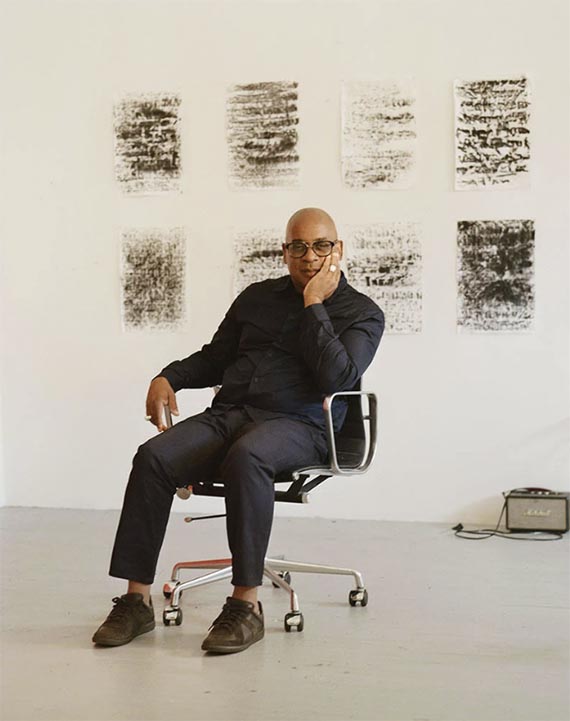
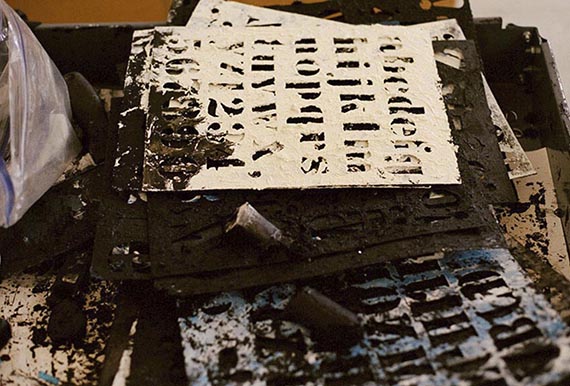
Writing, or the written word, is a central theme in the work of many modern and contemporary artists, yet few match Glenn Ligon's conceptual depth and visual resonance. Born in the Bronx in 1960, Ligon studied at Wesleyan University before participating in the Whitney Museum’s Independent Study Program in 1985. Ligon’s sensitivity to written language may have been honed while working as a proofreader for a corporate law firm, even as he established his artistic practice. Initially, he drew inspiration from Abstract Expressionism, but soon began bringing words directly onto the canvas. Upon entering the New York art scene of the 1980s, Ligon turned to pioneering authors such as Zora Neale Hurston and James Baldwin to explore how language, race, and subjectivity intertwine on the canvas. Ligon dissolves the texts' clarity through a deliberately tactile process. He traces passages letter by letter onto the canvas using an oil stick. The viscous mixture of oil paint, pigment, and wax gradually blurs the characters as he works his way across the canvas. Inspired by Andy Warhol’s use of diamond dust, Ligon uses coal dust for its light-reflecting properties and its layered meanings. By transforming an industrial waste product into a dense, sculptural relief, Ligon turns an often-overlooked material into a self-assured, dignified surface that challenges conventional notions of values and visibility.
“Stranger in the Village”: Baldwin’s Words Materialized
The dialogue between literature and materiality finds its purest expression in “Stranger #71” (2013), an outstanding work from Ligon’s longest series, the “Stranger” series, which he began in 1996. The series draws directly on James Baldwin’s seminal 1953 essay “Stranger in the Village”, in which the author recounts his experience of racial alienation in a remote Swiss mountain village. Baldwin describes how the villagers regard him as an exotic curiosity and notes: “Some [...] thought my hair was the color of tar [...] or put [their] hand on my hand, astonished that the color did not rub off.” (ibid.) For Baldwin, the village exemplifies Western civilization. Through this encounter, he examined how European imperial history and U.S. white supremacy turned the Black body into an exotic abstraction rather than recognizing it as an equal human presence. In “Stranger #71,” Ligon translates this tension into pure color and matter. The dense, tar-like layer of oil stick and coal dust directly alludes to how Baldwin’s appearance in the village was reduced to a mere spectacle. By appropriating Baldwin’s text, Ligon interweaves questions of racial and queer identity with his own position in today’s art world.
Between Legibility and Abstraction
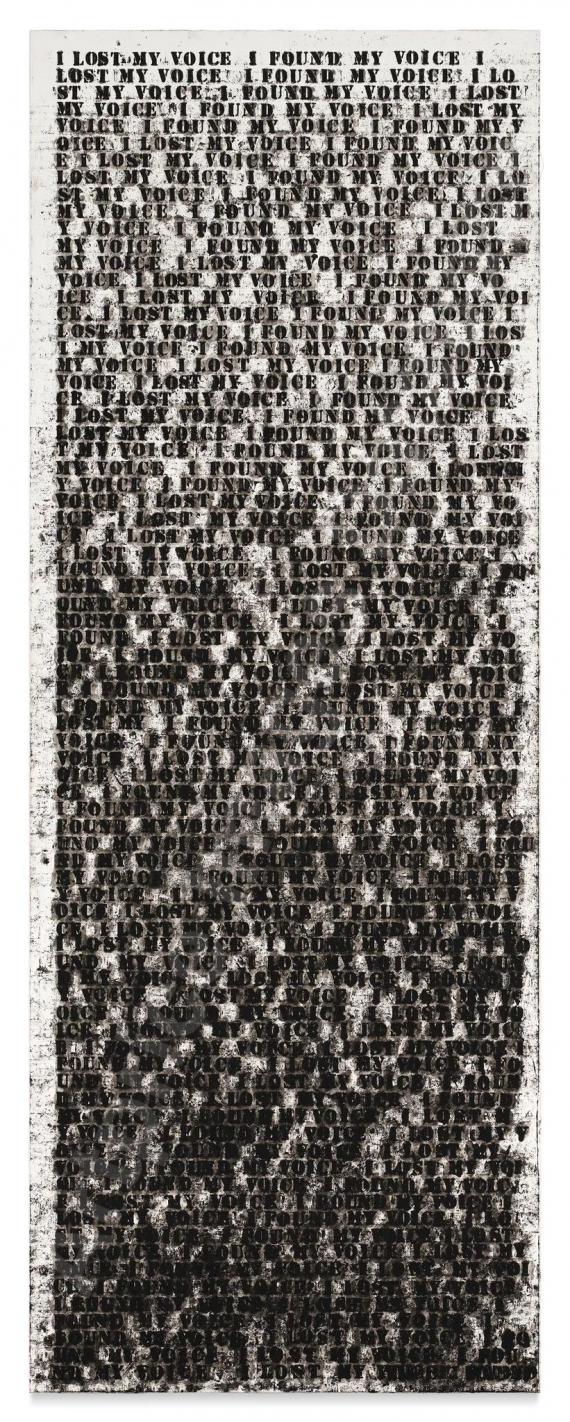
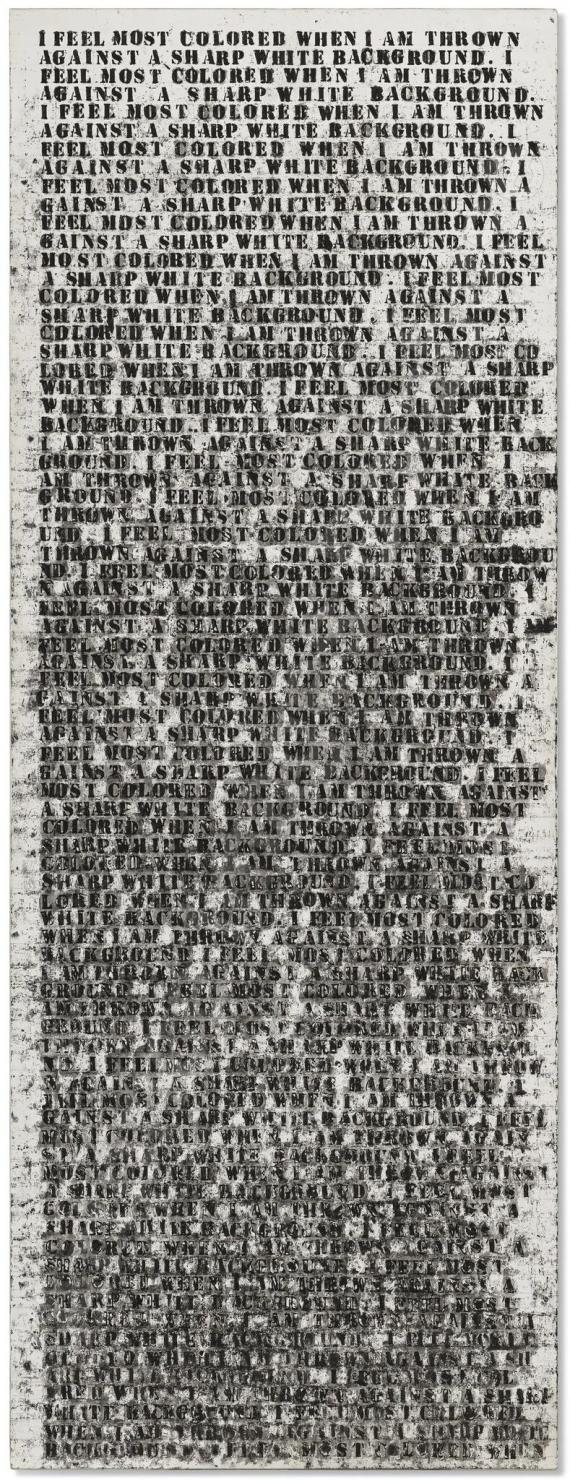
In the “Stranger” paintings, the text gradually shifts from legible to near-total abstraction. While earlier works retain legible opening lines before they dissolve toward the bottom, “Stranger #71” appears as an almost impenetrable, monochromatic field. The passage is not easy to read. Viewers must look closely and follow the contours of the stenciled lettering, the thick raised areas, and the faint glimmer of the coal dust on the black paint. In our work, language oscillates between a vehicle of meaning and an impenetrable barrier. This interplay of legibility and concealment echoes Baldwin’s critique of society’s reduction of Black lives to abstractions. By refusing to provide a readily consumable text, Ligon compels the audience to pause and actively decipher the surface. Thus, viewing becomes a conscious effort to unearth voices history has marginalized. [KA]
Glenn Ligon in his studio, images commissioned for “Frieze“, 2024, photo: Clifford Prince King. © Clifford Prince King 2026
“Stranger in the Village”: Baldwin’s Words Materialized
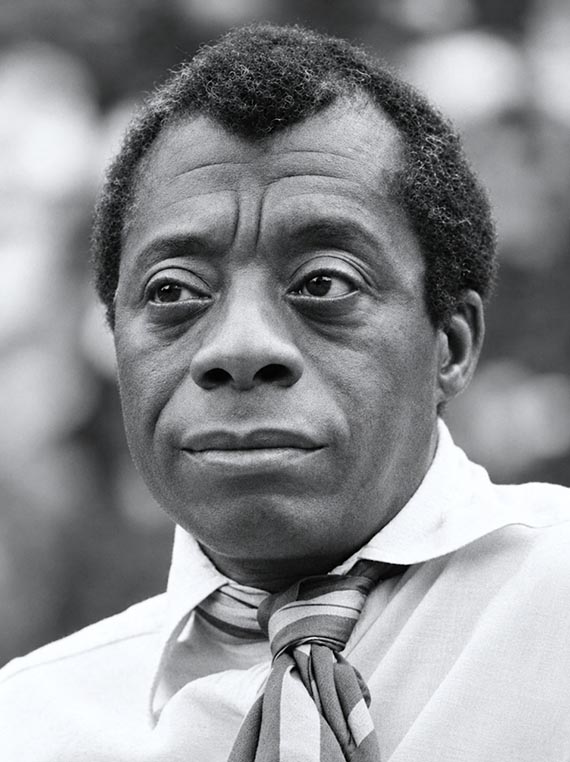
The dialogue between literature and materiality finds its purest expression in “Stranger #71” (2013), an outstanding work from Ligon’s longest series, the “Stranger” series, which he began in 1996. The series draws directly on James Baldwin’s seminal 1953 essay “Stranger in the Village”, in which the author recounts his experience of racial alienation in a remote Swiss mountain village. Baldwin describes how the villagers regard him as an exotic curiosity and notes: “Some [...] thought my hair was the color of tar [...] or put [their] hand on my hand, astonished that the color did not rub off.” (ibid.) For Baldwin, the village exemplifies Western civilization. Through this encounter, he examined how European imperial history and U.S. white supremacy turned the Black body into an exotic abstraction rather than recognizing it as an equal human presence. In “Stranger #71,” Ligon translates this tension into pure color and matter. The dense, tar-like layer of oil stick and coal dust directly alludes to how Baldwin’s appearance in the village was reduced to a mere spectacle. By appropriating Baldwin’s text, Ligon interweaves questions of racial and queer identity with his own position in today’s art world.
Portrait of the writer James Baldwin (1924–1987), photo: Allan Warren. © 2026 Allan Warren
Between Legibility and Abstraction
In the “Stranger” paintings, the text gradually shifts from legible to near-total abstraction. While earlier works retain legible opening lines before they dissolve toward the bottom, “Stranger #71” appears as an almost impenetrable, monochromatic field. The passage is not easy to read. Viewers must look closely and follow the contours of the stenciled lettering, the thick raised areas, and the faint glimmer of the coal dust on the black paint. In our work, language oscillates between a vehicle of meaning and an impenetrable barrier. This interplay of legibility and concealment echoes Baldwin’s critique of society’s reduction of Black lives to abstractions. By refusing to provide a readily consumable text, Ligon compels the audience to pause and actively decipher the surface. Thus, viewing becomes a conscious effort to unearth voices history has marginalized. [KA]
Glenn Ligon’s studio, images commissioned for „Frieze”, 2024, photo: Clifford Prince King. © Clifford Prince King 2026
Commission, taxes et droit de suite
Cet objet est offert avec imposition régulière ou avec imposition différentielle.
Calcul en cas d'imposition différentielle:
Prix d’adjudication jusqu’à 1 000 000 euros : frais de vente 34 %.
Des frais de vente de 29% sont facturés sur la partie du prix d’adjudication dépassant 1 000 000 euros. Ils sont additionnés aux frais de vente dus pour la partie du prix d’adjudication allant jusqu’à 1 000 000 euros.
Des frais de vente de 22% sont facturés sur la partie du prix d’adjudication dépassant 4 000 000 euros. Ils sont additionnés aux frais de vente dus pour la partie du prix d’adjudication allant jusqu’à 4 000 000 euros.
La commission comprend la TVA, mais celle-ci n'est pas indiquée.
Calcul en cas d'imposition régulière:
Prix d'adjudication jusqu'à 1 000 000 € : 29 % de commission.
Prix d'adjudication supérieur à 1 000 000 € : montants partiels jusqu'à 1 000 000 € 29 % de commission, montants partiels supérieurs à 1 000 000 € : 23 % de commission.
Prix d'adjudication supérieur à 4.000 000 € : montants partiels supérieurs à 4.000 000 € : 15 % de commission.
La TVA légale de 7 % est prélevée sur la somme du prix d'adjudication et de la commission.
Si vous souhaitez appliquer l'imposition régulière, merci de bien vouloir le communiquer par écrit avant la facturation.
Calcul en cas de droit de suite:
Pour les œuvres originales d’arts plastiques et de photographie d’artistes vivants ou d’artistes décédés il y a moins de 70 ans, soumises au droit de suite, une rémunération au titre du droit de suite à hauteur des pourcentages indiqués au § 26, al. 2 de la loi allemande sur les droits d’auteur (UrhG) est facturée en sus pour compenser la rémunération liée au droit de suite due par le commissaire-priseur conformément au § 26 UrhG. À ce jour, elle est calculée comme suit :
4 pour cent pour la part du produit de la vente à partir de 400,00 euros et jusqu’à 50 000 euros,
3 pour cent supplémentaires pour la part du produit de la vente entre 50 000,01 et 200 000 euros,
1 pour cent supplémentaire pour la part entre 200 000,01 et 350 000 euros,
0,5 pour cent supplémentaire pour la part entre 350 000,01 et 500 000 euros et
0,25 pour cent supplémentaire pour la part au-delà de 500 000 euros.
Le total de la rémunération au titre du droit de suite pour une revente s’élève au maximum à 12 500 euros.