


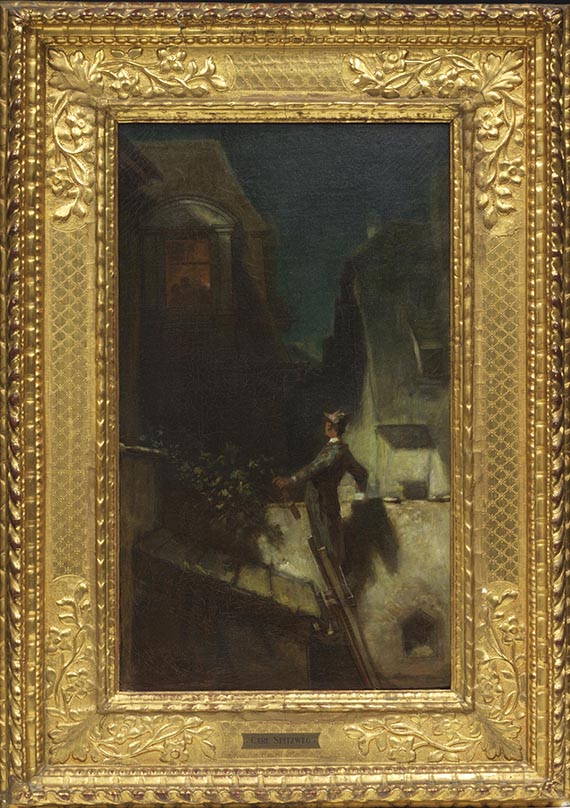
Image du cadre
Raumbeispiel
217
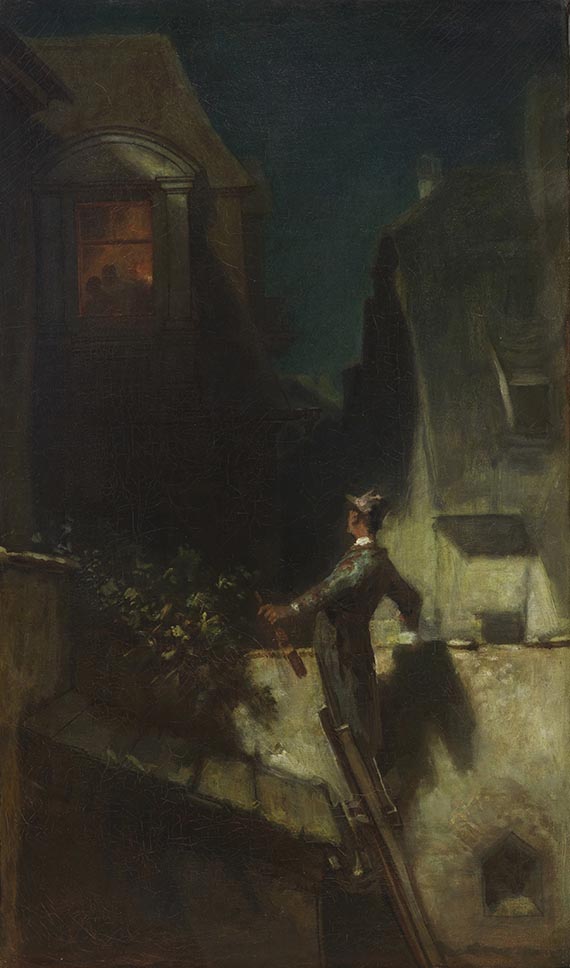
Carl Spitzweg
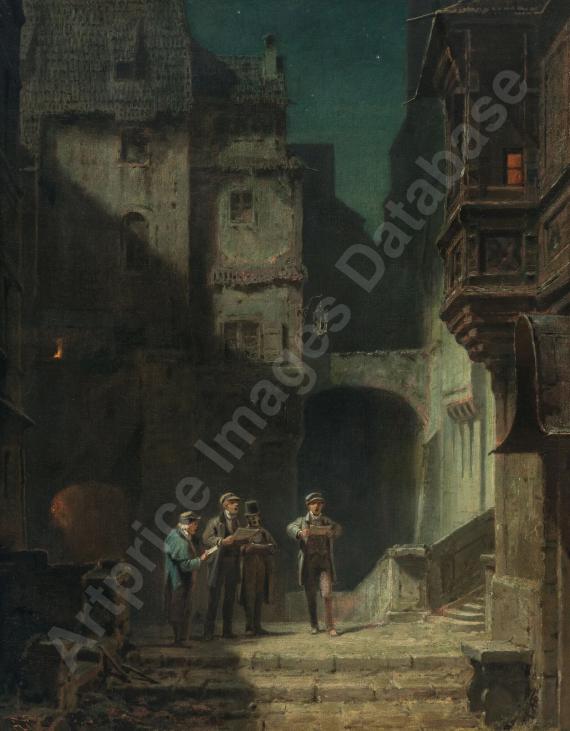
Der Mondscheingeiger, Ende 1840.
Oil on canvas
Estimation: € 40,000 / $ 44,800
217
Carl Spitzweg
Der Mondscheingeiger, Ende 1840.
Oil on canvas
Estimation: € 40,000 / $ 44,800
Carl Spitzweg
1808 - 1885
Der Mondscheingeiger. Ende 1840s.
Oil on canvas.
With three estate stamps on the reverse of the canvas (Lugt 2307). 53 x 32 cm (20.8 x 12.5 in).
• A moonlit scene in an excellent composition in typical silvery shades of blue.
• The rooftop fiddler in love remains an important and recurring motif in Carl Spitzweg’s oeuvre well into the 1870s.
• Its narrative and humorous qualities find playful expression here.
• A variation on this motif is in the Schack Collection in Munich.
We are grateful to Mr. Detlef Rosenberger, who examined the original work, for his kind assistance. The work will be included in the forthcoming catalogue raisonné.
PROVENANCE: From the artist’s estate.
Neue Galerie Schönemann & Lampl, Munich (1927).
Hermann Abels, Cologne (1928).
Charles Hosmer Morse Collection, Munich/USA (presumably acquired from the above, subsequently by descent within the family).
Private collection, Sweden (acquired 2022, Ketterer Kunst; thence inherited by the current owner).
EXHIBITION: Spitzweg exhibition, in collaboration with Hermann Uhde-Bernays, Neue Galerie Schönemann & Lampl, Munich, May/June 1927, no. 24 (titled here: “Ständchen, Geiger auf der Leiter” [Serenade, Fiddler on the Ladder]).
Meisterwerke deutscher Kunst, Kunstsalon Hermann Abels, Cologne, 1930 (with illu.).
LITERATURE: Günther Roennefahrt, Carl Spitzweg. Beschreibendes Verzeichnis seiner Gemälde, Ölstudien und Aquarelle, Munich 1960, CR no. 1077.
Der Cicerone, issue 20, 1928, p. 410 (with illustration).
"A violinist at night—just like in the old days!—Long shadows—points of light on the wall"
Carl Spitzweg, ca. 1848, quoted from: Wichmann, p. 180
Called up: December 5, 2026 - ca. 15.36 h +/- 20 min.
Carl Spitzweg, from a wealthy Munich family that owned a wholesale spice business, initially followed his father’s wishes and pursued a career in pharmacy; he completed his studies with honors in 1832. The keen observational skills and analytical eye of a natural scientist are also evident in his incisive drawings and paintings. In addition, his musical and artistic talent—which distinguished him as a member of the educated upper middle class—allowed him, after receiving an inheritance that secured his financial future, to devote himself entirely to painting in the late 1830s. What sets his works apart is his outstanding narrative ability to capture the moment just before a plot twist and play with viewers’ expectations. This is also the case in our Ständchen (Serenade): Amid the winding, secretive passages of the shaded architecture—sparsely illuminated by moonlight and obscured by walls and bay windows—the enamored violinist has climbed to the top rung of the ladder. Once there, he realizes another suitor has likely already beaten him to his beloved, as he sees a shadowy figure in the tall window. Like a spotlight, the moon casts his shadow on the wall, making his plight even more evident: his shock at this humiliation makes him stagger as he struggles to maintain his balance; a fall backward—and the additional humiliation that would follow—seems imminent. The motif of the lovesick rooftop violinist appears early on in Spitzweg’s work, initially in a landscape format with similarities to the artist’s own features (Wichmann 1075), and continues to occupy him well into the 1870s with numerous imaginative variations and intensifications. In 1848, he noted in his diary: “Saw a nighttime violinist—just like in the old days!—Long shadows—points of light on the wall” (Wichmann, p. 180). At times, Spitzweg himself lived above the rooftops of Munich and may have witnessed quite a few such occurrences. Furthermore, these scenes align with Spitzweg’s interest in music and theater; one variation on the motif, for example, is the 1856 version of the “Spanish Serenade” (Bavarian State Painting Collections, Schack Collection, Munich), in which Spitzweg presumably depicts the opening scene of the opera “The Barber of Seville”. Spitzweg’s nephews by marriage were members and prominent soloists of the Bavarian Court Orchestra, led by his uncle Joseph Moralt, who performed in the orchestra during a production of this opera. The enamored violinist or the serenade may be considered a favorite and personal motif of Spitzweg’s, rendered here in the silvery blue tones of moonlit towns so characteristic of Spitzweg’s night scenes. [KT)
Commission, taxes et droit de suite
Cet objet est offert avec imposition régulière ou avec imposition différentielle.
Calcul en cas d'imposition différentielle:
Prix d’adjudication jusqu’à 1 000 000 euros : frais de vente 34 %.
Des frais de vente de 29% sont facturés sur la partie du prix d’adjudication dépassant 1 000 000 euros. Ils sont additionnés aux frais de vente dus pour la partie du prix d’adjudication allant jusqu’à 1 000 000 euros.
Des frais de vente de 22% sont facturés sur la partie du prix d’adjudication dépassant 4 000 000 euros. Ils sont additionnés aux frais de vente dus pour la partie du prix d’adjudication allant jusqu’à 4 000 000 euros.
La commission comprend la TVA, mais celle-ci n'est pas indiquée.
Calcul en cas d'imposition régulière:
Prix d'adjudication jusqu'à 1 000 000 € : 29 % de commission.
Prix d'adjudication supérieur à 1 000 000 € : montants partiels jusqu'à 1 000 000 € 29 % de commission, montants partiels supérieurs à 1 000 000 € : 23 % de commission.
Prix d'adjudication supérieur à 4.000 000 € : montants partiels supérieurs à 4.000 000 € : 15 % de commission.
La TVA légale de 7 % est prélevée sur la somme du prix d'adjudication et de la commission.
Si vous souhaitez appliquer l'imposition régulière, merci de bien vouloir le communiquer par écrit avant la facturation.
Calcul en cas de droit de suite:
Pour les œuvres originales d’arts plastiques et de photographie d’artistes vivants ou d’artistes décédés il y a moins de 70 ans, soumises au droit de suite, une rémunération au titre du droit de suite à hauteur des pourcentages indiqués au § 26, al. 2 de la loi allemande sur les droits d’auteur (UrhG) est facturée en sus pour compenser la rémunération liée au droit de suite due par le commissaire-priseur conformément au § 26 UrhG. À ce jour, elle est calculée comme suit :
4 pour cent pour la part du produit de la vente à partir de 400,00 euros et jusqu’à 50 000 euros,
3 pour cent supplémentaires pour la part du produit de la vente entre 50 000,01 et 200 000 euros,
1 pour cent supplémentaire pour la part entre 200 000,01 et 350 000 euros,
0,5 pour cent supplémentaire pour la part entre 350 000,01 et 500 000 euros et
0,25 pour cent supplémentaire pour la part au-delà de 500 000 euros.
Le total de la rémunération au titre du droit de suite pour une revente s’élève au maximum à 12 500 euros.