


Raumbeispiel
324
Günther Förg
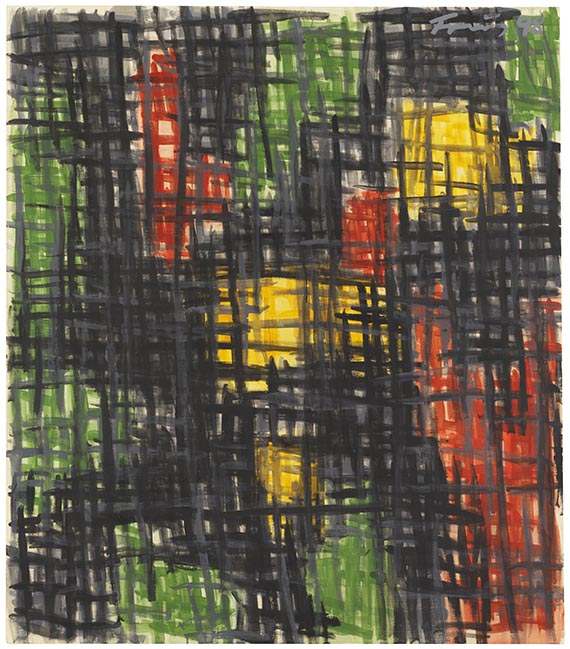
Untitled, 1998.
Acrylic and oil on canvas
Estimation: € 100,000 / $ 112,000
324
Günther Förg
Untitled, 1998.
Acrylic and oil on canvas
Estimation: € 100,000 / $ 112,000
Günther Förg
1952 - 2013
Untitled. 1998.
Acrylic and oil on canvas.
Signed and dated in the upper right. 150 x 130 cm (59 x 51.1 in).
• Grid Painting: Förg’s “grid paintings” are among the highlights of his body of work.
• A powerful composition that derives its particular strength from the radiant color and the contrast between surface and texture.
• Tension: Concealment and revelation, symmetry and asymmetry, monochromy.
• A splendid example of Förg’s masterful adaptation of art-historical traditions: For his “Grid Paintings”, Förg engaged deeply with the late work of Edvard Munch, adopting motifs and stylistic gestures in an abstract form.
• New on the market: Available on the international auction market for the first time (source: artprice.com).
The work is registered in the Günther Förg Estate archive under the number WVF.98.B0010 (F1, F2).
PROVENANCE: MASSIMODECARLO Gallery, London
Private collection, Hesse (acquired from the above in 2015).
“Günther Förg is a painter who pursues his own path, employing rigorous means of reduction and concentration to achieve a state in which a painting makes a visual impact through color, form, and structure, while simultaneously conveying a wealth of references and meanings through its background.”
Bern Reiss, in exhibition cat. Günther Förg 1987-2011, Galerie Max Hetzler, Berlin 2012, p. 17.
Called up: December 5, 2026 - ca. 17.58 h +/- 20 min.
Günther Förg’s body of work is a dedication to color, a ceaseless endeavor to reveal its intrinsic nature and the sheer endless wealth of its variations through ever-new combinations. His painting effortlessly unites seemingly incompatible elements on the canvas, blending Concrete Art with gestural components: geometric rigor meets expressive spontaneity, and a calculated system meets the spontaneous intuition of color application.
He transforms the pictorial surface into an open structure of color, light, and gestural movement. Through these means, he challenges established traditions of art history and, more specifically, the “masterpieces” of Modernism that have been elevated to icon status. Through this fusion, Günther Förg developed a distinctive, independent visual language, making himself an icon of Contemporary Art.
Whether in his serial works, grid paintings, lead paintings, or late large-format works, Förg’s paintings had to turn out right in one go; the pictorial event had to be realized in a single stroke, in just one layer of paint. Time and again, Förg’s painting stylistically engages with other artists. In addition to influences from pre-war Abstract Modernism, Constructivism, and Suprematism, the work of the prematurely deceased Blinky Palermo played a formative role for the art student Förg in the 1970s. Later, American Action Painting and Color Field Painting—such as the works of Willem de Kooning, Clifford Still, and Barnett Newman—also emerged as sources of inspiration. Förg adapted and transformed what he saw, repeatedly harnessing new impulses in color or form for his diverse work. The decisive source of inspiration for Förg’s large-format grid paintings—which he has been creating since the 1990s and which include our luminous composition—comes not only from the grid- or cross-like linear structures that regularly appear in Paul Klee’s watercolors from 1913 onward, but also from the late work of Edvard Munch. Förg’s grid paintings transform and alienate these art-historical influences—so significant to the development of modern painting—as he transposes Munch’s motifs and gestural style into abstract painting. Klee’s works are small and graphic; Munch’s paintings are figurative, whereas Förg’s creations are monumental and painterly. In his famous grid paintings, Förg achieves enormous impact and color intensity, derived solely from the luminosity of the color and the contrast between surface and structure. [EH]


Commission, taxes et droit de suite
Cet objet est offert avec imposition régulière ou avec imposition différentielle.
Calcul en cas d'imposition différentielle:
Prix d’adjudication jusqu’à 1 000 000 euros : frais de vente 34 %.
Des frais de vente de 29% sont facturés sur la partie du prix d’adjudication dépassant 1 000 000 euros. Ils sont additionnés aux frais de vente dus pour la partie du prix d’adjudication allant jusqu’à 1 000 000 euros.
Des frais de vente de 22% sont facturés sur la partie du prix d’adjudication dépassant 4 000 000 euros. Ils sont additionnés aux frais de vente dus pour la partie du prix d’adjudication allant jusqu’à 4 000 000 euros.
La commission comprend la TVA, mais celle-ci n'est pas indiquée.
Calcul en cas d'imposition régulière:
Prix d'adjudication jusqu'à 1 000 000 € : 29 % de commission.
Prix d'adjudication supérieur à 1 000 000 € : montants partiels jusqu'à 1 000 000 € 29 % de commission, montants partiels supérieurs à 1 000 000 € : 23 % de commission.
Prix d'adjudication supérieur à 4.000 000 € : montants partiels supérieurs à 4.000 000 € : 15 % de commission.
La TVA légale de 7 % est prélevée sur la somme du prix d'adjudication et de la commission.
Si vous souhaitez appliquer l'imposition régulière, merci de bien vouloir le communiquer par écrit avant la facturation.
Calcul en cas de droit de suite:
Pour les œuvres originales d’arts plastiques et de photographie d’artistes vivants ou d’artistes décédés il y a moins de 70 ans, soumises au droit de suite, une rémunération au titre du droit de suite à hauteur des pourcentages indiqués au § 26, al. 2 de la loi allemande sur les droits d’auteur (UrhG) est facturée en sus pour compenser la rémunération liée au droit de suite due par le commissaire-priseur conformément au § 26 UrhG. À ce jour, elle est calculée comme suit :
4 pour cent pour la part du produit de la vente à partir de 400,00 euros et jusqu’à 50 000 euros,
3 pour cent supplémentaires pour la part du produit de la vente entre 50 000,01 et 200 000 euros,
1 pour cent supplémentaire pour la part entre 200 000,01 et 350 000 euros,
0,5 pour cent supplémentaire pour la part entre 350 000,01 et 500 000 euros et
0,25 pour cent supplémentaire pour la part au-delà de 500 000 euros.
Le total de la rémunération au titre du droit de suite pour une revente s’élève au maximum à 12 500 euros.