


24
Wladimir Georgiewitsch von Bechtejeff
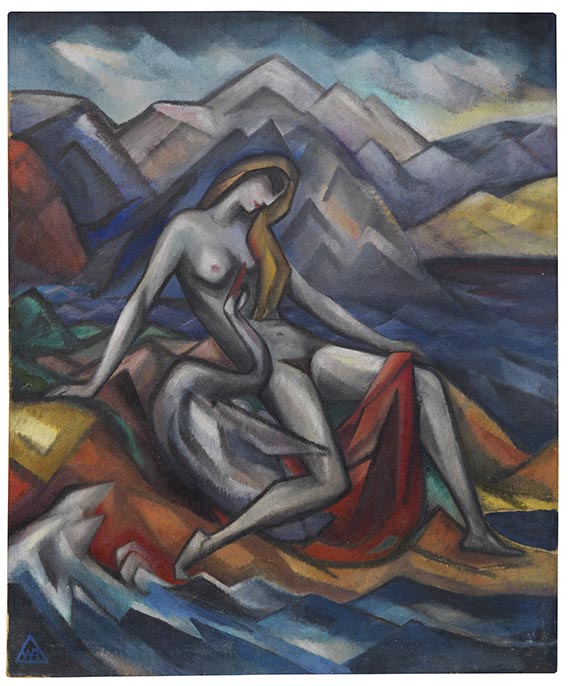
Leda und der Schwan, 1912.
Oil on canvas
Estimation: € 180,000 / $ 201,600
24
Wladimir Georgiewitsch von Bechtejeff
Leda und der Schwan, 1912.
Oil on canvas
Estimation: € 180,000 / $ 201,600
Wladimir Georgiewitsch von Bechtejeff
1878 - 1971
Leda und der Schwan. 1912.
Oil on canvas.
Monogrammed in the lower left. 165 x 136 cm (64.9 x 53.5 in).
With two stamps of the art supplies store Richard Wurm, Munich, on the reverse, and inscribed with the artist’s name, the title, and the inventory number of Galerie Arnold, Dresden, on the stretcher. [AT/EH].
• MUSEUM MASTERPIECE from 1912, created during the pivotal early period of Munich Expressionism, in the immediate circle of the “Blauer Reiter.”
• AVANT-GARDE STYLE The crystalline landscape and expressive use of color show remarkable parallels to Franz Marc’s groundbreaking compositions.
• MONUMENTAL AND EXTREMELY RARE Measuring 165 × 136 cm, this is an exceptionally large-scale painting from Bechtejeff’s most significant creative phase. Large portions of his early oeuvre are considered lost.
• SIGNIFICANT PROVENANCE Formerly in the renowned Werner Dücker Collection in Düsseldorf and exhibited at the Neue Künstlervereinigung München as early as 1912.
• REDISCOVERED In 2018, the Schlossmuseum Murnau honored the artist with a comprehensive retrospective, once again highlighting his significance for early Modernism.
PROVENANCE: Kunstverein Barmen (likely acquired directly from the artist in December 1912 or taken on consignment until March 1913).
Werner Dücker Collection, Düsseldorf (acquired from the above in March 1913).
Private collection, Germany.
Kunsthandel Saarbrücken (acquired from the above approximately 25 years ago).
Private collection, Saxony (acquired from the above).
Private collection, Hesse (acquired from the above in 2021, Ketterer Kunst).
EXHIBITION: Exhibition of 41 works by the Neue Künstlervereinigung München, Kunstverein Barmen, December 1912 (no catalog).
Die neue Malerei. Expressionist Exhibition, January 1914, Galerie Ernst Arnold, Dresden, cat. no. 14 (title: “Leda,” on loan from Werner Dücker, Düsseldorf, “not for sale.” The gallery’s handwritten inventory number is on the stretcher).
LITERATURE: Ledger of the Barmen Art Association, “Management Records from 1904 Onward,” Archive of the Von der Heydt Museum, Wuppertal (copy), fol. 92 (“Sales to Private Individuals”).
Antje Birthälmer and Sabine Fehlemann, Die “Neue Künstlervereinigung München” und ihre Verbindungen zur rheinischen Kunstszene, in: Der Blaue Reiter und das Neue Bild 1909–1912. From the “Neue Künstlervereinigung München” to the “Blauer Reiter,” catalog accompanying the exhibition at the Städtische Galerie im Lenbachhaus, Munich, July 2–October 3, 1999, pp. 276–285, here p. 284, note 65.
Ketterer Kunst, Munich, Auction 525, Evening Sale, December 10, 2021, lot 203 (with color illustration).
Agnes Thum, Kandinskys Treppe zum Schloss—ein Bild mit Geschichte, in: Murnau Castle Museum (ed.), Und morgen nach Murnau!, Murnau 2022, color illustration p. 12.
Jelena Hahl-Fontaine, in: Wladimir von Bechtejeff 1878–1971. Wiederentdeckt! (Rediscovered!), exhibition catalog, Murnau 2018, p. 17.
Jelena Hahl-Fontaine, in: Wladimir von Bechtejeff 1878-1971. Wiederentdeckt!, exhib. cat. Murnau 2018, p. 17.
Called up: December 4, 2026 - ca. 17.46 h +/- 20 min.
To Munich in Search of Something New
Vladimir von Bechtejeff grew up in affluent circumstances in Russia and received a military education befitting his social standing. In his fragmentary, unpublished biography, which is reprinted in the catalog for the exhibition “Vladimir von Bechtejeff 1878–1971. Rediscovered!” at the Murnau Castle Museum, he wrote: “Throughout my entire military service, I took every opportunity to paint, as I saw it as my true calling” (quoted from: Exhibition catalog, Murnau 2018, p. 25). In his army unit in St. Petersburg, he met Alexei von Jawlensky's brother Sergei, who recommended going to Munich: "My colleague in the army, Alexei Jawlensky’s brother, strongly advised me to go to Munich, where young, talented Russians were searching for something new, whereas, as is well known, the atmosphere at the St. Petersburg Academy was stifling. So, with a small inheritance from an aunt and a letter to Alexei Jawlensky, I set off for Munich” (ibid., p. 26). He arrived there in 1902 and, through Alexei von Jawlensky, quickly made contact with the local avant-garde circles. At the Giselists’ salon hosted by Werefkin and Jawlensky, he met the movement's pioneering minds. Jawlensky was enthusiastic about his rapid artistic progress, and Franz Marc praised his ability to incorporate the human form as a linear ornament into his compositions (ibid., p. 30). In the year the “New Artists’ Association of Munich” was founded, Bechtejeff contributed three paintings to its first exhibition and was also represented in subsequent exhibitions.
Mythology in a Cubist Guise
His subjects are primarily drawn from mythology: “Bacchanal,” “Amazons,” “Hesperides,” “Venus at Her Toilet,” and, likewise, the large-format painting “Leda and the Swan” offered here. Leda is the wife of the Spartan king Tyndareus. Zeus falls in love with her and approaches her as a swan. This encounter results in Helen, over whom the Trojan War would later be waged. Artists have used the motif of “Leda and the Swan” for centuries to depict nudity and lust in an innocuous way. On his travels to France, Italy, and Spain, Bechtolff surely saw masterpieces on this theme in local museums, which he then fundamentally reinterpreted in his own painting.
Bechtejeff’s style is close to Cubism. The figures are characterized by a strong emphasis on contour and dissolve into cubic shading of colors in the flesh tones. This is also the case in our painting; Leda and the swan are fused in various shades of blue and gray. They seem unfazed by the surrounding waves and shifting forms. They are calm, yet their surroundings foreshadow the impending disaster. Jelena Hahl-Fontaine wrote the following about our painting: “The difference in painting style between Bechtejeff’s ‘The Horse Tamer’ (Lenbachhaus, Munich, Cat. Murnau, p. 93) and ‘Leda,’ created soon after, is evident: instead of flowing, impetuous movement, there is a stylization in a harsher, Cubist manner—not only the mountains and rocks, but even the ocean waves appear as angular and jagged forms. Only Leda’s beauty remains intact; Picasso-like distortions of the human body would have been out of the question for the refined aesthete Bechtejeff. He treated Leda’s figure, with the swan caressing her, in his typical manner as a “linear ornament,” influenced by Art Nouveau and the cloisonné technique, though slightly more rigid than we are accustomed to from his earlier paintings, such as “Two Bathing Women” from 1910 (Museum Abteiberg, Mönchengladbach, Cat. Murnau, p. 80). The painting “Leda” undoubtedly represents an important milestone between “The Horse Tamer” (1912) and “Diana on the Hunt” (1912/13) (Staatsgalerie Stuttgart, Cat. Murnau, p. 91). (Jelena Hahl-Fontaine, quoted from: Ketterer Kunst, Auction Catalog 525, 2021, p. 32)
The History of the Painting
Bechtejeff’s “Leda” is not just a fascinating work of art; it also boasts a fascinating history. Shortly after its creation in 1912, the nearly human—height painting was sent to Barmen. Under Richard Reiche, the local art association had become a vibrant center of modern art. In December 1912, Bechtejeff participated in an exhibition there featuring 41 works by the Expressionist “New Artists’ Association of Munich” (N.K.V.M.), the nucleus of the “Blue Rider.” And as chance would have it, the Düsseldorf collector and “painter” Werner Dücker (1887–1945) was also showing his outstanding collection in Barmen at the same time. On display were 18 paintings and one sculpture by French artists such as Vincent van Gogh, Paul Cézanne, and Paul Gauguin, as well as by such outstanding German painters as Franz Marc, Alexej von Jawlensky, and, not least, Vladimir von Bechtejeff. Although neither exhibition was accompanied by a catalog, one can easily imagine that Dücker discovered the large painting “Leda” during his strolls through the exhibition halls of the “N.K.V.M.” section. Indeed, he purchased the painting from the Barmen Art Association shortly thereafter, as the ledgers note. In January 1914, Galerie Arnold in Dresden finally presented the work at the important exhibition “Die neue Malerei”, organized by Richard Reiche—the first major Expressionist show in Dresden. The work was on loan from Werner Dücker, who had his “Leda” marked as “not for sale” in the catalog.
A Fascinating Collector
The collector Werner Dücker was—as far as the sparse sources reveal—a flamboyant figure: wealthy and sophisticated, progressive and free-spirited. Dücker and his wife, the sculptor Marta Zahn, were close friends with Richard Schultz, who introduced them both to Berlin’s vibrant gay scene (for further details, see Karl-Heinz Steinle, Der literarische Salon bei Richard Schultz, Berlin 2002). The circle of friends gathered for literary salons, indulged in nudism with its leading figure, Adolf Koch, and frequented the legendary “Westend-Klause” run by innkeeper Walter Franke. Werner Dücker was evidently deeply drawn to this modernity, sexual freedom, and openness. Bechtcheff’s “Leda with the Swan” also has a distinct sexual energy and an eroticism as elegant as it is striking. It is not surprising that Werner Dücker, of all people, was willing to spend the considerable sum of 1,650 marks on the work in 1913.
However, Dücker was likely unable to enjoy his “Leda” for very long. In 1923, he lost his entire fortune to inflation. Marta subsequently opened a fashion salon to earn a little more money than she could from sculpture, and the highly significant art collection had to be sold. Richard Schultz acquired several works from his friend Dücker—yet there is no mention of “Leda” in Schultz’s estate. Only a few decades ago, Bechtejeff’s masterpiece resurfaced in a private collection, unrecognized as such. [AT]
Plus d'informations


Commission, taxes et droit de suite
Cet objet est offert avec imposition régulière ou avec imposition différentielle.
Calcul en cas d'imposition différentielle:
Prix d’adjudication jusqu’à 1 000 000 euros : frais de vente 34 %.
Des frais de vente de 29% sont facturés sur la partie du prix d’adjudication dépassant 1 000 000 euros. Ils sont additionnés aux frais de vente dus pour la partie du prix d’adjudication allant jusqu’à 1 000 000 euros.
Des frais de vente de 22% sont facturés sur la partie du prix d’adjudication dépassant 4 000 000 euros. Ils sont additionnés aux frais de vente dus pour la partie du prix d’adjudication allant jusqu’à 4 000 000 euros.
La commission comprend la TVA, mais celle-ci n'est pas indiquée.
Calcul en cas d'imposition régulière:
Prix d'adjudication jusqu'à 1 000 000 € : 29 % de commission.
Prix d'adjudication supérieur à 1 000 000 € : montants partiels jusqu'à 1 000 000 € 29 % de commission, montants partiels supérieurs à 1 000 000 € : 23 % de commission.
Prix d'adjudication supérieur à 4.000 000 € : montants partiels supérieurs à 4.000 000 € : 15 % de commission.
La TVA légale de 7 % est prélevée sur la somme du prix d'adjudication et de la commission.
Si vous souhaitez appliquer l'imposition régulière, merci de bien vouloir le communiquer par écrit avant la facturation.
Calcul en cas de droit de suite:
Pour les œuvres originales d’arts plastiques et de photographie d’artistes vivants ou d’artistes décédés il y a moins de 70 ans, soumises au droit de suite, une rémunération au titre du droit de suite à hauteur des pourcentages indiqués au § 26, al. 2 de la loi allemande sur les droits d’auteur (UrhG) est facturée en sus pour compenser la rémunération liée au droit de suite due par le commissaire-priseur conformément au § 26 UrhG. À ce jour, elle est calculée comme suit :
4 pour cent pour la part du produit de la vente à partir de 400,00 euros et jusqu’à 50 000 euros,
3 pour cent supplémentaires pour la part du produit de la vente entre 50 000,01 et 200 000 euros,
1 pour cent supplémentaire pour la part entre 200 000,01 et 350 000 euros,
0,5 pour cent supplémentaire pour la part entre 350 000,01 et 500 000 euros et
0,25 pour cent supplémentaire pour la part au-delà de 500 000 euros.
Le total de la rémunération au titre du droit de suite pour une revente s’élève au maximum à 12 500 euros.