


Image du cadre
Raumbeispiel
295
Willi Baumeister
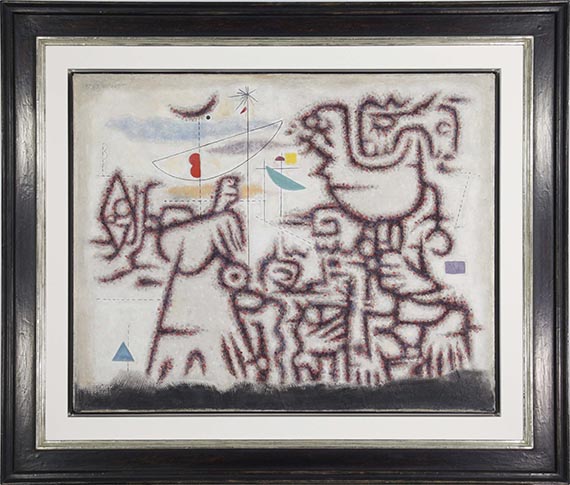
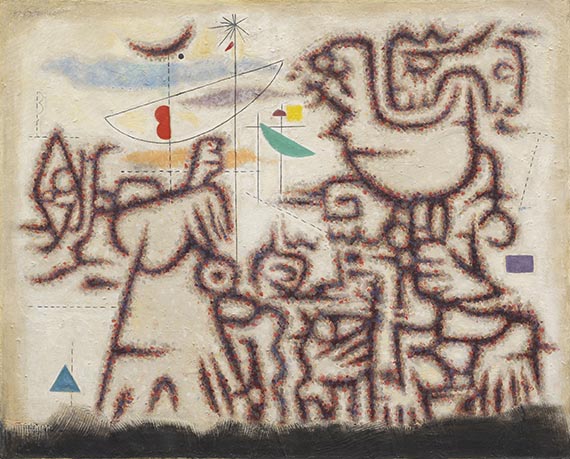
Zwei Weltalter, 1947.
Oil with synthetic resin and filling compound o...
Estimation: € 70,000 / $ 78,400
295
Willi Baumeister
Zwei Weltalter, 1947.
Oil with synthetic resin and filling compound o...
Estimation: € 70,000 / $ 78,400
Willi Baumeister
1889 - 1955
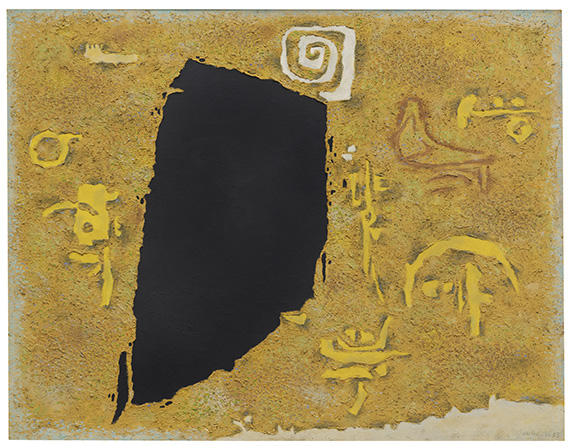
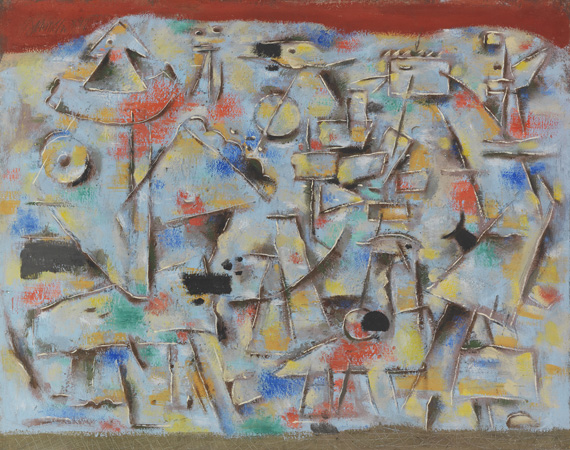
Zwei Weltalter. 1947.
Oil with synthetic resin and filling compound on canvas.
Signed and dated “5.47” in the upper left. 81.4 x 100.5 cm (32 x 39.5 in). [KA].
• An impressive work from the significant series “Zwei Weltalter” (1947–1955).
• Thematically, Baumeister moves within an archaic world whose timeless relevance took on special significance for him in the postwar period.
• The relief-like surface, achieved through the use of synthetic resin and filling compound, reinforces the work’s tactile effect.
• The enigmatic figures are left in limbo, hovering between recognizability and abstraction.
• Offered on the international auction market for the first time (source: artprice.com).
We are grateful to Ms. Hadwig Goez for her kind assistance.
PROVENANCE: Peter Harnden Collection, New York (no later than 1963).
Galerie Otto Stangl, Munich (since 1980, Hauswedell & Nolte, Hamburg).
Galerie Schwarzer, Düsseldorf.
Private collection, North Rhine-Westphalia (acquired from the above in 2006).
In the family’s possession ever since.
LITERATURE: Peter Beye, Felicitas Baumeister, Willi Baumeister. Catalog Raisonné of Paintings, vol. II, Ostfildern 2002, CR no. 1328 (with black-and-white illustration).
Will Grohmann, Willi Baumeister. Leben und Werk, Cologne 1963, CR no. 970 (listed here under the title “Zwei Weltalter V” and dated “1947/48,” with b/w illustration).
- -
The Artist’s Diary, Baumeister Archive (unpublished), dated “5.47” beneath a pasted-in photograph of the work, p. 603.
Hauswedell & Nolte, Hamburg, 235th Auction, Modern Art, June 5, 1980, lot 82 (with color illustration on p. 27).
Called up: December 5, 2026 - ca. 17.20 h +/- 20 min.
With the end of World War II and his return to teaching at the State Academy of Fine Arts in Stuttgart in 1946, Willi Baumeister entered a phase of immense creative freedom and productivity. His body of work from the late 1940s reveals a sense of bright lightness that seems to transcend the trauma of isolation as well as the official ban on professional practice and exhibitions during the Nazi era. The composition “Zwei Weltalter” (Two Ages of the World), created in 1947, marks a fascinating peak within this pivotal moment as it combines existential conceptions of time with groundbreaking painterly techniques.
The programmatic title alone points to Baumeister’s lifelong engagement with the mythical, the prehistoric, and the archaic. In the present work, the artist does not depict a real landscape, but a spiritual cosmos wherein prehistory and the present enter into a dialog. For Baumeister, the concept of “world ages” becomes a pictorial metaphor for the basic states of nature and being: shadowy, biomorphic symbols and figurative allusions move across the surface like primal signs and seem to float right above the surface.
Characteristic of this creative phase is the pronounced materiality of the image carrier. Baumeister understood the pictorial surface not as a passive space of illusion, but as a haptic resonate body. Through the impasto application of synthetic resin and putty, he gave the surface a relief-like texture. This background, which appears weathered, evokes associations with ancient cave walls or even prehistoric layers of rock, upon which the painterly elements stand out much like fossil traces. At the same time, continuous lines break up the density of the relief, capture the light, and create subtle areas of shadow that lend the work a lively sense of depth.
Despite its thematic reference to archaic origins, the painting “Zwei Weltalter” is devoid of any somber heaviness. Instead, a rhythmic, almost musical order dominates. Floating color fields and lyrical lines dance in a dynamic dialog, lending the scene a cheerful sense of weightlessness. Baumeister achieves a masterful synthesis of constructive pictorial architecture and organic, spontaneous invention of form. The work stands as a masterpiece of postwar German Modernism, celebrating the triumph over darkness in favor of a universal, timeless light. [KA]
Commission, taxes et droit de suite
Cet objet est offert avec imposition régulière ou avec imposition différentielle.
Calcul en cas d'imposition différentielle:
Prix d’adjudication jusqu’à 1 000 000 euros : frais de vente 34 %.
Des frais de vente de 29% sont facturés sur la partie du prix d’adjudication dépassant 1 000 000 euros. Ils sont additionnés aux frais de vente dus pour la partie du prix d’adjudication allant jusqu’à 1 000 000 euros.
Des frais de vente de 22% sont facturés sur la partie du prix d’adjudication dépassant 4 000 000 euros. Ils sont additionnés aux frais de vente dus pour la partie du prix d’adjudication allant jusqu’à 4 000 000 euros.
La commission comprend la TVA, mais celle-ci n'est pas indiquée.
Calcul en cas d'imposition régulière:
Prix d'adjudication jusqu'à 1 000 000 € : 29 % de commission.
Prix d'adjudication supérieur à 1 000 000 € : montants partiels jusqu'à 1 000 000 € 29 % de commission, montants partiels supérieurs à 1 000 000 € : 23 % de commission.
Prix d'adjudication supérieur à 4.000 000 € : montants partiels supérieurs à 4.000 000 € : 15 % de commission.
La TVA légale de 7 % est prélevée sur la somme du prix d'adjudication et de la commission.
Si vous souhaitez appliquer l'imposition régulière, merci de bien vouloir le communiquer par écrit avant la facturation.
Calcul en cas de droit de suite:
Pour les œuvres originales d’arts plastiques et de photographie d’artistes vivants ou d’artistes décédés il y a moins de 70 ans, soumises au droit de suite, une rémunération au titre du droit de suite à hauteur des pourcentages indiqués au § 26, al. 2 de la loi allemande sur les droits d’auteur (UrhG) est facturée en sus pour compenser la rémunération liée au droit de suite due par le commissaire-priseur conformément au § 26 UrhG. À ce jour, elle est calculée comme suit :
4 pour cent pour la part du produit de la vente à partir de 400,00 euros et jusqu’à 50 000 euros,
3 pour cent supplémentaires pour la part du produit de la vente entre 50 000,01 et 200 000 euros,
1 pour cent supplémentaire pour la part entre 200 000,01 et 350 000 euros,
0,5 pour cent supplémentaire pour la part entre 350 000,01 et 500 000 euros et
0,25 pour cent supplémentaire pour la part au-delà de 500 000 euros.
Le total de la rémunération au titre du droit de suite pour une revente s’élève au maximum à 12 500 euros.