


Vente: 612 / Evening Sale 04 décembre 2026 à Munich → Lot 126000888
Image du cadre
Raumbeispiel
126000888
Gabriele Münter
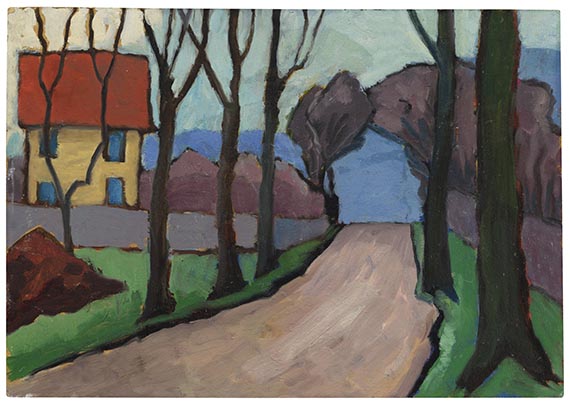
Landstraße mit gelbem Haus, 1949.
Oil on cardboard
Estimation: € 120,000 / $ 139,200
Les informations sur la commission d´achat, les taxes et le droit de suite sont disponibles quatre semaines avant la vente.
126000888
Gabriele Münter
Landstraße mit gelbem Haus, 1949.
Oil on cardboard
Estimation: € 120,000 / $ 139,200
Les informations sur la commission d´achat, les taxes et le droit de suite sont disponibles quatre semaines avant la vente.
Gabriele Münter
1877 - 1962
Landstraße mit gelbem Haus. 1949.
Oil on cardboard.
With the estate stamp, as well as a label bearing the stamped number “579” and another label with the number “L 228”, partly handwritten and partly stamped, on the reverse. Also with the inscription “nach 1930” (after 1930) on the reverse. 31 x 44 cm (12.2 x 17.3 in).
• Atmospheric view of the “Blaues Land.”
• Rare, muted color palette.
• As a key figure of the “Blauer Reiter,” Münter combined the depiction of nature, expression, and color in a unique way throughout her life..
Accompanied by a written certificate of authenticity issued by the Gabriele Münter and Johannes Eichner Foundation on April 13, 2011. The painting will be included in the catalogue raisonné of Gabriele Münter’s paintings.
PROVENANCE: Estate of the artist
Gabriele Münter and Johannes Eichner Foundation.
Private collection, Switzerland.
Dietmar Manke Collection, Schleswig-Holstein (since 2011, Lempertz, Cologne).
LITERATURE: Lempertz, A 979 Modern Art, Cologne, June 1, 2011, lot 262 (with color plate).
Following years of continuous travel, Gabriele Münter returned to her “Russian House” in Murnau in 1931—the home where she had lived with Wassily Kandinsky from 1908 to 1914. It was a homecoming to a place of great emotional significance to her. “She began to reclaim the house, which had been abandoned and neglected for years. [...] She clearly drew on her pre-war style—the era of the ‘Blue Rider’—in the numerous paintings she produced at that time [...], with the only difference being that the forms were now softer, more homogeneous, and less expressive. Even in her choice of subjects, she frequently returned to familiar places and views” (quoted from: Annegret Hoberg, Gabriele Münter, Munich 2003, p. 39). Still lifes, portraits, and landscapes—including views of Lake Staffelsee and the Murnau area—were created. In the years that followed, Gabriele Münter broke free from her early influences. The present painting “Landstraße mit gelbem Haus” (Country Road With Yellow House) represents this creative phase.
Gabriele Münter developed a new sense of color and a new approach to its use. The hues are slightly muted, yet retain their freshness and luminosity. The color areas feature almost imperceptible variations within themselves. Gabriele Münter thus creates, as if in passing, a subtle suggestion of spatiality. With minimal means, she distills the familiar and beloved landscape into a clear, dynamic composition.
Her emotional connection to the landscape is palpable through the way she employs color to convey mood. In terms of expressive quality, works like this painting are in no way inferior to her early work.
The year this painting was created is also the year Gabriele Münter came into contact with Hans Konrad Roethel. At the Haus der Kunst, Hans Grote organized the major exhibition “Der Blaue Reiter,” which contributed significantly to the rehabilitation of the long-ostracized art of the avant-garde. Münter was present in her capacity as a lender at the opening and, during the preparations, came into close contact with Hans Konrad Roethel—who would later become director of the Städtische Galerie im Lenbachhaus in Munich—for the first time” (ibid., p. 40). Throughout the Nazi era, Münter had preserved the treasure trove of works by Wassily Kandinsky from their time in Murnau. In two installments, in 1957 and 1962, Gabriele Münter donated these treasures, along with her entire estate, to the Lenbachhaus, thereby establishing the outstanding Expressionist collection and the archive of the Gabriele Münter and Johannes Eichner Foundation at this institution. [EH]