


Raumbeispiel
27
Karl Schmidt-Rottluff
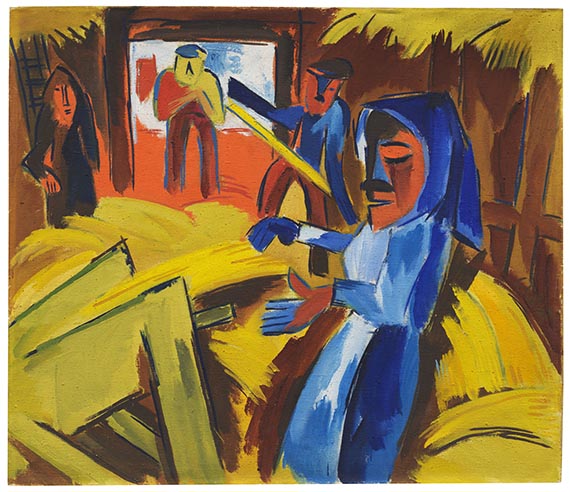
Scheune (Jershöft), 1921.
Oil on canvas
Estimation: € 300,000 / $ 336,000
27
Karl Schmidt-Rottluff
Scheune (Jershöft), 1921.
Oil on canvas
Estimation: € 300,000 / $ 336,000
Karl Schmidt-Rottluff
1884 - 1976
Scheune (Jershöft). 1921.
Oil on canvas.
Signed in center right. Inscribed with the work number “21i4” on the reverse. 97.5 x 112 cm (38.3 x 44 in).
The reverse of the canvas features an oil painting that has been painted over by the artist. [CH].
• RADICAL Jagged forms, vibrant colors, and strong contours.
• A PLACE OF LONGING Beginning in 1920, Jershöft on the Baltic Sea became a source of inspiration and an important creative retreat for the artist.
• RARE Paintings by the artist of this outstanding quality are extremely rare on the auction market.
• PROVENANCE A complex, international provenance history; part of the outstanding collection of Berthold and Else Beitz, Essen, for nearly 65 years.
The work is documented in the archive of the Karl and Emy Schmidt-Rottluff Foundation, Berlin.
PROVENANCE: Ferdinand Möller Collection, Berlin (acquired directly from the artist no later than 1928; with a gallery label on the stretcher, partially inscribed by hand).
Detroit Institute of Arts, Detroit, Michigan (taken into custody in March 1938 as a loan from the aforementioned owner; confiscated in December 1940 as “enemy property” by the U.S. government).
U.S. government property (1950–1957; ownership of the aforementioned seizure transferred on October 30, 1950, via “Vesting Order 15411” issued by the Office of Alien Property at the Department of Justice).
Maria Möller-Garny, Cologne (repurchased from the U.S. government in 1957; held by the Stuttgart Kunstkabinett until 1961).
Berthold and Else Beitz Collection, Essen (acquired from the above through the mediation of Galerie Grosshennig, Düsseldorf, in 1961; remained in the family’s possession until 2025).
Dietmar Manke Collection, Schleswig-Holstein (acquired from the above in 2025, Ketterer Kunst, Munich).
EXHIBITION: Presumably: A Collection of Modern German Art, New York, Anderson Galleries, Oct. 1–20, 1923, cat. no. 230.
50 Selected Works of Contemporary Art. Exhibition at the Reckendorfhaus, Hedemannstrasse 24, Berlin (publishing house of the “Kunstblatt”), November 1928 (no catalog).
Schmidt-Rottluff traveling exhibition, Galerie Möller, Berlin; Museum Danzig, November 1928–March 1929 (no catalog for either).
Karl Schmidt-Rottluff, Paintings, Watercolors, Prints, Amber Jewelry, Art Collections of the City of Königsberg / Königsberg Art Association, December 30, 1928–January 20, 1929, cat. no. 19.
Frauen in Not, exhibition by the International Workers’ Aid (IAH), Haus der Juryfreien, Berlin, October 9–November 1, 1931, cat. no. 322 (Female Farmworker).
Pomeranian State Museum, Greifswald (permanent loan, 2015–2024).
Zwei Männer – ein Meer. Pechstein und Schmidt-Rottluff an der Ostsee, Pomeranian State Museum, Greifswald, March 29–June 28, 2015, cat. no. 10 (with illu.).
LITERATURE: Will Grohmann, Karl Schmidt-Rottluff, Stuttgart 1956, p. 266 (with b&w illustration) and p. 292.
- -
Paul Westheim (ed.), 50 ausgewählte Werke heutiger Kunst. Exhibition at the Reckendorfhaus, Hedemannstrasse 24, in: Das Kunstblatt, vol. 13, no. 1, January 1929, pp. 365.
Stuttgarter Kunstkabinett, Stuttgart, 36th Auction, 1961, lot 462 (with color illustration, plate 109).
Eberhard Roters, Galerie Ferdinand Möller. Die Geschichte einer Galerie für Moderne Kunst in Deutschland 1917–1956, Berlin 1984, pp. 156 and 227.
Gisela Schirmer, Käthe Kollwitz und die Kunst ihrer Zeit. Positionen zur Geburtenpolitik, Weimar 1998 (with illustration, no. 277: View of the exhibition “Frauen in Not”).
Ketterer Kunst, Munich, 590th Auction, Evening Sale, June 6, 2025, lot 38 (with illustration).
ARCHIVE MATERIALS (selection): Index card from the art collection of Galerie Ferdinand Möller (“Scheune, oil on canvas” by Karl Schmidt-Rottluff), Berlinische Galerie, Berlin, Ferdinand Möller Estate, BG-KA-N/F.Möller-KK3,74 (https://sammlung-online.berlinischegalerie.de/de/collection/item/226939/, accessed Oct. 9, 2026).
Application documents from various artists for the exhibition “Modern German Art” (Oct. 1–20, 1923) at Anderson Galleries in New York City (USA), Berlinische Galerie, Berlin, Ferdinand Möller Estate, BG-GFM-D I,86 (https://sammlung-online.berlinischegalerie.de/de/collection/item/281905/, accessed Oct. 9, 2026).
Business correspondence between Galerie Ferdinand Möller and the Art Collections of the Free City of Danzig, Berlinische Galerie, Berlin, Ferdinand Möller Estate, BG-GFM-C, II 1, 587f. (https://sammlung-online.berlinischegalerie.de/de/collection/item/211952/, accessed October 9, 2026).
Business correspondence between the Ferdinand Möller Gallery and Dr. Wilhelm Reinhold Valentiner, Director of the Detroit Institute of Arts, Detroit (USA), Berlinische Galerie, Berlin, Ferdinand Möller Estate, BG-GFM-C, II 1, 115 (among others) (https://sammlung-online.berlinischegalerie.de/de/collection/item/211478/, accessed October 9, 2026).
Customs invoice and customs declaration for the import of 18 oil paintings from Galerie Ferdinand Möller to the Detroit Institute of Arts, 1938, Berlinische Galerie, Berlin, Ferdinand Möller Estate, BG-KA-N/F.Möller-66-M66,18-23 (https://sammlung-online.berlinischegalerie.de/de/collection/item/248308/, accessed Oct. 9, 2026).
Department of Justice, Office of Alien Property, Washington, D.C., and others: Purchase agreement between the Office of Alien Property of the U.S. Department of Justice and Maria Möller-Garny regarding the repurchase of 19 paintings in custody at the Detroit Institute of Arts, Berlinische Galerie, Berlin, Ferdinand Möller Estate, BG-KA-N/F.Möller-68-M68,88-89 (https://sammlung-online.berlinischegalerie.de/de/collection/item/248263/, accessed October 9, 2026).
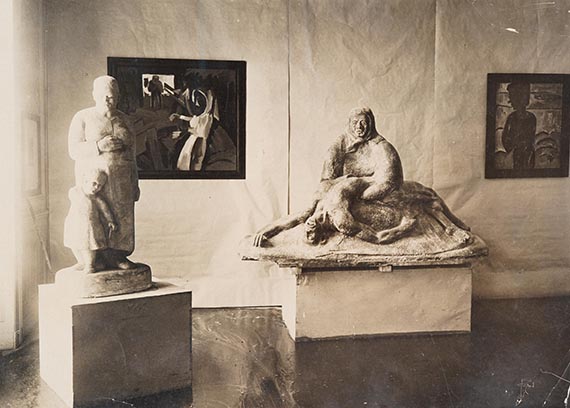
Heise Estate, Schönebeck District Museum, view of the exhibition “Frauen in Not” featuring works by Katharina Heise; on the wall, Schmidt-Rottluff’s paintings “Frau am Meer” and “Scheune”.
Called up: December 4, 2026 - ca. 17.52 h +/- 20 min.
Artistic and personal renewal after the First World War
The years after the First World War proved a particularly fruitful, eventful, and successful time for Karl Schmidt-Rottluff. In 1919, Galerie Ferdinand Möller in Berlin held the first major solo exhibition after the war. In the following period, the number of exhibitions and exhibition participation increased sharply. An enthusiastic essay by Ernst Gosebruch, then director of the Essen Art Museum, appeared in the art magazine Genius. In 1920, the first monograph on Karl Schmidt-Rottluff was published by Wilhelm R. Valentiner. Numerous museums acquired the artist's works, which, after the privations of the war years, now express his enormous artistic creativity and a mature and particularly powerful expressiveness. Schmidt-Rottluff is now one of Germany's most important living artists.
Artistic work was only possible to a minimal extent during the war. Schmidt-Rottluff was drafted into military service as early as May 1915 and was stationed in Russia and Lithuania until 1918. Initially, he was deployed as a soldier to build posts, trenches, and barbed-wire fortifications. In late 1916, he was transferred to the auditing office of the press department through the intervention of the writer Richard Dehmel. The artist could not devote himself to painting during these years, but he created some woodcuts and sculptures, many of which were unfortunately destroyed during the Second World War.
In the spring after his return, Schmidt-Rottluff marries the photographer Emy Frisch, who also comes from Chemnitz and whom he had already met several years earlier. He establishes new contacts with the sculptors Georg Kolbe, Richard Scheibe, Emy Roeder, and architect Walter Gropius. The artist laboriously tried to detach himself from what he had experienced: “I am very little satisfied with this summer, which, with its oppressive melancholy, found that all too receptive soil. The whole agony of the war years had such an effect that I still could not free myself from it and felt very weak in the process. I have regained some color confidence – but that may be all,” Schmidt-Rottluff wrote to his friend and collector, the art historian Wilhelm Niemeyer, in 1919. (Quoted from: Gerhard Wietek, Schmidt-Rottluff in Hamburg und Schleswig-Holstein, Neumünster 1984, p. 62)
The Baltic Sea paradise of Jershöft: a retreat and source of inspiration
In his efforts to come to terms with his wartime experiences, the artist longed for peace, seclusion, and intense encounters with nature. In 1920, he discovered the fishing village of Jershöft [today: Jarosławiec] on the Baltic Sea in what was then called Eastern Pomerania, just a few hours by train from Berlin. Jershöft remained the artist's and his family's summer residence until 1931. They regularly spent the summer months between May and September in the secluded coastal village, which became a haven of peace, a place of longing, and a source of great inspiration. Here, the artist came to appreciate the landscape and the simple life far from the big city. He observed the people of Jershöft going about their daily, usually physically demanding work in an unusual rural setting, and finally processed this wealth of impressions and experiences into expressive pictorial ideas entirely without socio-critical undertones. During these creative years, his depictions of workers, fishermen, farmers, and artisans, along with landscapes, became among the most important pictorial themes of his oeuvre from the 1920s. The experiences Schmidt-Rottluff gained with his expressive woodcuts, which he created towards the end of the war, can now also be found in his painting: Simplified, almost geometrically abstracted forms and generous areas determine the character of the composition, while strong contrasts of light and dark and cold and warm subtly recall the black and white of the woodcuts, but are given a further dimension by the radiance of the colors.
Expressive density in a frenzy of colors
The work offered here, Barn, also stems from this vital creative period. He painted it during Schmidt-Rottluff's second stay in Jershöft in 1921, and it attests to his enormous artistic development, as well as to the pent-up creative urge that had built up during the war years and now broke through with great energy in a highly expressive, powerfully colored, and dynamic composition.
The figures, not formulated as individuals but schematized and greatly simplified, are arranged in a circle, showing the communal togetherness necessary for this life, and are shown frontally except for the female figure on the right, who is kept in cool blue. The painter and the viewer are located in the interior of the barn, in the far corner of the building, separated from the working figures at the entrance by a barrier: a large pile of hay. Although Schmidt-Rottluff places himself amid the action on the workers' side, he remains an objective observer despite his fascination and interest.
As with the artist's other images of workers, the activity depicted in the picture is not the actual subject of the portrayal, despite the clear motif. Instead, Schmidt-Rottluff explores formal aspects and elevates them to the image's central content.
The once-distinct dark contours are now broken up, sometimes left out entirely or reduced to shorter contour lines, allowing the sculptural figures to merge with their surroundings. With their expressive, flat style, the calm, atmospheric, and harmonious compositions of the pre-war years gave way to a “zone painting” that was also based on the colored surface and now contained a wealth of emotions and dynamics. (Will Grohmann, Karl Schmidt-Rottluff, Stuttgart 1956, p. 106)
Color now takes center stage: it develops a magnificent, radiant life. Schmidt-Rottluff boldly juxtaposes radiant, deep blue with contrasting, bright sun yellow and warming reddish brown with bright, almost gaudy orange-red. The representational is thus dissolved into color with broad, visible brushstrokes in places; forms intertwine and mutate into a colorful, planar painting with angular outlines and an enormous expressive density. [CH]
Provenance
The rural motif of the barn should not be misleading: artworks with such a complex, international history are rare.
The painting was likely among the works that the artist loaned to the Anderson Galleries in New York in 1923 for an exhibition of German art. Wilhelm R. Valentiner rejoices in the catalog's preface: “Schmidt-Rottluff appears as the most individual and powerful personality in Germany. In the surety of his artistic advances, he is reminiscent of Van Gogh, without being influenced by him, but he goes much further than Van Gogh. [...] He aspires to the greatest possible simplification of form and expresses his emotions in a condensed way, with powerful lines and vast surfaces of color. He knows how to render the subconscious life of nature and humanity with uncanny power.” (”Schmidt-Rottluff appears to be the most individual and strongest personality in Germany. In the certainty of his artistic stance, he recalls Van Gogh without being influenced by him, but he goes much further than Van Gogh. [...] He strives for the greatest simplification of form and expresses his emotions in a condensed way, with powerful lines and large areas of color. He understands how to depict the subconscious life of nature and humanity with almost uncanny power.")
Probably shortly thereafter, but before 1928, the art dealer Ferdinand Möller purchased the painting. Möller, a bookseller by trade, began his fabulously successful career in 1912 at the famous Galerie Arnold in Dresden; in 1910, the gallery's owner at the time, Ludwig Gutbier, had presented the epochal exhibition of the “Brücke” artists. In 1913, Möller founded a branch of the Arnold Gallery in Breslau, and then in October 1918, he set up his gallery on Potsdamer Straße in Berlin. His artists included Erich Heckel, Ernst Ludwig Kirchner, Otto Mueller, Emil Nolde, Karl Schmidt-Rottluff and others. Like many other paintings by the “Brücke” group, the work “Barn” remained in the gallery's possession. And Möller sent it to other important exhibitions. In his review of the show “50 ausgewählte Werke heutiger Kunst” (50 selected works of contemporary art) in the magazine “Kunstblatt,” Paul Westheim called the painting “a concept of extraordinary intensity.” It then toured from Berlin to Königsberg and Danzig. Back in Berlin in 1931, the painting was shown in the programmatic exhibition “Women in Need” – as the embodiment of the exploited female farmhand.
However, the tide soon turned against modern art. In July 1937, the infamous exhibition “Degenerate Art” opened; the artworks confiscated from museums were finally expropriated by law by Hitler on May 1, 1938. In response, Möller had 19 works, including our painting, shipped to his friend Wilhelm R. Valentiner in Detroit on loan. The German-American art historian had been director of the Detroit Art Institute since 1924 and published the first monograph on Karl Schmidt-Rottluff as early as 1920. On October 30, 1950, the Möller collection was confiscated as “enemy property” by the “Vesting Order” of the Department of Justice, Office of Alien Property, and taken over by the US government. After long and arduous negotiations – Ferdinand Möller died in January 1956 – 17 of the paintings sent initially as loans finally arrived in Cologne, where the gallery had been based since 1951, in January 1958. The family donated two paintings, Wassily Kandinsky's “Bild mit weißer Form” (1913) and Lyonel Feininger's “Grüne Brücke” (1916), to the Detroit Art Institute and the North Carolina Museum of Arts in Raleigh as compensation.
In 1961, Maria Möller-Garny gave “Scheune” to the Kunstkabinett in Stuttgart. Subsequently, through the mediation of Wilhelm Grosshennig, the painting entered the important collection of Berthold and Else Beitz in Essen. Eventually, it came into the possession of Dietmar Manke, a collector from Schleswig-Holstein. [AT]
The years after the First World War proved a particularly fruitful, eventful, and successful time for Karl Schmidt-Rottluff. In 1919, Galerie Ferdinand Möller in Berlin held the first major solo exhibition after the war. In the following period, the number of exhibitions and exhibition participation increased sharply. An enthusiastic essay by Ernst Gosebruch, then director of the Essen Art Museum, appeared in the art magazine Genius. In 1920, the first monograph on Karl Schmidt-Rottluff was published by Wilhelm R. Valentiner. Numerous museums acquired the artist's works, which, after the privations of the war years, now express his enormous artistic creativity and a mature and particularly powerful expressiveness. Schmidt-Rottluff is now one of Germany's most important living artists.
Artistic work was only possible to a minimal extent during the war. Schmidt-Rottluff was drafted into military service as early as May 1915 and was stationed in Russia and Lithuania until 1918. Initially, he was deployed as a soldier to build posts, trenches, and barbed-wire fortifications. In late 1916, he was transferred to the auditing office of the press department through the intervention of the writer Richard Dehmel. The artist could not devote himself to painting during these years, but he created some woodcuts and sculptures, many of which were unfortunately destroyed during the Second World War.
In the spring after his return, Schmidt-Rottluff marries the photographer Emy Frisch, who also comes from Chemnitz and whom he had already met several years earlier. He establishes new contacts with the sculptors Georg Kolbe, Richard Scheibe, Emy Roeder, and architect Walter Gropius. The artist laboriously tried to detach himself from what he had experienced: “I am very little satisfied with this summer, which, with its oppressive melancholy, found that all too receptive soil. The whole agony of the war years had such an effect that I still could not free myself from it and felt very weak in the process. I have regained some color confidence – but that may be all,” Schmidt-Rottluff wrote to his friend and collector, the art historian Wilhelm Niemeyer, in 1919. (Quoted from: Gerhard Wietek, Schmidt-Rottluff in Hamburg und Schleswig-Holstein, Neumünster 1984, p. 62)
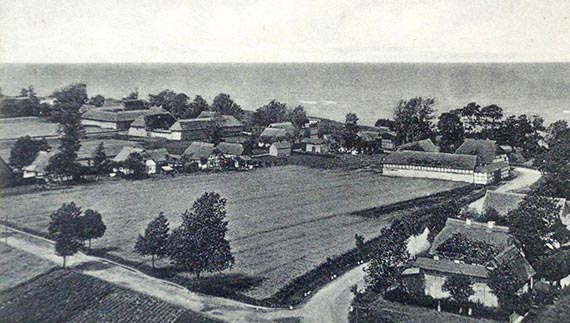
Ostseebad Jershöft (Baltic Sea resort Jershöft), ca. 1905-1915, postcard.
The Baltic Sea paradise of Jershöft: a retreat and source of inspiration
In his efforts to come to terms with his wartime experiences, the artist longed for peace, seclusion, and intense encounters with nature. In 1920, he discovered the fishing village of Jershöft [today: Jarosławiec] on the Baltic Sea in what was then called Eastern Pomerania, just a few hours by train from Berlin. Jershöft remained the artist's and his family's summer residence until 1931. They regularly spent the summer months between May and September in the secluded coastal village, which became a haven of peace, a place of longing, and a source of great inspiration. Here, the artist came to appreciate the landscape and the simple life far from the big city. He observed the people of Jershöft going about their daily, usually physically demanding work in an unusual rural setting, and finally processed this wealth of impressions and experiences into expressive pictorial ideas entirely without socio-critical undertones. During these creative years, his depictions of workers, fishermen, farmers, and artisans, along with landscapes, became among the most important pictorial themes of his oeuvre from the 1920s. The experiences Schmidt-Rottluff gained with his expressive woodcuts, which he created towards the end of the war, can now also be found in his painting: Simplified, almost geometrically abstracted forms and generous areas determine the character of the composition, while strong contrasts of light and dark and cold and warm subtly recall the black and white of the woodcuts, but are given a further dimension by the radiance of the colors.
Expressive density in a frenzy of colors
The work offered here, Barn, also stems from this vital creative period. He painted it during Schmidt-Rottluff's second stay in Jershöft in 1921, and it attests to his enormous artistic development, as well as to the pent-up creative urge that had built up during the war years and now broke through with great energy in a highly expressive, powerfully colored, and dynamic composition.
The figures, not formulated as individuals but schematized and greatly simplified, are arranged in a circle, showing the communal togetherness necessary for this life, and are shown frontally except for the female figure on the right, who is kept in cool blue. The painter and the viewer are located in the interior of the barn, in the far corner of the building, separated from the working figures at the entrance by a barrier: a large pile of hay. Although Schmidt-Rottluff places himself amid the action on the workers' side, he remains an objective observer despite his fascination and interest.
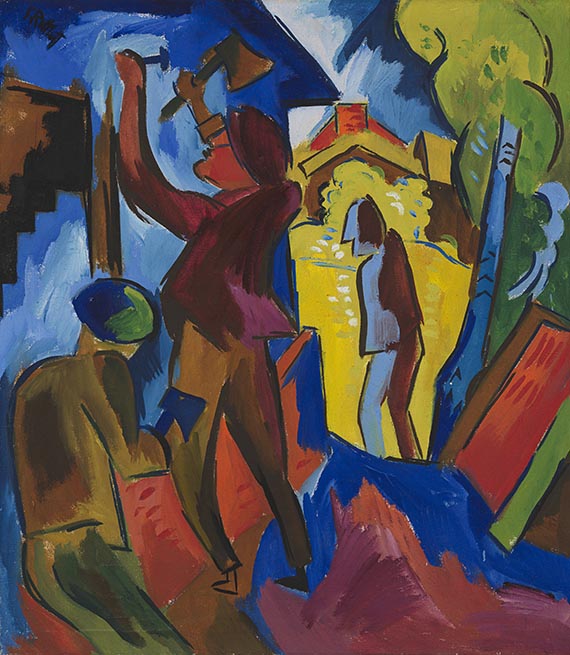
Karl Schmidt-Rottluff, Handwerker am Haus (Craftsmen at the House), 1922, oil on canvas, Brücke-Museum, Berlin. © VG Bild-Kunst, Bonn 2026
As with the artist's other images of workers, the activity depicted in the picture is not the actual subject of the portrayal, despite the clear motif. Instead, Schmidt-Rottluff explores formal aspects and elevates them to the image's central content.
The once-distinct dark contours are now broken up, sometimes left out entirely or reduced to shorter contour lines, allowing the sculptural figures to merge with their surroundings. With their expressive, flat style, the calm, atmospheric, and harmonious compositions of the pre-war years gave way to a “zone painting” that was also based on the colored surface and now contained a wealth of emotions and dynamics. (Will Grohmann, Karl Schmidt-Rottluff, Stuttgart 1956, p. 106)
Color now takes center stage: it develops a magnificent, radiant life. Schmidt-Rottluff boldly juxtaposes radiant, deep blue with contrasting, bright sun yellow and warming reddish brown with bright, almost gaudy orange-red. The representational is thus dissolved into color with broad, visible brushstrokes in places; forms intertwine and mutate into a colorful, planar painting with angular outlines and an enormous expressive density. [CH]
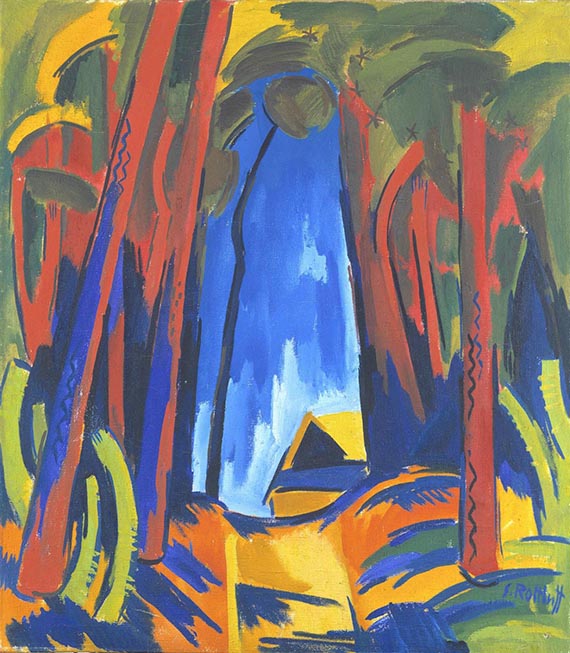
Karl Schmidt-Rottluff, Waldbild (Forest Scene), 1921, oil on canvas, Hamburger Kunsthalle, Hamburg. © VG Bild-Kunst, Bonn 2026
Provenance
The rural motif of the barn should not be misleading: artworks with such a complex, international history are rare.
The painting was likely among the works that the artist loaned to the Anderson Galleries in New York in 1923 for an exhibition of German art. Wilhelm R. Valentiner rejoices in the catalog's preface: “Schmidt-Rottluff appears as the most individual and powerful personality in Germany. In the surety of his artistic advances, he is reminiscent of Van Gogh, without being influenced by him, but he goes much further than Van Gogh. [...] He aspires to the greatest possible simplification of form and expresses his emotions in a condensed way, with powerful lines and vast surfaces of color. He knows how to render the subconscious life of nature and humanity with uncanny power.” (”Schmidt-Rottluff appears to be the most individual and strongest personality in Germany. In the certainty of his artistic stance, he recalls Van Gogh without being influenced by him, but he goes much further than Van Gogh. [...] He strives for the greatest simplification of form and expresses his emotions in a condensed way, with powerful lines and large areas of color. He understands how to depict the subconscious life of nature and humanity with almost uncanny power.")
Our painting shown in the exhibition “Frauen in Not”, an exhibition organised by Internationale Arbeiterhilfe (IAH), Haus der Juryfreien, Berlin, 9.10.-1.11.1931. © VG Bild-Kunst, Bonn 2026
Probably shortly thereafter, but before 1928, the art dealer Ferdinand Möller purchased the painting. Möller, a bookseller by trade, began his fabulously successful career in 1912 at the famous Galerie Arnold in Dresden; in 1910, the gallery's owner at the time, Ludwig Gutbier, had presented the epochal exhibition of the “Brücke” artists. In 1913, Möller founded a branch of the Arnold Gallery in Breslau, and then in October 1918, he set up his gallery on Potsdamer Straße in Berlin. His artists included Erich Heckel, Ernst Ludwig Kirchner, Otto Mueller, Emil Nolde, Karl Schmidt-Rottluff and others. Like many other paintings by the “Brücke” group, the work “Barn” remained in the gallery's possession. And Möller sent it to other important exhibitions. In his review of the show “50 ausgewählte Werke heutiger Kunst” (50 selected works of contemporary art) in the magazine “Kunstblatt,” Paul Westheim called the painting “a concept of extraordinary intensity.” It then toured from Berlin to Königsberg and Danzig. Back in Berlin in 1931, the painting was shown in the programmatic exhibition “Women in Need” – as the embodiment of the exploited female farmhand.
However, the tide soon turned against modern art. In July 1937, the infamous exhibition “Degenerate Art” opened; the artworks confiscated from museums were finally expropriated by law by Hitler on May 1, 1938. In response, Möller had 19 works, including our painting, shipped to his friend Wilhelm R. Valentiner in Detroit on loan. The German-American art historian had been director of the Detroit Art Institute since 1924 and published the first monograph on Karl Schmidt-Rottluff as early as 1920. On October 30, 1950, the Möller collection was confiscated as “enemy property” by the “Vesting Order” of the Department of Justice, Office of Alien Property, and taken over by the US government. After long and arduous negotiations – Ferdinand Möller died in January 1956 – 17 of the paintings sent initially as loans finally arrived in Cologne, where the gallery had been based since 1951, in January 1958. The family donated two paintings, Wassily Kandinsky's “Bild mit weißer Form” (1913) and Lyonel Feininger's “Grüne Brücke” (1916), to the Detroit Art Institute and the North Carolina Museum of Arts in Raleigh as compensation.
In 1961, Maria Möller-Garny gave “Scheune” to the Kunstkabinett in Stuttgart. Subsequently, through the mediation of Wilhelm Grosshennig, the painting entered the important collection of Berthold and Else Beitz in Essen. Eventually, it came into the possession of Dietmar Manke, a collector from Schleswig-Holstein. [AT]
Commission, taxes et droit de suite
Cet objet est offert avec imposition régulière ou avec imposition différentielle.
Calcul en cas d'imposition différentielle:
Prix d’adjudication jusqu’à 1 000 000 euros : frais de vente 34 %.
Des frais de vente de 29% sont facturés sur la partie du prix d’adjudication dépassant 1 000 000 euros. Ils sont additionnés aux frais de vente dus pour la partie du prix d’adjudication allant jusqu’à 1 000 000 euros.
Des frais de vente de 22% sont facturés sur la partie du prix d’adjudication dépassant 4 000 000 euros. Ils sont additionnés aux frais de vente dus pour la partie du prix d’adjudication allant jusqu’à 4 000 000 euros.
La commission comprend la TVA, mais celle-ci n'est pas indiquée.
Calcul en cas d'imposition régulière:
Prix d'adjudication jusqu'à 1 000 000 € : 29 % de commission.
Prix d'adjudication supérieur à 1 000 000 € : montants partiels jusqu'à 1 000 000 € 29 % de commission, montants partiels supérieurs à 1 000 000 € : 23 % de commission.
Prix d'adjudication supérieur à 4.000 000 € : montants partiels supérieurs à 4.000 000 € : 15 % de commission.
La TVA légale de 7 % est prélevée sur la somme du prix d'adjudication et de la commission.
Si vous souhaitez appliquer l'imposition régulière, merci de bien vouloir le communiquer par écrit avant la facturation.
Calcul en cas de droit de suite:
Pour les œuvres originales d’arts plastiques et de photographie d’artistes vivants ou d’artistes décédés il y a moins de 70 ans, soumises au droit de suite, une rémunération au titre du droit de suite à hauteur des pourcentages indiqués au § 26, al. 2 de la loi allemande sur les droits d’auteur (UrhG) est facturée en sus pour compenser la rémunération liée au droit de suite due par le commissaire-priseur conformément au § 26 UrhG. À ce jour, elle est calculée comme suit :
4 pour cent pour la part du produit de la vente à partir de 400,00 euros et jusqu’à 50 000 euros,
3 pour cent supplémentaires pour la part du produit de la vente entre 50 000,01 et 200 000 euros,
1 pour cent supplémentaire pour la part entre 200 000,01 et 350 000 euros,
0,5 pour cent supplémentaire pour la part entre 350 000,01 et 500 000 euros et
0,25 pour cent supplémentaire pour la part au-delà de 500 000 euros.
Le total de la rémunération au titre du droit de suite pour une revente s’élève au maximum à 12 500 euros.