


Verso
Autre image
Autre image
Autre image
Autre image
15
Arnaldo Pomodoro
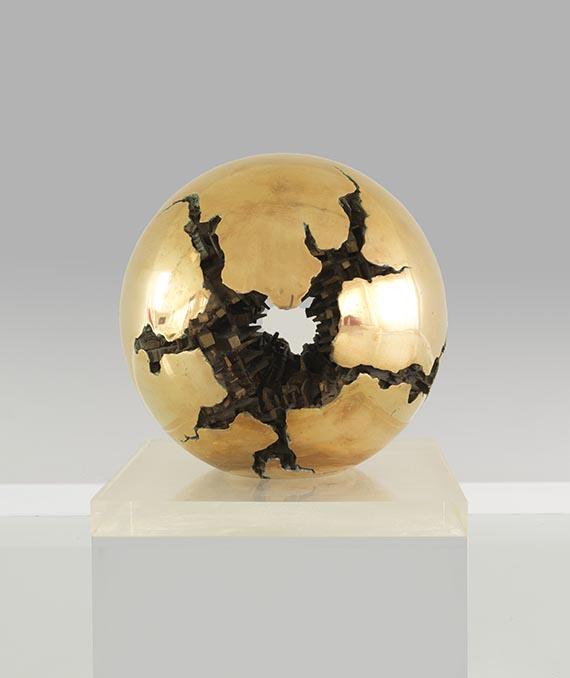
Sfera con perforazione, 1966.
Bronze
Estimation: € 250,000 / $ 280,000
15
Arnaldo Pomodoro
Sfera con perforazione, 1966.
Bronze
Estimation: € 250,000 / $ 280,000
Arnaldo Pomodoro
1926 - 2025
Sfera con perforazione. 1966.
Bronze.
On a Plexiglas base bearing the signature, date, title, and number. One of two artist’s proofs outside the edition of two. Diameter: 57.5 cm (22.6 in). Base: 60 x 60 x 5,5 cm (23,6 x 23,6 x 2,1 in).
[AW].
EXTREMELY RARE Early spherical sculptures from the 1960s are extremely rare on the international auction market.
ICONIC SERIES Pomodoro’s famous Sfere are represented in collections such as the Peggy Guggenheim Collection in Venice, the Vatican Museums, and the United Nations Headquarters in New York.
PIONEERING STYLE As early as 1966, Pomodoro’s fractured sphere foreshadowed a motif that would shortly thereafter also characterize Fritz Koenig’s world-famous sculpture for the World Trade Center.
MAJOR RETROSPECTIVE The Galleria d’Italia in Milan honored the artist on the occasion of his 100th birthday in 2026 with a comprehensive retrospective that also focused on his famous spherical sculptures.
AUCTION MARKET DEBUT One of only two artist’s proofs outside the edition, in private hands for decades.
Accompanied by a certificate of authenticity issued by the Fondazione Arnaldo Pomodoro, Milan, dated October 26, 2026. The work is registered in the archive under the number “AP 269”.
PROVENANCE: Private collection of Ottomar Lampe, Kiel.
LITERATURE: Flaminio Gualdoni, Arnaldo Pomodoro. Catalogo ragionato della scultura, vol. I, Milan 2007, CR no. 389.
Called up: December 4, 2026 - ca. 17.28 h +/- 20 min.
1926 - 2025
Sfera con perforazione. 1966.
Bronze.
On a Plexiglas base bearing the signature, date, title, and number. One of two artist’s proofs outside the edition of two. Diameter: 57.5 cm (22.6 in). Base: 60 x 60 x 5,5 cm (23,6 x 23,6 x 2,1 in).
[AW].
EXTREMELY RARE Early spherical sculptures from the 1960s are extremely rare on the international auction market.
ICONIC SERIES Pomodoro’s famous Sfere are represented in collections such as the Peggy Guggenheim Collection in Venice, the Vatican Museums, and the United Nations Headquarters in New York.
PIONEERING STYLE As early as 1966, Pomodoro’s fractured sphere foreshadowed a motif that would shortly thereafter also characterize Fritz Koenig’s world-famous sculpture for the World Trade Center.
MAJOR RETROSPECTIVE The Galleria d’Italia in Milan honored the artist on the occasion of his 100th birthday in 2026 with a comprehensive retrospective that also focused on his famous spherical sculptures.
AUCTION MARKET DEBUT One of only two artist’s proofs outside the edition, in private hands for decades.
Accompanied by a certificate of authenticity issued by the Fondazione Arnaldo Pomodoro, Milan, dated October 26, 2026. The work is registered in the archive under the number “AP 269”.
PROVENANCE: Private collection of Ottomar Lampe, Kiel.
LITERATURE: Flaminio Gualdoni, Arnaldo Pomodoro. Catalogo ragionato della scultura, vol. I, Milan 2007, CR no. 389.
Called up: December 4, 2026 - ca. 17.28 h +/- 20 min.
Arnaldo Pomodoro (1926–2025) is recognized as one of the most significant sculptors of Italian post-war Modernism, and his radical approach to form continues to shape 20th-century abstract sculpture. Born into a world scarred by war, he began his career as a stage designer before turning to goldsmithing with his brother Giò. This training in the craft would have a lasting influence on his later work. After moving to Milan in 1954, he made contacts with Lucio Fontana and Alberto Giacometti, which led him to develop a unique synthesis of craftsmanship and cutting-edge design. His sculptures in bronze, iron, or gold attest to a deep understanding of materials and technique, always combined with an almost philosophical reflection on form and destruction.
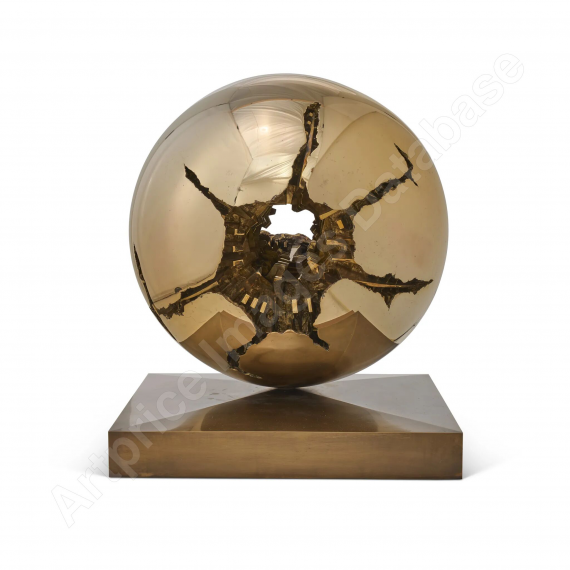
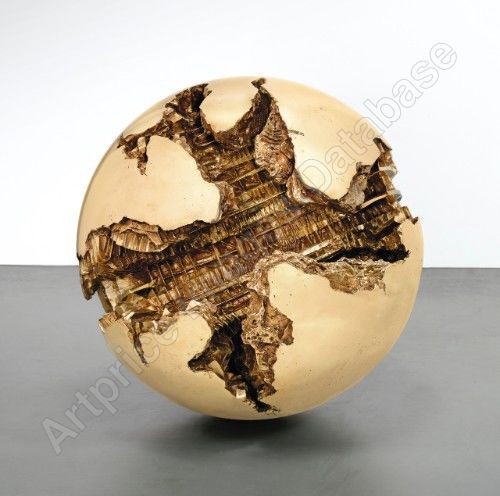
An encounter with Constantin Brancusi’s flawless spheres at the Museum of Modern Art in New York in 1959 was pivotal. While Brancusi embodied the perfect, closed form, Pomodoro viewed it as a challenge: “For me, the sphere is a perfect, almost magical form. Then you try to break the surface, go inside, and give life to the form.” (quoted from: Sculpture: Dissatisfied Aristotle, Time magazine, December 3, 1965) Beginning in 1963, he increasingly devoted himself to spherical forms, yet unlike Brancusi, he broke up the surface to reveal the interior. The sphere became a symbol of the tension between harmony and fragmentation, between organic vitality and mechanical precision. The 1966 sculpture is among the earliest and most fascinating examples of this body of work. The highly polished bronze surface reflects the world around it, while deep cracks and erosions reveal a mysterious interior. A space of interlocking facets opens up, reminiscent of circuit boards, machine parts, or symbols of a lost script. Teeth seem to bite into the void; the interior appears almost organic, almost alive, as if it were pushing its way out of its shell. Through the tension between the presence and absence of form, Pomodoro explores its essence and literally turns the abstract inside out.
“Sfera con perforazione” embodies Pomodoro’s conviction that art must penetrate the surface of things and give form to invisible elements. With its fascinating ambivalence between destruction and creation, between the mechanical and the organic, it exemplifies the artist’s entire body of work. It allows viewers to experience the full depth of his artistic vision. [AW]
An encounter with Constantin Brancusi’s flawless spheres at the Museum of Modern Art in New York in 1959 was pivotal. While Brancusi embodied the perfect, closed form, Pomodoro viewed it as a challenge: “For me, the sphere is a perfect, almost magical form. Then you try to break the surface, go inside, and give life to the form.” (quoted from: Sculpture: Dissatisfied Aristotle, Time magazine, December 3, 1965) Beginning in 1963, he increasingly devoted himself to spherical forms, yet unlike Brancusi, he broke up the surface to reveal the interior. The sphere became a symbol of the tension between harmony and fragmentation, between organic vitality and mechanical precision. The 1966 sculpture is among the earliest and most fascinating examples of this body of work. The highly polished bronze surface reflects the world around it, while deep cracks and erosions reveal a mysterious interior. A space of interlocking facets opens up, reminiscent of circuit boards, machine parts, or symbols of a lost script. Teeth seem to bite into the void; the interior appears almost organic, almost alive, as if it were pushing its way out of its shell. Through the tension between the presence and absence of form, Pomodoro explores its essence and literally turns the abstract inside out.
“Sfera con perforazione” embodies Pomodoro’s conviction that art must penetrate the surface of things and give form to invisible elements. With its fascinating ambivalence between destruction and creation, between the mechanical and the organic, it exemplifies the artist’s entire body of work. It allows viewers to experience the full depth of his artistic vision. [AW]
Commission, taxes et droit de suite
Cet objet est offert avec imposition régulière ou avec imposition différentielle.
Calcul en cas d'imposition différentielle:
Prix d’adjudication jusqu’à 1 000 000 euros : frais de vente 34 %.
Des frais de vente de 29% sont facturés sur la partie du prix d’adjudication dépassant 1 000 000 euros. Ils sont additionnés aux frais de vente dus pour la partie du prix d’adjudication allant jusqu’à 1 000 000 euros.
Des frais de vente de 22% sont facturés sur la partie du prix d’adjudication dépassant 4 000 000 euros. Ils sont additionnés aux frais de vente dus pour la partie du prix d’adjudication allant jusqu’à 4 000 000 euros.
La commission comprend la TVA, mais celle-ci n'est pas indiquée.
Calcul en cas d'imposition régulière:
Prix d'adjudication jusqu'à 1 000 000 € : 29 % de commission.
Prix d'adjudication supérieur à 1 000 000 € : montants partiels jusqu'à 1 000 000 € 29 % de commission, montants partiels supérieurs à 1 000 000 € : 23 % de commission.
Prix d'adjudication supérieur à 4.000 000 € : montants partiels supérieurs à 4.000 000 € : 15 % de commission.
La TVA légale de 7 % est prélevée sur la somme du prix d'adjudication et de la commission.
Si vous souhaitez appliquer l'imposition régulière, merci de bien vouloir le communiquer par écrit avant la facturation.
Calcul en cas de droit de suite:
Pour les œuvres originales d’arts plastiques et de photographie d’artistes vivants ou d’artistes décédés il y a moins de 70 ans, soumises au droit de suite, une rémunération au titre du droit de suite à hauteur des pourcentages indiqués au § 26, al. 2 de la loi allemande sur les droits d’auteur (UrhG) est facturée en sus pour compenser la rémunération liée au droit de suite due par le commissaire-priseur conformément au § 26 UrhG. À ce jour, elle est calculée comme suit :
4 pour cent pour la part du produit de la vente à partir de 400,00 euros et jusqu’à 50 000 euros,
3 pour cent supplémentaires pour la part du produit de la vente entre 50 000,01 et 200 000 euros,
1 pour cent supplémentaire pour la part entre 200 000,01 et 350 000 euros,
0,5 pour cent supplémentaire pour la part entre 350 000,01 et 500 000 euros et
0,25 pour cent supplémentaire pour la part au-delà de 500 000 euros.
Le total de la rémunération au titre du droit de suite pour une revente s’élève au maximum à 12 500 euros.
Calcul en cas d'imposition différentielle:
Prix d’adjudication jusqu’à 1 000 000 euros : frais de vente 34 %.
Des frais de vente de 29% sont facturés sur la partie du prix d’adjudication dépassant 1 000 000 euros. Ils sont additionnés aux frais de vente dus pour la partie du prix d’adjudication allant jusqu’à 1 000 000 euros.
Des frais de vente de 22% sont facturés sur la partie du prix d’adjudication dépassant 4 000 000 euros. Ils sont additionnés aux frais de vente dus pour la partie du prix d’adjudication allant jusqu’à 4 000 000 euros.
La commission comprend la TVA, mais celle-ci n'est pas indiquée.
Calcul en cas d'imposition régulière:
Prix d'adjudication jusqu'à 1 000 000 € : 29 % de commission.
Prix d'adjudication supérieur à 1 000 000 € : montants partiels jusqu'à 1 000 000 € 29 % de commission, montants partiels supérieurs à 1 000 000 € : 23 % de commission.
Prix d'adjudication supérieur à 4.000 000 € : montants partiels supérieurs à 4.000 000 € : 15 % de commission.
La TVA légale de 7 % est prélevée sur la somme du prix d'adjudication et de la commission.
Si vous souhaitez appliquer l'imposition régulière, merci de bien vouloir le communiquer par écrit avant la facturation.
Calcul en cas de droit de suite:
Pour les œuvres originales d’arts plastiques et de photographie d’artistes vivants ou d’artistes décédés il y a moins de 70 ans, soumises au droit de suite, une rémunération au titre du droit de suite à hauteur des pourcentages indiqués au § 26, al. 2 de la loi allemande sur les droits d’auteur (UrhG) est facturée en sus pour compenser la rémunération liée au droit de suite due par le commissaire-priseur conformément au § 26 UrhG. À ce jour, elle est calculée comme suit :
4 pour cent pour la part du produit de la vente à partir de 400,00 euros et jusqu’à 50 000 euros,
3 pour cent supplémentaires pour la part du produit de la vente entre 50 000,01 et 200 000 euros,
1 pour cent supplémentaire pour la part entre 200 000,01 et 350 000 euros,
0,5 pour cent supplémentaire pour la part entre 350 000,01 et 500 000 euros et
0,25 pour cent supplémentaire pour la part au-delà de 500 000 euros.
Le total de la rémunération au titre du droit de suite pour une revente s’élève au maximum à 12 500 euros.