


Image du cadre
Autre image
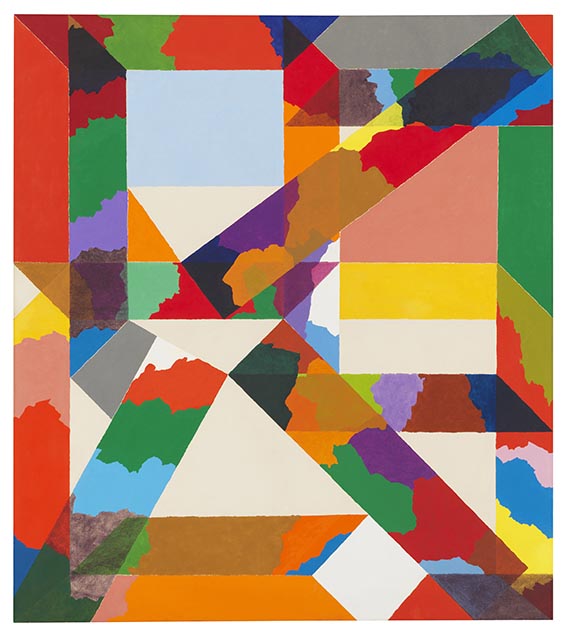
46
Piero Dorazio
Puzzle II, 1968.
Oil on canvas
Estimation: € 130,000 / $ 145,600
46
Piero Dorazio
Puzzle II, 1968.
Oil on canvas
Estimation: € 130,000 / $ 145,600
Piero Dorazio
1927 - 2005
Puzzle II. 1968.
Oil on canvas.
Signed, dated, and titled on the reverse of the canvas. 170 x 150 cm (66.9 x 59 in). [AW].
• PROTAGONIST Color in an expressive composition of space, light, and form.
• TURNING POINT A decisive transition from the dense “Reticoli” grids to open-plan Color Field Painting.
• PUZZLE Interlocking color fields create a fluid, almost architectural sense of depth and dynamism.
• SIGNIFICANT BERLIN PERIOD: A monumental work created as part of the DAAD Artists-in-Residence Program.
• MUSEUM QUALITY Another work from 1968 is in the Nationalgalerie Berlin.
Accompanied by a photo certificate issued by the Archivio Piero Dorazio, Milan. The work is documented in the Archivio Piero Dorazio, Milan.
PROVENANCE: The Owens-Corning Collection, Toledo, Ohio.
Private collection, Southern Germany (acquired from the above).
EXHIBITION: Piero Dorazio, Marlborough Galleria d’Arte, Rome, Nov./Dec. 1968 (with illustration; exhibition label on the reverse of the stretcher).
Piero Dorazio, Marlborough-Gerson Gallery, New York, Feb. 1969 (with illustration).
The Owens-Corning Fiberglass Corporation Art Collections, Toledo Museum of Art, Toledo, Ohio, March 13–April 10, 1977.
Piero Dorazio—A Retrospective, Albright Knox Gallery, Buffalo, New York, 1979–80, cat. no. 42 (with an exhibition label on the reverse of the stretcher).
LITERATURE: Marisa Volpi Orlandini, Jacques Lassaigne, and Giorgio Crisafi, Dorazio, Milan 1977 / Stuttgart 1978, CR no. 1060 (with illustration).
Called up: December 4, 2026 - ca. 18.30 h +/- 20 min.
The 1968 painting “Puzzle II” marks a pivotal phase in Piero Dorazio’s “la nuova pittura”—a work that illustrates a programmatic shift in his oeuvre. Dorazio, who co-founded the pioneering group “Forma 1” in Rome in 1947 and championed autonomous, non-representational art early on, distanced himself from Italian Futurism after 1945 because of conflicting political views. Through a critical engagement with the history of painting since Impressionism, he explored new paths toward abstraction in European art. Following stays in the United States in the 1950s, during which he became acquainted with Abstract Expressionist artists and Marc Rothko’s Color Field Painting, he was appointed to a teaching post at the University of Pennsylvania in 1959 and exhibited at documenta in Kassel in both 1959 and 1964. As a bridge between European formal discipline and American color experiments, he played a key role on the international stage.
While Dorazio’s imagery remained defined by the “Reticoli”—net-like structures composed of fine colored stripes—until 1963, he gradually began to open up his pictorial spaces starting in 1963. The works from this period distinguish themselves from the reductive approaches of visual art studies and systemic painting, as well as from trends in media-based visual reflection. When he worked in West Berlin in 1968— on a DAAD fellowship at the age of 41—he entered “a particularly fruitful creative period” (Thomas Kempas, Peter Nestler, foreword to the exhibition at the Haus am Waldsee in 1969). In Berlin, the artist devised sophisticated systems consisting of parallel bands of color, curved wave motifs, and puzzle pieces reminiscent of inlays.
“Puzzle II” exemplifies this principle: Instead of dense grid structures, monochromatic color fields interlock like puzzle pieces. The chromatic segments overlap and intertwine to form rhythmic structures of increasing scale, creating a fluid, architectural spatial order. Through the deliberate juxtaposition of pure primary colors, the painting unfolds vibrant dynamics: Dorazio redefines the supremacy of color as a formative force and fulfills his maxim that color is a fundamental spatial and expressive value in painting (Dorazio, in: Exhibition catalog, Galerie im Erker 1966, no page).
In this sense, “Puzzle II” epitomizes the moment when a compact grid structure gives way to an open, rhythmic composition of color fields. The work underscores Piero Dorazio’s status as a defining innovator of European abstraction. [AW]
Commission, taxes et droit de suite
Cet objet est offert avec imposition régulière ou avec imposition différentielle.
Calcul en cas d'imposition différentielle:
Prix d’adjudication jusqu’à 1 000 000 euros : frais de vente 34 %.
Des frais de vente de 29% sont facturés sur la partie du prix d’adjudication dépassant 1 000 000 euros. Ils sont additionnés aux frais de vente dus pour la partie du prix d’adjudication allant jusqu’à 1 000 000 euros.
Des frais de vente de 22% sont facturés sur la partie du prix d’adjudication dépassant 4 000 000 euros. Ils sont additionnés aux frais de vente dus pour la partie du prix d’adjudication allant jusqu’à 4 000 000 euros.
La commission comprend la TVA, mais celle-ci n'est pas indiquée.
Calcul en cas d'imposition régulière:
Prix d'adjudication jusqu'à 1 000 000 € : 29 % de commission.
Prix d'adjudication supérieur à 1 000 000 € : montants partiels jusqu'à 1 000 000 € 29 % de commission, montants partiels supérieurs à 1 000 000 € : 23 % de commission.
Prix d'adjudication supérieur à 4.000 000 € : montants partiels supérieurs à 4.000 000 € : 15 % de commission.
La TVA légale de 7 % est prélevée sur la somme du prix d'adjudication et de la commission.
Si vous souhaitez appliquer l'imposition régulière, merci de bien vouloir le communiquer par écrit avant la facturation.
Calcul en cas de droit de suite:
Pour les œuvres originales d’arts plastiques et de photographie d’artistes vivants ou d’artistes décédés il y a moins de 70 ans, soumises au droit de suite, une rémunération au titre du droit de suite à hauteur des pourcentages indiqués au § 26, al. 2 de la loi allemande sur les droits d’auteur (UrhG) est facturée en sus pour compenser la rémunération liée au droit de suite due par le commissaire-priseur conformément au § 26 UrhG. À ce jour, elle est calculée comme suit :
4 pour cent pour la part du produit de la vente à partir de 400,00 euros et jusqu’à 50 000 euros,
3 pour cent supplémentaires pour la part du produit de la vente entre 50 000,01 et 200 000 euros,
1 pour cent supplémentaire pour la part entre 200 000,01 et 350 000 euros,
0,5 pour cent supplémentaire pour la part entre 350 000,01 et 500 000 euros et
0,25 pour cent supplémentaire pour la part au-delà de 500 000 euros.
Le total de la rémunération au titre du droit de suite pour une revente s’élève au maximum à 12 500 euros.