


Image du cadre
Raumbeispiel
117
Ernst Ludwig Kirchner
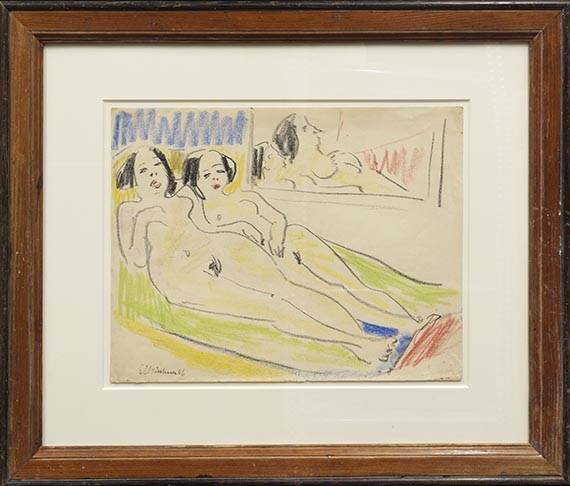
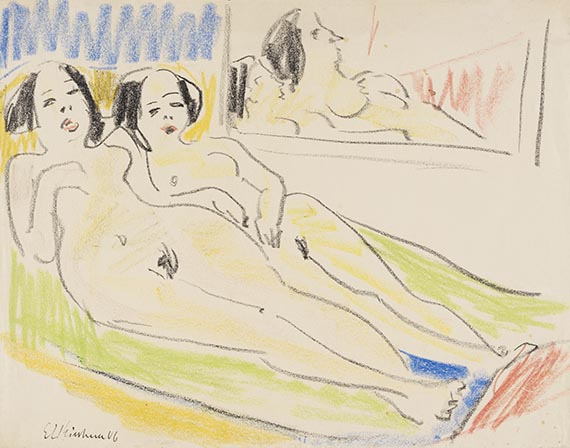
Zwei liegende Akte, Um 1909.
Black and color Chalks
Estimation: € 60,000 / $ 67,200
117
Ernst Ludwig Kirchner
Zwei liegende Akte, Um 1909.
Black and color Chalks
Estimation: € 60,000 / $ 67,200
Ernst Ludwig Kirchner
1880 - 1938
Zwei liegende Akte. Um 1909.
Black and color Chalks.
Signed in the lower left and predated “06” by the artist. 36.1 x 46.2 cm (14.2 x 18.1 in), the full sheet. [CH].
• A striking drawing from the artist’s Dresden studio.
• Formerly part of the collection of Dr. Frédéric Bauer, Davos, Kirchner’s physician, an important patron, and close confidant.
• The female nude in the studio was one of the primary motifs of E. L. Kirchner and the “Brücke” artists during these years.
• Using bold colors, a minimalist formal language, skillfully placed contour lines, hatching, and a sophisticated reflection, Kirchner composes a particularly charming, intimate scene.
• The drawing was created in direct connection with the paintings “Zwei liegende Akte” and “Zwei Akte auf Teppichen” (1909, Gordon 78 + 79).
The work is documented in the Ernst Ludwig Kirchner Archive, Wichtrach/Bern.
PROVENANCE: Collection of Dr. Frédéric Bauer, Davos.
Collection of Marianne and Gerhard Pinkus, New York.
Fischer Kunsthandel & Edition, Berlin (acquired from the above in 2005, Christie’s, London).
Private collection, Southern Germany (acquired from the above)
In the family’s possession ever since.
EXHIBITION: Sammlung Dr. F. Bauer, Davos; Nuremberg, 1952/1953; Munich; Freiburg im Breisgau; Mannheim, cat. no. 50 (with illustration).
Ernst Ludwig Kirchner. Painting, Drawings, and Prints, National Gallery of Art, Washington, D.C., May 3–August 16, 1992 (titled “Fränzi and Marcella on a Sofa”).
LITERATURE: Stuttgarter Kunstkabinett Roman Norbert Ketterer, Stuttgart, 18th Auction, Nov. 24–26, 1953, lot 1859.
Christie’s, London, June 23, 2005, lot 416 (with illustration).
Called up: December 5, 2026 - ca. 13.22 h +/- 20 min.
“The future burst out” – Studio Scenes and Kirchner’s Artistic View of the Modern City
Together with his fellow students Erich Heckel, Fritz Bleyl, and Karl Schmidt-Rottluff from the Dresden University of Technology, E. L. Kirchner founded the artists’ group “Brücke” in June 1905. During this time, they closely observed artistic innovations in the European art world. An exhibition at Galerie Arnold in Dresden featuring over 50 works by Vincent van Gogh proved pivotal for the young artists in 1905. One of their professors later recalled that his students had gone “wild” at the time. They began “to my dismay to draw in a most disorderly manner […]. But in truth, the future burst out at this point […].” (Fritz Schumacher, Stufen des Lebens. Erinnerungen eines Baumeisters, Stuttgart 1935, p. 283)
The atmosphere in the “Brücke” studio became quite boisterous and far from academic: the drawings grew more dynamic and were inspired by the moment. The human figure—particularly the female figure and the female nude—often took center stage. “People gathered to work in Kirchner’s studio, where they had the opportunity to study nudes, the foundation of all visual art, with complete freedom and authenticity. Drawing on this foundation gave rise to a shared sense among all of us that inspiration for our work came directly from life.” (E. L. Kirchner, 1913, Chronik KG Brücke, quoted from: Fritz Bleyl und die frühen Jahre der “Brücke,” Schleswig 1999, p. 19)
Kirchner found completely new means of expression—his unmistakable Expressionist visual language—through which he subjected German art of the time to a radical transformation and expressed his artistic goals—the immediate and unadulterated depiction of his observations—brilliantly and compellingly. The color drawings from the Dresden studio showcase him at the height of his artistic career.
In addition to the many female models who frequented his studio, Kirchner essentially captured everything he saw and experienced in his daily life: streetscapes in Dresden and later in Berlin, the Elbe River teeming with activity, and the cultural life in department stores, bars, variety shows, and dance halls—scenes of a changing world caught between tradition and modernization.
After moving to the exciting metropolis and cultural hub of Berlin, these two motifs—the shimmering cityscape and the female figure—which had been so central to his work up to that point, finally culminated in the “Street Scenes” of 1913–14, arguably Kirchner’s most famous works. [CH]


Commission, taxes et droit de suite
Cet objet est offert avec imposition régulière ou avec imposition différentielle.
Calcul en cas d'imposition différentielle:
Prix d’adjudication jusqu’à 1 000 000 euros : frais de vente 34 %.
Des frais de vente de 29% sont facturés sur la partie du prix d’adjudication dépassant 1 000 000 euros. Ils sont additionnés aux frais de vente dus pour la partie du prix d’adjudication allant jusqu’à 1 000 000 euros.
Des frais de vente de 22% sont facturés sur la partie du prix d’adjudication dépassant 4 000 000 euros. Ils sont additionnés aux frais de vente dus pour la partie du prix d’adjudication allant jusqu’à 4 000 000 euros.
La commission comprend la TVA, mais celle-ci n'est pas indiquée.
Calcul en cas d'imposition régulière:
Prix d'adjudication jusqu'à 1 000 000 € : 29 % de commission.
Prix d'adjudication supérieur à 1 000 000 € : montants partiels jusqu'à 1 000 000 € 29 % de commission, montants partiels supérieurs à 1 000 000 € : 23 % de commission.
Prix d'adjudication supérieur à 4.000 000 € : montants partiels supérieurs à 4.000 000 € : 15 % de commission.
La TVA légale de 7 % est prélevée sur la somme du prix d'adjudication et de la commission.
Si vous souhaitez appliquer l'imposition régulière, merci de bien vouloir le communiquer par écrit avant la facturation.
Calcul en cas de droit de suite:
Pour les œuvres originales d’arts plastiques et de photographie d’artistes vivants ou d’artistes décédés il y a moins de 70 ans, soumises au droit de suite, une rémunération au titre du droit de suite à hauteur des pourcentages indiqués au § 26, al. 2 de la loi allemande sur les droits d’auteur (UrhG) est facturée en sus pour compenser la rémunération liée au droit de suite due par le commissaire-priseur conformément au § 26 UrhG. À ce jour, elle est calculée comme suit :
4 pour cent pour la part du produit de la vente à partir de 400,00 euros et jusqu’à 50 000 euros,
3 pour cent supplémentaires pour la part du produit de la vente entre 50 000,01 et 200 000 euros,
1 pour cent supplémentaire pour la part entre 200 000,01 et 350 000 euros,
0,5 pour cent supplémentaire pour la part entre 350 000,01 et 500 000 euros et
0,25 pour cent supplémentaire pour la part au-delà de 500 000 euros.
Le total de la rémunération au titre du droit de suite pour une revente s’élève au maximum à 12 500 euros.