


Image du cadre
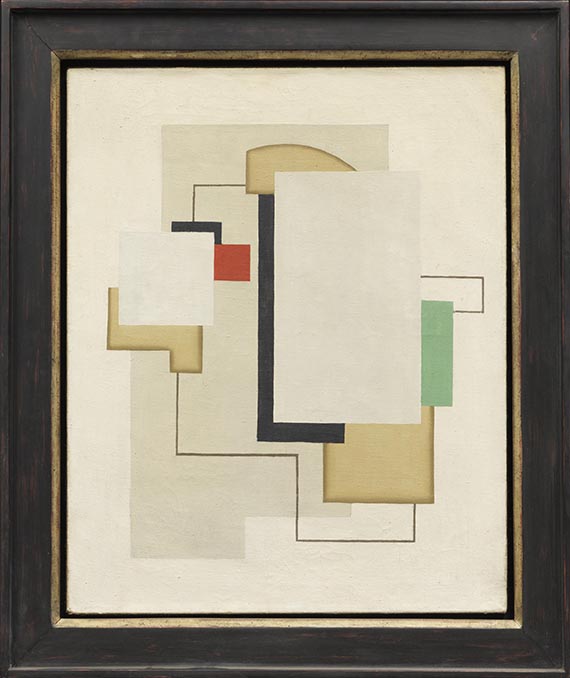
Raumbeispiel
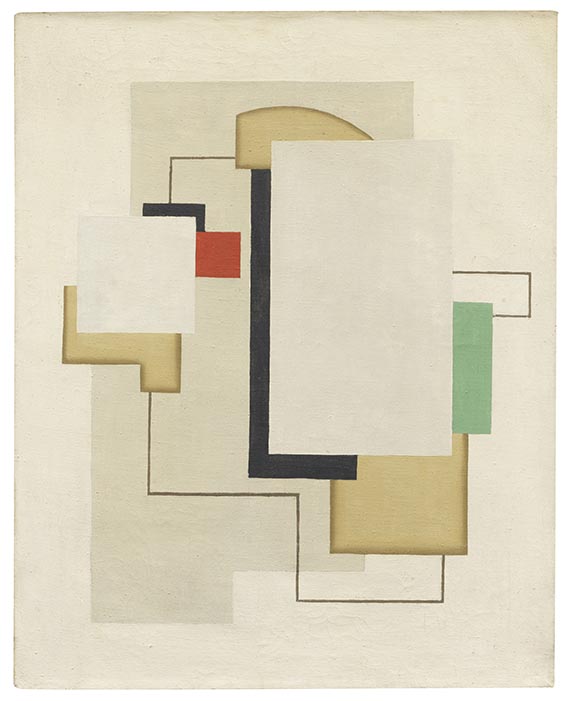
230
Willi Baumeister
Verspannung, 1921.
Oil on canvas
Estimation: € 90,000 / $ 100,800
230
Willi Baumeister
Verspannung, 1921.
Oil on canvas
Estimation: € 90,000 / $ 100,800
Willi Baumeister
1889 - 1955
Verspannung. 1921.
Oil on canvas.
Signed on the reverse of the canvas and monogrammed and dated on the stretcher. 69.5 x 55.5 cm (27.3 x 21.8 in). [AW].
• An early and iconic example of Willi Baumeister’s transition from a figurative to a geometrical style.
• From the significant series of works titled “Flächenkräfte” (1920–1925).
• “Verspannung” was included in the major retrospective at the Nationalgalerie in Berlin in 1989.
• Works from 1921 are held by, among others, the Kunstmuseum Stuttgart and the Museum of Modern Art, New York.
• Distinguished provenance: formerly part of the collection of Alfred Roth (1903–1998), a Swiss architect and designer and an important representative of the “Neues Bauen” movement.
• Offered on the international auction market for the first time (source: artprice.com).
We are grateful to Felicitas Baumeister and Hadwig Goez of the Baumeister Archive in Stuttgart for their kind expert advice.
PROVENANCE: Alfred Roth Collection, Zurich.
Private collection, North Rhine-Westphalia (acquired in 1995, Galerie Michael Haas, Berlin).
In the family’s possession ever since.
EXHIBITION: Willi Baumeister, Alte Nationalgalerie, Berlin, April 7–May 28, 1989, cat. no. 15 (with color ill. p. 139).
LITERATURE: Peter Beye, Felicitas Baumeister, Willi Baumeister. Catalogue raisonné of paintings, vol. II, Ostfildern 2002, CR no. 244 (with b&w ill., p. 108).
Will Grohmann, Willi Baumeister. Leben und Werk, Cologne 1963, CR no. 132 (with b&w illustration on p. 265.
Called up: December 5, 2026 - ca. 15.53 h +/- 20 min.
As a leading figure of abstraction in Germany, Willi Baumeister ranks among the most influential representatives of the interwar avant-garde. Influenced by early Constructivism, Cubism, and the clear formal language of artists such as Fernand Léger and Paul Klee, he developed a distinctive visual language of flat, floating forms and precisely rhythmic order.
The early 1920s marked a particularly productive phase in the development of the artist, who was born in Stuttgart in 1889. After returning from World War I, Baumeister completed his studies at the Stuttgart Academy of Art in 1920. As early as 1919, he was accepted into the Berlin artists’ association “Novembergruppe” led by Max Pechstein and, in the same year, founded the artists’ group “Üecht” with Oskar Schlemmer. At the same time, Baumeister began designing stage sets and costumes for the Stuttgart Theater—another field in which he experimented with his modern style.
Against this backdrop, we created our painting “Verspannung” in 1921. The work belongs to the “Flächenkräfte” (Surface Forces) series developed between 1920 and 1925 and exemplifies Baumeister’s artistic innovation in abstract composition. During this creative phase, he took the decisive step from figurative art toward a radically reduced, geometrically defined visual language. The title “Verspannung” already points to the central concern: the delicate yet dynamic balance of the pictorial surface.
In the composition, Baumeister arranges precisely contoured areas of color within a powerful network of relationships, modulating color and line to create a vibrant structural interplay. At the center is a narrow, black L-shaped area, surrounded by rectangles of varying shapes in finely graded, earthy shades of brown and gray. Delicate, precisely drawn lines encircle and connect these forms. A small red square on the left and a green rectangle on the right serve as accentuated color focal points and dynamically frame the composition. The concentrated use of color and clearly structured composition recall the sober conciseness and order of early Bauhaus works.
“Verspannung” was created during a period when Modernism's dynamics were intensifying in Germany in the aftermath of World War I. By then, Baumeister was already closely connected with leading figures of the European avant-garde and was beginning to establish himself internationally. Despite the later defamation and censorship of his art under National Socialism, he continued to work undeterred and, after 1945, became one of the most influential and well-known artistic figures of postwar German modernism. [AW]
Commission, taxes et droit de suite
Cet objet est offert avec imposition régulière ou avec imposition différentielle.
Calcul en cas d'imposition différentielle:
Prix d’adjudication jusqu’à 1 000 000 euros : frais de vente 34 %.
Des frais de vente de 29% sont facturés sur la partie du prix d’adjudication dépassant 1 000 000 euros. Ils sont additionnés aux frais de vente dus pour la partie du prix d’adjudication allant jusqu’à 1 000 000 euros.
Des frais de vente de 22% sont facturés sur la partie du prix d’adjudication dépassant 4 000 000 euros. Ils sont additionnés aux frais de vente dus pour la partie du prix d’adjudication allant jusqu’à 4 000 000 euros.
La commission comprend la TVA, mais celle-ci n'est pas indiquée.
Calcul en cas d'imposition régulière:
Prix d'adjudication jusqu'à 1 000 000 € : 29 % de commission.
Prix d'adjudication supérieur à 1 000 000 € : montants partiels jusqu'à 1 000 000 € 29 % de commission, montants partiels supérieurs à 1 000 000 € : 23 % de commission.
Prix d'adjudication supérieur à 4.000 000 € : montants partiels supérieurs à 4.000 000 € : 15 % de commission.
La TVA légale de 7 % est prélevée sur la somme du prix d'adjudication et de la commission.
Si vous souhaitez appliquer l'imposition régulière, merci de bien vouloir le communiquer par écrit avant la facturation.
Calcul en cas de droit de suite:
Pour les œuvres originales d’arts plastiques et de photographie d’artistes vivants ou d’artistes décédés il y a moins de 70 ans, soumises au droit de suite, une rémunération au titre du droit de suite à hauteur des pourcentages indiqués au § 26, al. 2 de la loi allemande sur les droits d’auteur (UrhG) est facturée en sus pour compenser la rémunération liée au droit de suite due par le commissaire-priseur conformément au § 26 UrhG. À ce jour, elle est calculée comme suit :
4 pour cent pour la part du produit de la vente à partir de 400,00 euros et jusqu’à 50 000 euros,
3 pour cent supplémentaires pour la part du produit de la vente entre 50 000,01 et 200 000 euros,
1 pour cent supplémentaire pour la part entre 200 000,01 et 350 000 euros,
0,5 pour cent supplémentaire pour la part entre 350 000,01 et 500 000 euros et
0,25 pour cent supplémentaire pour la part au-delà de 500 000 euros.
Le total de la rémunération au titre du droit de suite pour une revente s’élève au maximum à 12 500 euros.