


Image du cadre
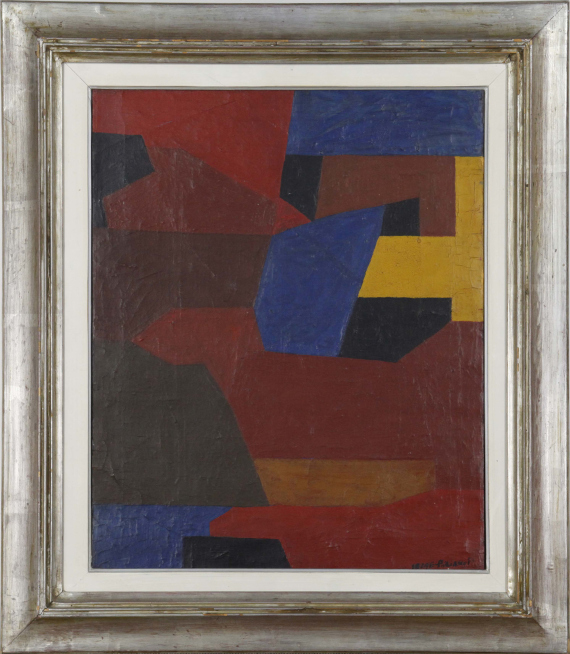
Raumbeispiel
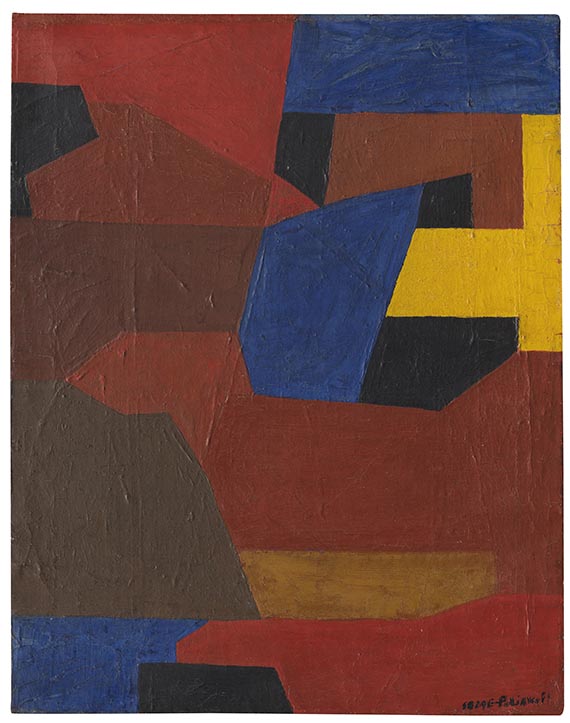
322
Serge Poliakoff
Composition multicolore, 1950.
Oil on canvas
Estimation: € 80,000 / $ 89,600
322
Serge Poliakoff
Composition multicolore, 1950.
Oil on canvas
Estimation: € 80,000 / $ 89,600
Serge Poliakoff
1900 - 1969
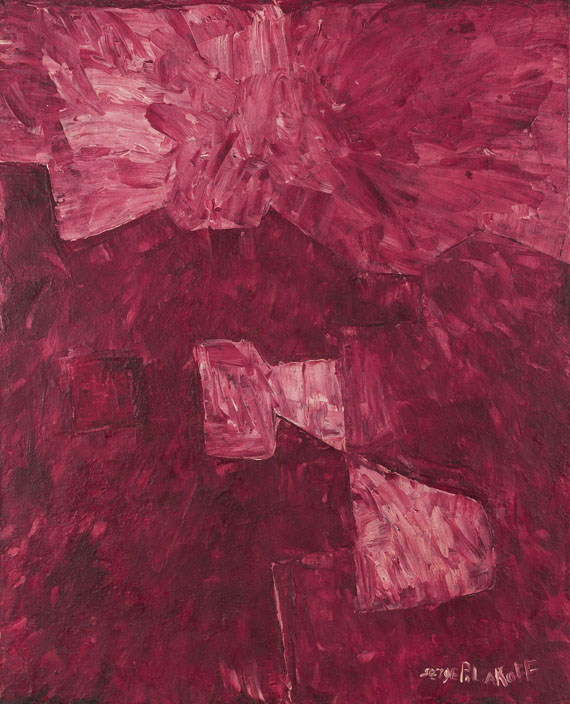
Composition multicolore. 1950.
Oil on canvas.
Signed in the lower right. 62 x 50 cm (24.4 x 19.6 in). [AW].
• A compelling early composition—beginning in 1950, Poliakoff expanded his palette to include vibrant yet contrasting hues.
• A captivating and dynamic interplay of color and geometry.
• The radiant works from the 1950s are the artist’s most sought-after pieces on the international auction market.
• Paintings from the 1950s are held in major museum collections, including the Tate Modern, London; the Centre Pompidou, Paris; the Phillips Collection, Washington, D.C.; the Solomon R. Guggenheim Museum; and the Museum of Modern Art, New York.
• Part of a distinguished Berlin private collection for nearly 40 years.
Accompanied by a photographic certificate of authenticity issued by Alexis Poliakoff, Paris, on April 10, 1987. The work is registered in the archive there under the number “950006”.
PROVENANCE: Nuova BrerArte, Milan.
Private collection, Berlin (acquired from the above in 1986).
From a German collection (acquired from the above).
LITERATURE: Alexis Poliakoff, Serge Poliakoff. Catalogue raisonné, vol. 1: 1922–1954, Paris 2004, CR no. 50-04 (with color illustration on p. 336).
“Many people say that there is nothing to see in abstract painting. If it were up to me, I could live three times as long and still not have said everything I see.”
Serge Poliakoff, quoted from: Künstler. Kritisches Lexikon der Gegenwartskunst, Issue 31, no. 21, III 1995, p. 2
Called up: December 5, 2026 - ca. 17.56 h +/- 20 min.
Vibrant color fields collide and interlock in a dynamic composition, forming rhythms that are partly orderly, partly disorderly, yet always charged with tension. Using these techniques, Serge Poliakoff developed a highly individual form of abstract painting characterized by a high recognition value. A bright yellow field of color on the right edge is artfully interlocked with blue and black. Next to it, polygonal fields of color in earth tones of red and brown interlock, foreshadowing his later work, which is characterized by a reduction of polychrome hues to monochrome in earth tones. However, our “Composition multicolore” from 1950 can be regarded as an outstanding piece from Poliakoff’s early period, characterized by clearly contoured, gently merging color fields. Gradually intensifying towards the center of the painting, form and color unite to create a harmonious whole.
Before Poliakoff was able to dedicate his life to art again in Paris from 1923 onwards, his existence was marked by turbulence. After attending painting classes in Moscow in 1914, he found the political situation in Russia becoming increasingly tense, prompting him to flee the country following the November Revolution in 1920. After various stops along his way, he eventually made his way to Paris, where he was finally able to resume his studies in painting. Inspired by formative encounters with other artists such as Robert and Sonia Delaunay, Wassily Kandinsky, and Otto Freundlich, Poliakoff's interest in the expressive power of color grew in the 1930s, leading his work to become more abstract after its figurative beginnings. While he still tended to use shades of gray in the 1940s, from 1950 onwards he expanded his spectrum to include bright and contrasting tones, as can be clearly seen in our early composition. However, the 1950s were not only a turning point in Serge Poliakoff's life from a purely artistic point of view. Having had to earn a living with his music since his emigration, he was not able to devote himself entirely to painting until the early 1950s. The first exhibition of his abstract works opened in Paris in 1945, followed by major solo exhibitions in New York and Brussels in 1953. Serge Poliakoff became a key representative of the Nouvelle École de Paris and, until he died in 1969, rose to become one of the most significant protagonists of European Color Field painting. [AW]
Before Poliakoff was able to dedicate his life to art again in Paris from 1923 onwards, his existence was marked by turbulence. After attending painting classes in Moscow in 1914, he found the political situation in Russia becoming increasingly tense, prompting him to flee the country following the November Revolution in 1920. After various stops along his way, he eventually made his way to Paris, where he was finally able to resume his studies in painting. Inspired by formative encounters with other artists such as Robert and Sonia Delaunay, Wassily Kandinsky, and Otto Freundlich, Poliakoff's interest in the expressive power of color grew in the 1930s, leading his work to become more abstract after its figurative beginnings. While he still tended to use shades of gray in the 1940s, from 1950 onwards he expanded his spectrum to include bright and contrasting tones, as can be clearly seen in our early composition. However, the 1950s were not only a turning point in Serge Poliakoff's life from a purely artistic point of view. Having had to earn a living with his music since his emigration, he was not able to devote himself entirely to painting until the early 1950s. The first exhibition of his abstract works opened in Paris in 1945, followed by major solo exhibitions in New York and Brussels in 1953. Serge Poliakoff became a key representative of the Nouvelle École de Paris and, until he died in 1969, rose to become one of the most significant protagonists of European Color Field painting. [AW]
Commission, taxes et droit de suite
Cet objet est offert avec imposition régulière ou avec imposition différentielle.
Calcul en cas d'imposition différentielle:
Prix d’adjudication jusqu’à 1 000 000 euros : frais de vente 34 %.
Des frais de vente de 29% sont facturés sur la partie du prix d’adjudication dépassant 1 000 000 euros. Ils sont additionnés aux frais de vente dus pour la partie du prix d’adjudication allant jusqu’à 1 000 000 euros.
Des frais de vente de 22% sont facturés sur la partie du prix d’adjudication dépassant 4 000 000 euros. Ils sont additionnés aux frais de vente dus pour la partie du prix d’adjudication allant jusqu’à 4 000 000 euros.
La commission comprend la TVA, mais celle-ci n'est pas indiquée.
Calcul en cas d'imposition régulière:
Prix d'adjudication jusqu'à 1 000 000 € : 29 % de commission.
Prix d'adjudication supérieur à 1 000 000 € : montants partiels jusqu'à 1 000 000 € 29 % de commission, montants partiels supérieurs à 1 000 000 € : 23 % de commission.
Prix d'adjudication supérieur à 4.000 000 € : montants partiels supérieurs à 4.000 000 € : 15 % de commission.
La TVA légale de 7 % est prélevée sur la somme du prix d'adjudication et de la commission.
Si vous souhaitez appliquer l'imposition régulière, merci de bien vouloir le communiquer par écrit avant la facturation.
Calcul en cas de droit de suite:
Pour les œuvres originales d’arts plastiques et de photographie d’artistes vivants ou d’artistes décédés il y a moins de 70 ans, soumises au droit de suite, une rémunération au titre du droit de suite à hauteur des pourcentages indiqués au § 26, al. 2 de la loi allemande sur les droits d’auteur (UrhG) est facturée en sus pour compenser la rémunération liée au droit de suite due par le commissaire-priseur conformément au § 26 UrhG. À ce jour, elle est calculée comme suit :
4 pour cent pour la part du produit de la vente à partir de 400,00 euros et jusqu’à 50 000 euros,
3 pour cent supplémentaires pour la part du produit de la vente entre 50 000,01 et 200 000 euros,
1 pour cent supplémentaire pour la part entre 200 000,01 et 350 000 euros,
0,5 pour cent supplémentaire pour la part entre 350 000,01 et 500 000 euros et
0,25 pour cent supplémentaire pour la part au-delà de 500 000 euros.
Le total de la rémunération au titre du droit de suite pour une revente s’élève au maximum à 12 500 euros.