


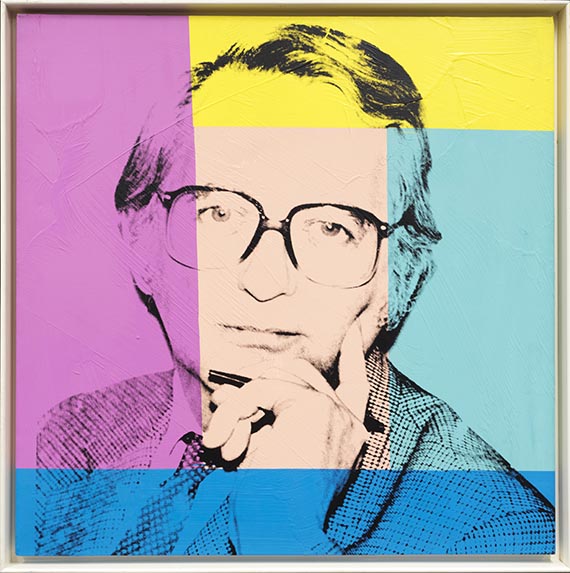
Image du cadre
Raumbeispiel
242
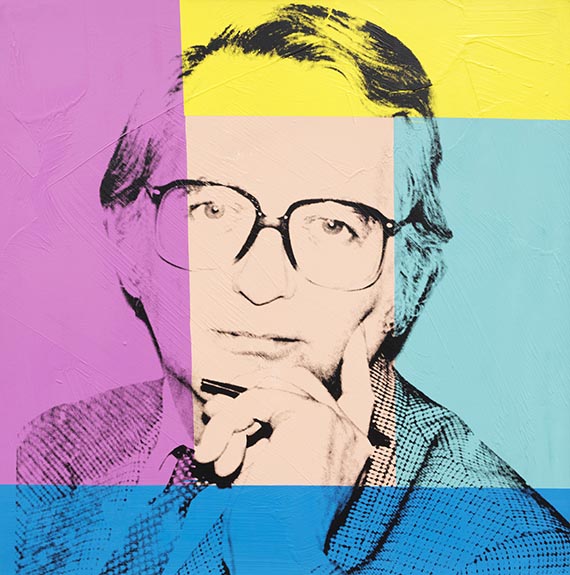
Andy Warhol
Porträt von Karl Ludwig Schweisfurth, 1980.
Oil on canvas and silkscreen ink on canvas
Estimation: € 80,000 / $ 89,600
242
Andy Warhol
Porträt von Karl Ludwig Schweisfurth, 1980.
Oil on canvas and silkscreen ink on canvas
Estimation: € 80,000 / $ 89,600
Andy Warhol
1928 - 1987
Porträt von Karl Ludwig Schweisfurth. 1980.
Oil on canvas and silkscreen ink on canvas.
Signed and dated on the folded canvas. 102 x 101.5 cm (40.1 x 39.9 in). [EH].
• One-of-a-kind.
• Andy Warhol is one of the most famous and influential artists of the 20th century.
• Andy Warhol had a lasting impact on 20th-century portraiture.
• Andy Warhol gained particular fame for his distinctive portraits.
PROVENANCE: Private collection, Southern Germany
From a Swiss collection.
Called up: December 5, 2026 - ca. 16.09 h +/- 20 min.
In the 1970s, Warhol returned to panel painting. As with his prints, he also favored portraits in his paintings, creating not only numerous self-portraits but also iconic portraits of people such as Jackie Kennedy, Mick Jagger, and Joseph Beuys, all in his signature Pop Art style. But Andy Warhol also immortalized lesser-known figures, as he accepted commissioned works. What used to be an exclusive privilege has become a highly sought-after collector’s item.
This portrait depicts the slaughterhouse owner and art collector Karl Ludwig Schweisfurth. Warhol depicts him as a pensive man and, in doing so, captures the essence of his personality. Schweisfurth, a trained butcher, inherited the “Fleischwaren- und Konserven-Fabrick L. Schweisfurth”, founded in 1902, and made it Europe’s largest meat-processing company under the name “Herta”. However, he was also the first to pull out of the industry, which is viewed so critically today: as early as 1984, Karl Ludwig Schweisfurth began to question the lucrative production methods and sold everything to Nestlé; soon afterward, he founded the Hermannsdorfer Werkstätten, an agricultural enterprise that operates according to biodynamic principles and a strong commitment to animal welfare.
His love of art became apparent in the construction of the new Herta administrative building, designed by Walter Ruhnau, and in its interior design. Renowned artists such as Christo and Wolf Vostell made their own unique—and often critical—artistic contributions to the project.
“He was certainly no ordinary slaughterhouse owner: Karl Ludwig Schweisfurth displayed his art collection right in the middle of Herta’s production facilities. From then on, the butchers worked with a view of portraits by Andy Warhol” (quoted from: Vanity Fair, October 2007, p. 84). Andy Warhol also visited his client and was deeply impressed by Karl Ludwig Schweisfurth and his art collection, as can be read in Warhol’s diary (see Das Buch der Tagebücher: Ausgewählt von Rainer Wieland, Munich 2010, p. 83). [EH]

Commission, taxes et droit de suite
Cet objet est offert avec imposition régulière.
Calcul en cas d'imposition régulière:
Prix d’adjudication jusqu’à 1 000 000 euros : frais de vente 29%.
Des frais de vente de 23% sont facturés sur la partie du prix d’adjudication dépassant 1 000 000 euros. Ils sont additionnés aux frais de vente dus pour la partie du prix d’adjudication allant jusqu’à 1 000 000 euros.
Des frais de vente de 15 % sont facturés sur la partie du prix d’adjudication dépassant 4 000 000 euros. Ils sont additionnés aux frais de vente dus pour la partie du prix d’adjudication allant jusqu’à 4 000 000 euros.
La taxe sur la valeur ajoutée allemande, actuellement de 7 %, est perçue sur la somme du prix d’adjudication et des frais de vente.
Pour les entreprises habilitées à déduire la TVA, le régime fiscal général peut être appliqué.
Calcul en cas de droit de suite:
Pour les œuvres originales d’arts plastiques et de photographie d’artistes vivants ou d’artistes décédés il y a moins de 70 ans, soumises au droit de suite, une rémunération au titre du droit de suite à hauteur des pourcentages indiqués au § 26, al. 2 de la loi allemande sur les droits d’auteur (UrhG) est facturée en sus pour compenser la rémunération liée au droit de suite due par le commissaire-priseur conformément au § 26 UrhG. À ce jour, elle est calculée comme suit :
4 pour cent pour la part du produit de la vente à partir de 400,00 euros et jusqu’à 50 000 euros,
3 pour cent supplémentaires pour la part du produit de la vente entre 50 000,01 et 200 000 euros,
1 pour cent supplémentaire pour la part entre 200 000,01 et 350 000 euros,
0,5 pour cent supplémentaire pour la part entre 350 000,01 et 500 000 euros et
0,25 pour cent supplémentaire pour la part au-delà de 500 000 euros.
Le total de la rémunération au titre du droit de suite pour une revente s’élève au maximum à 12 500 euros.