


Image du cadre
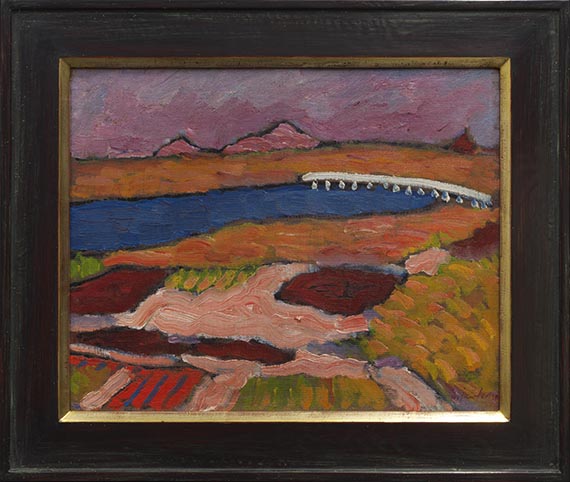
Raumbeispiel
148
Alexej von Jawlensky
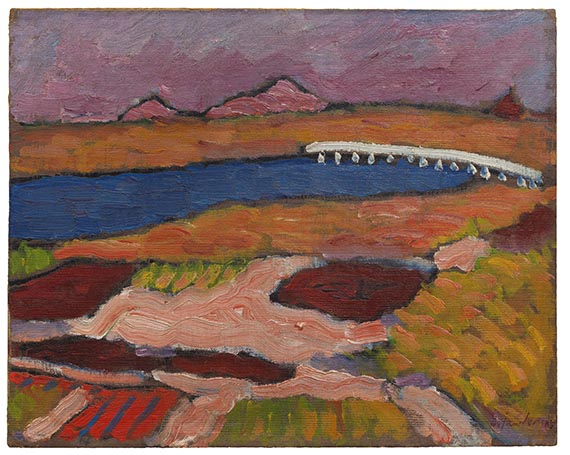
Prerow (Darß) Pommern, 1911.
Oil on canvas, originally mounted on cardboard
Estimation: € 100,000 / $ 112,000
148
Alexej von Jawlensky
Prerow (Darß) Pommern, 1911.
Oil on canvas, originally mounted on cardboard
Estimation: € 100,000 / $ 112,000
Alexej von Jawlensky
1864 - 1941
Prerow (Darß) Pommern. 1911.
Oil on canvas, originally mounted on cardboard.
Signed in the lower right. Titled and barely legibly inscribed “Fluss + Brücke” (River + Bridge) on the reverse. 32.4 x 40.8 cm (12.7 x 16 in). [AW].
• Rare early expressionist landscape from the “Blauer Reiter” period.
• Jawlensky considered the landscapes that he had painted in Prerow in 1911 to be his best.
• At the height of his creativity: painting that is maximally detached from nature, with free use of color and form.
• Works from this period in Prerow on the Baltic Sea are held in renowned museum collections, including the National Museum, Cardiff, the Museum Wiesbaden, and the Kunstmuseum Basel.
Accompanied by a written certificate of authenticity issued by Angelica Jawlensky Bianconi, Alexej von Jawlensky-Archive S.A., Muralto, dated September 3, 2018. The work is included in Alexej von Jawlensky’s catalogue raisonné.
PROVENANCE: Redfern Gallery, London (1956).
Galerie Beyeler, Basel (1957).
Private collection, USA (acquired from the above in 1957).
Dietmar Manke Collection, Schleswig-Holstein (acquired from the above).
EXHIBITION: Alexej von Jawlensky 1864–1941, Redfern Gallery, London, 2.5.-2.6.1956, probably cat. no. 15 ("Pnerow Costsee Pommern").
Alexej von Jawlensky 1864–1941, Galerie Beyeler, Basel, Jan./Feb. 1957, cat. no. 21 ("Prerow (Fluß mit weißer Brücke)"; on the reverse, two gallery labels, incorrectly labeled with cat. no. 20).
Michael Ayrton. Jawlensky. Vieira da Silva, Redfern Gallery, London, June/July 1959, probably cat. no. 58 ("Pnerow an den Ostsee").
Called up: December 5, 2026 - ca. 14.04 h +/- 20 min.
Alexej von Jawlensky and Marianne von Werefkin spent the summer of 1911 in Prerow on the Darß peninsula in the Baltic Sea. After spending time with Wassily Kandinsky and Gabriele Münter in Murnau, Jawlensky sought new inspiration on the Baltic coast. In his memoirs, he describes this period as pivotal to his artistic development:
“That summer marked a major development in my art. I painted my best landscapes there, as well as large figurative works in strong, vibrant colors—absolutely not naturalistic or textural. I used a great deal of red, blue, orange, cadmium yellow, and chrome oxide green. The forms were sharply contoured with Prussian blue and emerged from an intense inner ecstasy. […] This was a pivotal moment in my art. And up until 1914, just before the war, I painted my most powerful works […] in those years.” (Alexej von Jawlensky, Lebenserinnerungen [Memoirs], quoted from: Clemens Weiler, Jawlensky. Köpfe – Gesichte – Meditationen [Heads – Faces – Meditations], Hanau 1970, p. 112)
Our work is a striking testimony to this “turning point” toward an autonomous, expressive use of color. It shows the hinterland of the coastal town with the Prerow River, which once connected the Baltic Sea and the lagoon. Jawlensky does not depict the landscape with precise topographical detail: sandy beaches, narrow paths, and what might be fishermen’s cottages remain only vaguely recognizable. The decisive aspect is how color and contour organize the motif while also bringing it to life. The palette intensifies with high-contrast tones: ochre and burnt sienna meet salmon pink and deep blue. The result is a landscape that describes less a specific place than it conveys its sensual and emotional quality. Sky and foreground seem to engage in a dynamic interplay. Although no figures are depicted, the brushwork lends the scene palpable vitality.
Simplified forms and color detached from representational reality point toward abstraction. At the same time, echoes of Jawlensky’s engagement with Vincent van Gogh are still discernible. The clear composition, focused on the pictorial surface, shows how Jawlensky developed his visual language independently. While the portrait gained increasing importance in his work during this period, the 1911 landscape proved a key part of this renewal. In this work, the impressions from his stay on the Baltic Sea coalesce into a multi-layered exploration of color, form, and sensation—one of his “best landscapes,” as Jawlensky himself wrote. [AW]
Commission, taxes et droit de suite
Cet objet est offert avec imposition régulière ou avec imposition différentielle.
Calcul en cas d'imposition différentielle:
Prix d’adjudication jusqu’à 1 000 000 euros : frais de vente 34 %.
Des frais de vente de 29% sont facturés sur la partie du prix d’adjudication dépassant 1 000 000 euros. Ils sont additionnés aux frais de vente dus pour la partie du prix d’adjudication allant jusqu’à 1 000 000 euros.
Des frais de vente de 22% sont facturés sur la partie du prix d’adjudication dépassant 4 000 000 euros. Ils sont additionnés aux frais de vente dus pour la partie du prix d’adjudication allant jusqu’à 4 000 000 euros.
La commission comprend la TVA, mais celle-ci n'est pas indiquée.
Calcul en cas d'imposition régulière:
Prix d'adjudication jusqu'à 1 000 000 € : 29 % de commission.
Prix d'adjudication supérieur à 1 000 000 € : montants partiels jusqu'à 1 000 000 € 29 % de commission, montants partiels supérieurs à 1 000 000 € : 23 % de commission.
Prix d'adjudication supérieur à 4.000 000 € : montants partiels supérieurs à 4.000 000 € : 15 % de commission.
La TVA légale de 7 % est prélevée sur la somme du prix d'adjudication et de la commission.
Si vous souhaitez appliquer l'imposition régulière, merci de bien vouloir le communiquer par écrit avant la facturation.
Calcul en cas de droit de suite:
Pour les œuvres originales d’arts plastiques et de photographie d’artistes vivants ou d’artistes décédés il y a moins de 70 ans, soumises au droit de suite, une rémunération au titre du droit de suite à hauteur des pourcentages indiqués au § 26, al. 2 de la loi allemande sur les droits d’auteur (UrhG) est facturée en sus pour compenser la rémunération liée au droit de suite due par le commissaire-priseur conformément au § 26 UrhG. À ce jour, elle est calculée comme suit :
4 pour cent pour la part du produit de la vente à partir de 400,00 euros et jusqu’à 50 000 euros,
3 pour cent supplémentaires pour la part du produit de la vente entre 50 000,01 et 200 000 euros,
1 pour cent supplémentaire pour la part entre 200 000,01 et 350 000 euros,
0,5 pour cent supplémentaire pour la part entre 350 000,01 et 500 000 euros et
0,25 pour cent supplémentaire pour la part au-delà de 500 000 euros.
Le total de la rémunération au titre du droit de suite pour une revente s’élève au maximum à 12 500 euros.