


Verso
Autre image
Autre image
Autre image
Autre image
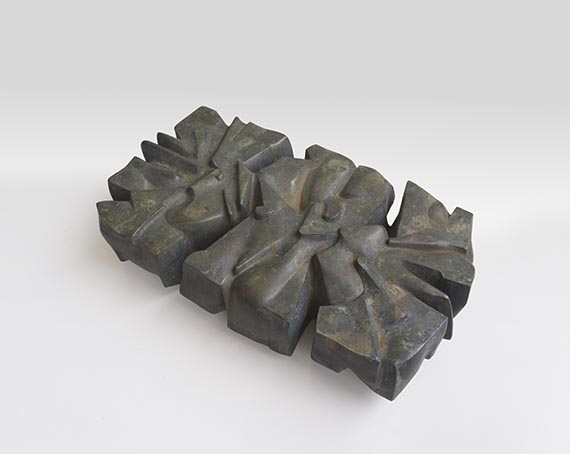
233
Fritz Koenig
Landschaft I, 1964.
Bronze with black-green patina
Estimation: € 80,000 / $ 89,600
233
Fritz Koenig
Landschaft I, 1964.
Bronze with black-green patina
Estimation: € 80,000 / $ 89,600
Fritz Koenig
1924 - 2017
Landschaft I. 1964.
Bronze with black-green patina.
With the embossed monogram. Unique object. 17 x 97 x 52 cm (6.6 x 38.1 x 20.4 in). [AW].
• Unique artwork.
• In Fritz Koenig’s work, landscapes become powerful, fragmentary abstractions.
• 1964: Participated in documenta III in Kassel and the 32nd Venice Biennale; appointed to the Technical University of Munich.
• “Large Landscape I” was also created that same year; today it is located in front of the Technical University of Munich.
• Koenig’s bronzes are held in major museums and collections, including the Peggy Guggenheim Collection in Venice, the Neue Nationalgalerie in Berlin, and the Museum of Modern Art in New York.
PROVENANCE: Private collection, Baden-Württemberg (acquired directly from the artist).
Private collection acquired from the above).
LITERATURE: Dietrich Clarenbach, Fritz Koenig. Skulpturen. Catalogue raisonné, Munich 2003, CR no. 339 (no. illustration).
Called up: December 5, 2026 - ca. 15.57 h +/- 20 min.
Fritz Koenig’s sculptural work is characterized by his pursuit of a form that unites geometric order and organic life. This tension is particularly evident in the group of works titled “Landschaften” (Landscapes), which includes the present work, “Landschaft I” . Since the 1960s, Koenig developed an abstract repertoire of forms that does not mimic nature but rather translates its elementary structures and forces into a concentrated sculptural language.
As one of the most significant German sculptors of the postwar period, Koenig decisively influenced the development of modern sculpture. He gained international recognition with his participation in the XXIX. Venice Biennale in 1958 and documenta II in Kassel in 1959. The year 1964 marked a particular milestone: Koenig participated in documenta 3 in Kassel and the XXXII Venice Biennale, and was simultaneously appointed to the Chair of Visual Design at the Faculty of Architecture of the Technical University of Munich. Another factor contributing to his worldwide renown as a sculptor is his works in public spaces. These include the “Große Kugelkaryatide N.Y.” (1968/1972) for the World Trade Center fountain, which—now only slightly damaged—has been integrated into the 9/11 Memorial Park in New York as a memorial to the terrorist attacks of 2001.
The “Landscapes” from the series of the same name are characterized by block-like, clearly structured forms. Their closed volumes appear both static and dynamic. They recall natural rock formations, tectonic strata, or other natural formations composed of interconnected elements. Here, “landscape” is not understood as a representation of an external natural space, but as a symbol of a creative principle in which order, growth, and movement intertwine.
Central to his work is the tension between geometric rigor and a reference to physicality. Although Koenig increasingly abstracts nature, his formal vocabulary remains directly perceptible. The sculptural mass has weight and presence, yet the individual elements seem to interact dynamically, creating the impression of a condensed, self-contained world.
The choice of material is also crucial to the impact of the landscapes. While Koenig favored bronze in his earlier works, he later increasingly turned to the more brittle iron, its resistant surface and angular structure supporting the block-like formal language. A larger version of the “Landscape I” offered here is located on the campus of the Technical University of Munich. [AW]
Commission, taxes et droit de suite
Cet objet est offert avec imposition régulière ou avec imposition différentielle.
Calcul en cas d'imposition différentielle:
Prix d’adjudication jusqu’à 1 000 000 euros : frais de vente 34 %.
Des frais de vente de 29% sont facturés sur la partie du prix d’adjudication dépassant 1 000 000 euros. Ils sont additionnés aux frais de vente dus pour la partie du prix d’adjudication allant jusqu’à 1 000 000 euros.
Des frais de vente de 22% sont facturés sur la partie du prix d’adjudication dépassant 4 000 000 euros. Ils sont additionnés aux frais de vente dus pour la partie du prix d’adjudication allant jusqu’à 4 000 000 euros.
La commission comprend la TVA, mais celle-ci n'est pas indiquée.
Calcul en cas d'imposition régulière:
Prix d'adjudication jusqu'à 1 000 000 € : 29 % de commission.
Prix d'adjudication supérieur à 1 000 000 € : montants partiels jusqu'à 1 000 000 € 29 % de commission, montants partiels supérieurs à 1 000 000 € : 23 % de commission.
Prix d'adjudication supérieur à 4.000 000 € : montants partiels supérieurs à 4.000 000 € : 15 % de commission.
La TVA légale de 7 % est prélevée sur la somme du prix d'adjudication et de la commission.
Si vous souhaitez appliquer l'imposition régulière, merci de bien vouloir le communiquer par écrit avant la facturation.
Calcul en cas de droit de suite:
Pour les œuvres originales d’arts plastiques et de photographie d’artistes vivants ou d’artistes décédés il y a moins de 70 ans, soumises au droit de suite, une rémunération au titre du droit de suite à hauteur des pourcentages indiqués au § 26, al. 2 de la loi allemande sur les droits d’auteur (UrhG) est facturée en sus pour compenser la rémunération liée au droit de suite due par le commissaire-priseur conformément au § 26 UrhG. À ce jour, elle est calculée comme suit :
4 pour cent pour la part du produit de la vente à partir de 400,00 euros et jusqu’à 50 000 euros,
3 pour cent supplémentaires pour la part du produit de la vente entre 50 000,01 et 200 000 euros,
1 pour cent supplémentaire pour la part entre 200 000,01 et 350 000 euros,
0,5 pour cent supplémentaire pour la part entre 350 000,01 et 500 000 euros et
0,25 pour cent supplémentaire pour la part au-delà de 500 000 euros.
Le total de la rémunération au titre du droit de suite pour une revente s’élève au maximum à 12 500 euros.