


Image du cadre
Raumbeispiel
119
Ernst Ludwig Kirchner
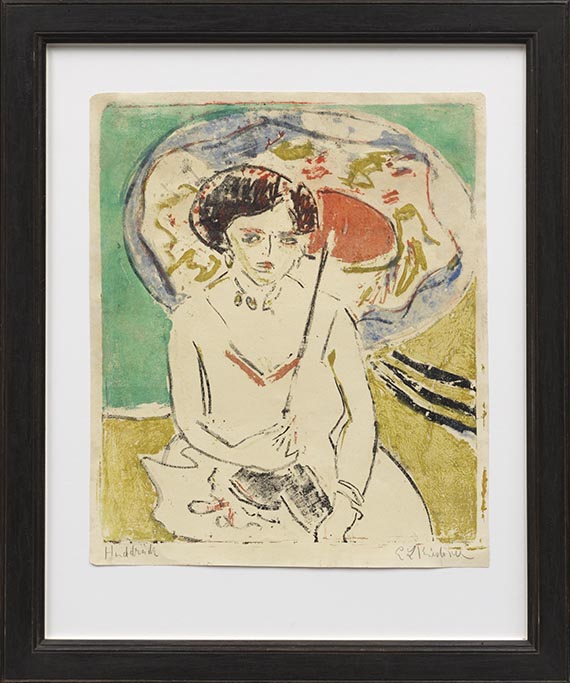
Dodo mit japanischem Schirm, 1909.
Lithograph in colors. Color print made from the...
Estimation: € 200,000 / $ 224,000
119
Ernst Ludwig Kirchner
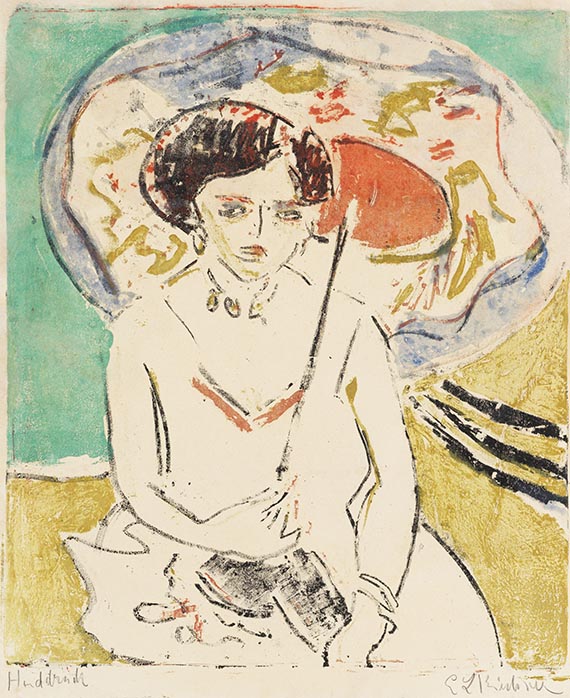
Dodo mit japanischem Schirm, 1909.
Lithograph in colors. Color print made from the...
Estimation: € 200,000 / $ 224,000
Ernst Ludwig Kirchner
1880 - 1938
Dodo mit japanischem Schirm. 1909.
Lithograph in colors. Color print made from the same stone in five passes: black, gray-blue, red, turquoise, and yellow.
Signed and inscribed “Handdruck”. One of only six known copies of this color lithograph and one of only two known copies in this color combination. The individual primary colors are tinted differently, so that all copies differ from one another. 38.1 x 32.4 cm (15 x 12.7 in). Sheet: 41,1 x 34,4 cm (16,1 x 13,5 in).
[CH].
• A rare print from the golden age of the “Brücke” in Dresden: One of only six known copies of this color lithograph.
• Hand-printed by the artist.
• Doris Große, affectionately called “Dodo”, was E. L. Kirchner’s lover and favorite model in Dresden.
• To date, only two other copies of this rare print have been offered on the international auction market (source: artprice.com).
• Kirchner also used this striking motif, with slight variations, in the paintings created around the same time, “Girl Under a Japanese Umbrella” (Kunstsammlung Nordrhein-Westfalen) and “Girl Under a Parasol” (whereabouts unknown).
PROVENANCE: Private collection, USA.
Private collection, Southern Germany (acquired from the above in 2013, Hauswedell & Nolte, Hamburg).
In the family’s possession ever since.
LITERATURE: Günther Gercken, Ernst Ludwig Kirchner. Kritisches Werkverzeichnis der Druckgraphik, vol. 2 (1909–1911), Bern 2013, CR no. 387 b (of c, with illu., different copy).
Annemarie and Wolf-Dieter Dube, E. L. Kirchner. Das graphische Werk, Munich 1967, WVZ No. L 135.
Gustav Schiefler, Die Graphik Ernst Ludwig Kirchners, vol. 1 (through 1916), Berlin-Charlottenburg 1926, CR no. L 83.
- -
Kunstverein für die Rheinlande und Westfalen, Düsseldorf (ed.), Exhibition catalog: Ernst Ludwig Kirchner, Kunsthalle Düsseldorf, Düsseldorf 1960 (with illustration, different copy).
Lothar Grisebach, E. L. Kirchner’s Davoser Tagebuch. Eine Darstellung des Malers und eine Sammlung seiner Schriften, Cologne 1968.
Nationalgalerie, Staatliche Museen Preußischer Kulturbesitz, Berlin (ed.), Exhibition catalog: Ernst Ludwig Kirchner, Nationalgalerie, Berlin; Haus der Kunst, Munich; Museum Ludwig, Cologne; Kunsthaus Zürich, 1979/1980, Berlin 1979 (with ill., different copy).
Magdalena M. Moeller, Foreword, in: Ernst Ludwig Kirchner. Meisterwerke der Druckgraphik, Stuttgart 1990, p. 73 (with ill., different copy).
Gerd Presler, Ernst Ludwig Kirchner. Seine Frauen, seine Modelle, seine Bilder, Munich 1990.
Lucius Grisebach, Ernst Ludwig Kirchner 1880–1938, Cologne 1999, p. 36 (with ill., different copy).
Christie’s, London, German and Austrian Art Auction, Oct. 11, 2001, lot 27 (with ill.).
Hauswedell & Nolte, Hamburg, Modern Art Auction, June 5, 2013, lot 50 (with illustration).
Günther Gercken, in: Exhibition catalog Ernst Ludwig Kirchner. Farbige Druckgraphik, Brücke Museum Berlin; Paula Modersohn-Becker Museum, Kunstsammlungen Böttcherstraße, Bremen, Munich 2008, cat. nos. 119–121 (with ill., different copy).
“The best way to get to know an artist is through his prints.”
Ernst Ludwig Kirchner under the pseudonym Louis de Marsalle, Über Kirchners Graphik, quoted from: Exhibition catalog Ernst Ludwig Kirchner. Farbige Druckgraphik, Brücke Museum Berlin / Paula Modersohn-Becker Museum Bremen, Munich 2008, p. 8.
Called up: December 5, 2026 - ca. 13.25 h +/- 20 min.
“The Most Important German Graphic Artist of the 20th Century”
“With his consistent, magnificent artistic achievement, Ernst Ludwig Kirchner is today regarded as the most important German graphic artist of the 20th century,” writes Magdalena M. Moeller, then director of the Brücke Museum in Berlin, in the 2012 publication accompanying the much-discussed exhibition "Ernst Ludwig Kirchner. Color Prints” (Brücke Museum Berlin; Paula Modersohn-Becker Museum Bremen, 2012, p. 9). Throughout his life, printmaking was important to E. L. Kirchner. Printmaking let him work with a wide variety of materials, fostered his love of experimentation, and challenged him with technical and artistic hurdles. At the same time, they appealed to him because they offered many possibilities for achieving effects that cannot be realized in drawing or painting. “The impulse that drives the artist toward printmaking is perhaps, in part, the desire to give the unique, loose form of the drawing a fixed and definitive shape. […] There is great appeal in working for weeks, even months—reworking the piece over and over again—to achieve the ultimate in expression and formal perfection without the plate losing any of its freshness.” (E. L. Kirchner under the pseudonym Louis de Marsalle, quoted from: ibid., p. 9)
Kirchner initially had his lithographs printed at the Römmler & Jonas Lithographic Institute in Dresden, but he soon wanted to take printing into his own hands. Together with Erich Heckel, he developed a process that let him print lithographs directly from the stone in his own studio, rather than using a lithographic press. Printing the works himself became as important as producing the printing plate.
Over the years, he created an extensive body of printmaking work comprising some 2,000 woodcuts, lithographs, and etchings, through which Kirchner explored a vast array of visual themes and developed impressive formal innovations. Only about ten percent of these prints were created in color, including the magnificent color lithograph “Dodo with a Japanese Umbrella.”
Dodo: Beloved, Girlfriend, Muse, and Model
The subject of the portrait, Doris Armgart Große—whom Kirchner called “Dodo”—was someone the artist had met while he was still an architecture student in Dresden. Fritz Bleyl, Kirchner’s fellow student and later co-founder of “Die Brücke,” reports that Kirchner had already been in a relationship with Dodo as early as 1903, before his study stay in Munich. The relationship lasted, albeit with minor interruptions, until Kirchner’s move to Berlin in the fall of 1911. They would never see each other again, yet even years later, Kirchner’s diary entries still contain intimate references to Dodo. “Your free passion for love—with you I experienced it fully, my destiny almost becoming a danger. Yet you gave me the strength to speak of your beauty in the purest image of a woman […]. I know that you sometimes think of me; we have both known happiness and torment.” (E. L. Kirchner, Davos Diary, July 5, 1919, p. 29)
The first depictions of Dodo appear in Kirchner’s oeuvre from 1906 onward, including the woodcut “Dodo, Seated, in a Striped Dress”
(Gercken 119). Kirchner elevates her to the ideal of feminine beauty. So Dodo appears in numerous drawings, prints, and paintings from his Dresden period, including “Dodo and Her Brother” (1908/1920, Smith College Museum of Art, Northampton, MA), “Dodo with a Large Feathered Hat” (1911, Milwaukee Art Museum), and “Dodo Nude on a Blue Background” (1911, Pinakothek der Moderne, Bavarian State Painting Collections, Munich).
Kirchner’s first color lithograph, created in 1907, also depicts Dodo: “Head of Doris” (Gercken 148). In the years that followed, Kirchner achieved great technical and artistic mastery in lithography, and particularly in color lithography, culminating in 1909 in what Günther Gercken termed the “Year of Lithography”—the year this work was created.
“The most magnificent color lithographs in Kirchner’s entire oeuvre”
Within Kirchner’s extensive and unique body of graphic work, color prints occupy a very special place. “Ernst Ludwig Kirchner’s color prints rank among the highlights of his oeuvre and, indeed, of 20th-century art. No other artist has created color prints in various printmaking media with such artistic and technical mastery as Kirchner,” explains Günther Gercken, author of the catalog raisonné of E. L. Kirchner’s prints (ibid., p. 11).
The individual prints Kirchner produced himself—such as the color lithographs he made from his own stones in his studio—differ from one another, sometimes quite markedly. Using a single lithographic stone, the artist applies the individual colors to the paper one after another. The image is thus composed of different colors only through successive stages of work and completed as a whole. In “Dodo with a Japanese Umbrella,” this process is wonderfully evident. Here, Kirchner develops a particularly appealing composition by dividing the picture plane into clearly delineated areas and limiting the depiction to just a few colors. He contrasts the delicate drawing and the bold negative spaces in the female figure with bold fields of color.
Kirchner varies the colors he uses, mixing them differently or, in individual prints, replacing one color with another. This results in a series of color variations—a principle Andy Warhol would also apply many years later in his silkscreen prints.
Kirchner attaches great importance to this diversity; he aims to create individual works that can stand alongside his drawings and paintings. Although his colored lithographs from this year, 1909, were produced in an edition of presumably seven to ten copies, the clearly visible differences mean they can be considered one-of-a-kind pieces, or even unique works.
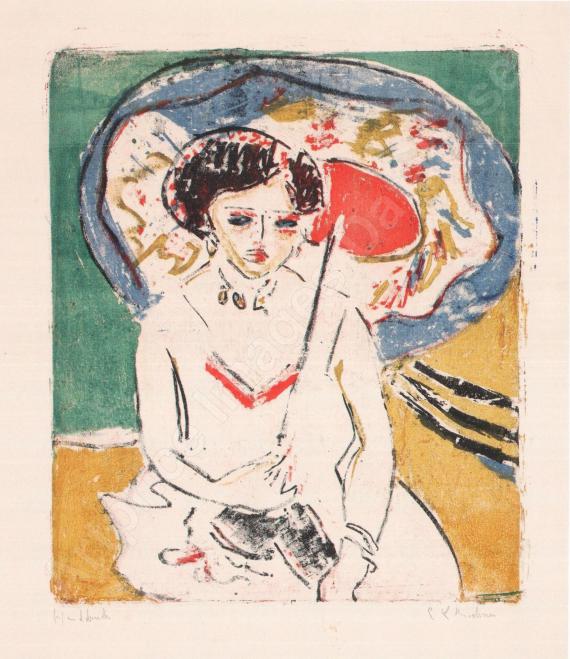
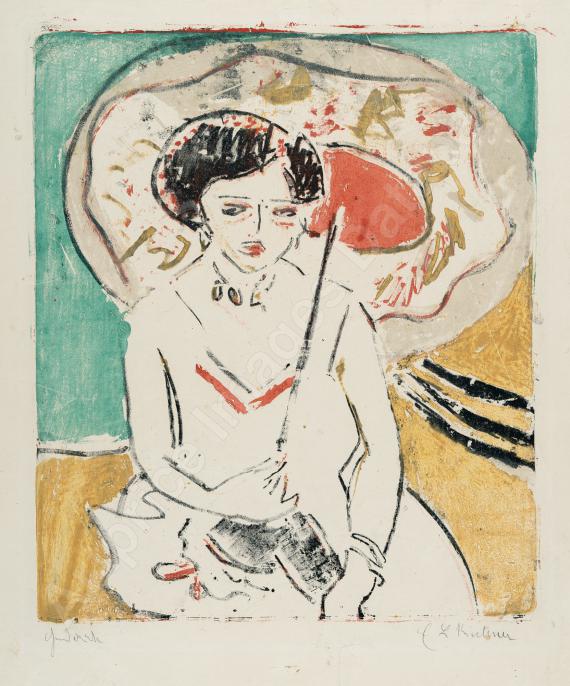
For “Dodo with a Japanese Umbrella,” the catalog raisonné distinguishes between three different color variations. Kirchner printed Variant a in black, light ochre, red, turquoise, and yellow. Only one copy of this is known to exist, and it is currently housed at the Neue Galerie in New York (formerly the Serge Sabarsky Collection). The artist printed Variant b in black, gray-blue, red, turquoise, and yellow; aside from the one offered here, only one other copy is known to exist (private collection).
Kirchner printed the third color variant in black, blue, red, green, and yellow. Only three copies of this variant are known to exist (including the Olbricht Collection, Essen, and the Ulmer Museum).
Along with “Russian Dancer Couple” (Gercken 378), “Head of a Courtesan” (Gercken 388), and “Rider and Clown” (Gercken 300), “Dodo with a Japanese Umbrella” explicitly ranks among the “most magnificent color lithographs in Kirchner’s entire oeuvre” (Günther Gercken, in: ibid., p. 38f.). “The loose drawing, limited to a few contours and accents, contrasts with the confident execution of the magnificent composition. The black drawing is colored in four additional printing passes using the same stone in four colors. [...] The colored background gives the light-colored figure a powerful visual presence. The color lithograph differs from the accompanying painting ‘Girl Under a Japanese Umbrella’ (1909) in the transparent purity of its colors, their lightness, and freshness. It is a highlight of Kirchner’s graphic work and is unparalleled in European printmaking of the time” (ibid.). [CH]
Commission, taxes et droit de suite
Cet objet est offert avec imposition régulière ou avec imposition différentielle.
Calcul en cas d'imposition différentielle:
Prix d’adjudication jusqu’à 1 000 000 euros : frais de vente 34 %.
Des frais de vente de 29% sont facturés sur la partie du prix d’adjudication dépassant 1 000 000 euros. Ils sont additionnés aux frais de vente dus pour la partie du prix d’adjudication allant jusqu’à 1 000 000 euros.
Des frais de vente de 22% sont facturés sur la partie du prix d’adjudication dépassant 4 000 000 euros. Ils sont additionnés aux frais de vente dus pour la partie du prix d’adjudication allant jusqu’à 4 000 000 euros.
La commission comprend la TVA, mais celle-ci n'est pas indiquée.
Calcul en cas d'imposition régulière:
Prix d'adjudication jusqu'à 1 000 000 € : 29 % de commission.
Prix d'adjudication supérieur à 1 000 000 € : montants partiels jusqu'à 1 000 000 € 29 % de commission, montants partiels supérieurs à 1 000 000 € : 23 % de commission.
Prix d'adjudication supérieur à 4.000 000 € : montants partiels supérieurs à 4.000 000 € : 15 % de commission.
La TVA légale de 7 % est prélevée sur la somme du prix d'adjudication et de la commission.
Si vous souhaitez appliquer l'imposition régulière, merci de bien vouloir le communiquer par écrit avant la facturation.
Calcul en cas de droit de suite:
Pour les œuvres originales d’arts plastiques et de photographie d’artistes vivants ou d’artistes décédés il y a moins de 70 ans, soumises au droit de suite, une rémunération au titre du droit de suite à hauteur des pourcentages indiqués au § 26, al. 2 de la loi allemande sur les droits d’auteur (UrhG) est facturée en sus pour compenser la rémunération liée au droit de suite due par le commissaire-priseur conformément au § 26 UrhG. À ce jour, elle est calculée comme suit :
4 pour cent pour la part du produit de la vente à partir de 400,00 euros et jusqu’à 50 000 euros,
3 pour cent supplémentaires pour la part du produit de la vente entre 50 000,01 et 200 000 euros,
1 pour cent supplémentaire pour la part entre 200 000,01 et 350 000 euros,
0,5 pour cent supplémentaire pour la part entre 350 000,01 et 500 000 euros et
0,25 pour cent supplémentaire pour la part au-delà de 500 000 euros.
Le total de la rémunération au titre du droit de suite pour une revente s’élève au maximum à 12 500 euros.