


Raumbeispiel
3
Ernst Wilhelm Nay
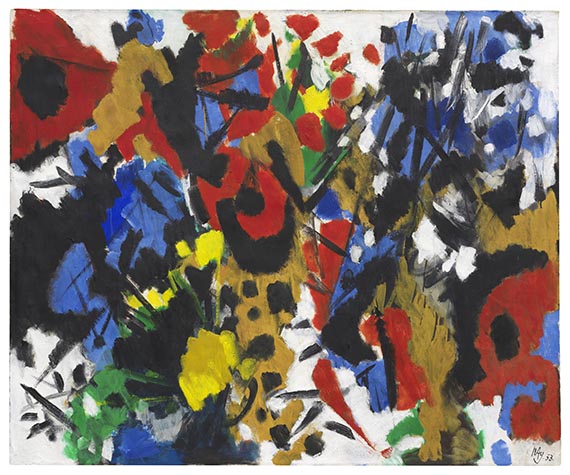
Figuration leicht und schwer, 1953.
Oil on canvas
Estimation: € 200,000 / $ 224,000
3
Ernst Wilhelm Nay
Figuration leicht und schwer, 1953.
Oil on canvas
Estimation: € 200,000 / $ 224,000
Ernst Wilhelm Nay
1902 - 1968
Figuration leicht und schwer. 1953.
Oil on canvas.
Signed and dated in the lower right. Once more dated, as well as titled and inscribed with the direction “oben” on the reverse of the stretcher. 100 x 120 cm (39.3 x 47.2 in).
Originally probably also signed on the reverse side of the stretcher; however, the signature is only fragmentarily preserved today. [AR].
• PURE RHYTHM Exhilarating freedom of expression.
• A NEW BEGINNING: The atmosphere of Cologne in the postwar years is almost physically palpable.
• WORK GROUP: From the “Rhythmic Pictures,” the beginning of Nay’s purely abstract creative phase.
• EXHIBITION: Shown in a major solo exhibition the year it was created.
• FAMILY-OWNED: In private hands for 70 years.
PROVENANCE: Private collection.
Galerie Hella Nebelung, Düsseldorf (around 1956).
Private collection, Southern Germany (since 1956, acquired from the above)
In the family’s possession ever since.
EXHIBITION: E. W. Nay. Ölgemälde, Aquarelle und Graphiken, Kunstverein für die Rheinlande und Westfalen, Düsseldorf, April 4–May 3, 1953.
LITERATURE: Aurel Scheibler, Ernst Wilhelm Nay. Catalogue raisonné of oil paintings, vol. II: 1952–1968, Cologne 1990, CR no. 690 (here still without an illustration and annotated as “whereabouts unknown”).
Called up: December 4, 2026 - ca. 17.04 h +/- 20 min.
Ernst Wilhelm Nay ranks among the most significant German painters of the postwar period. Over the decades, he consistently cultivated a unique painting style in which color, rhythm, and energy became his central means of expression. His creative period in Cologne in the early 1950s marked an important turning point in his career. In the winter of 1951, he left his studio in Hofheim im Taunus and moved to the vibrant metropolis on the Rhine. In this urban environment, still deeply scarred by the war, he experienced a new attitude toward life that was characterized by optimism and a sense of renewal, and he immersed himself, among other things, in modern and electronic music, such as that of Pierre Boulez, Luigi Nono, and Karlheinz Stockhausen. This atmosphere directly influenced his work and led to the creation of the “Rhythmic Pictures” series (1952–53), in which Nay made the decisive leap toward purely abstract painting.
Color became completely independent of any representational reference. Freely arranged, rhythmically moving color fields cover the canvas. Sharp contours and geometric forms recede in favor of an open, dynamic pictorial space. In his 1953 work “Figuration leicht und schwer”, Nay also combines this newly discovered liberty of expression with a thoroughly composed arrangement of color and gesture. The extremely powerful composition features vibrant color harmonies juxtaposed with structural black accents; their interplay creates an intense, almost physically palpable rhythm that makes the influences of Cologne’s postwar period instantly recognizable. In the year it was created, this highly dynamic work was first exhibited in the solo exhibition “E. W. Nay: Ölgemälde, Aquarelle und Graphiken” in Düsseldorf. For about 70 years, the work has been in the family's possession and is now being offered on the international auction market for the first time. [AR]
Color became completely independent of any representational reference. Freely arranged, rhythmically moving color fields cover the canvas. Sharp contours and geometric forms recede in favor of an open, dynamic pictorial space. In his 1953 work “Figuration leicht und schwer”, Nay also combines this newly discovered liberty of expression with a thoroughly composed arrangement of color and gesture. The extremely powerful composition features vibrant color harmonies juxtaposed with structural black accents; their interplay creates an intense, almost physically palpable rhythm that makes the influences of Cologne’s postwar period instantly recognizable. In the year it was created, this highly dynamic work was first exhibited in the solo exhibition “E. W. Nay: Ölgemälde, Aquarelle und Graphiken” in Düsseldorf. For about 70 years, the work has been in the family's possession and is now being offered on the international auction market for the first time. [AR]
Commission, taxes et droit de suite
Cet objet est offert avec imposition régulière ou avec imposition différentielle.
Calcul en cas d'imposition différentielle:
Prix d’adjudication jusqu’à 1 000 000 euros : frais de vente 34 %.
Des frais de vente de 29% sont facturés sur la partie du prix d’adjudication dépassant 1 000 000 euros. Ils sont additionnés aux frais de vente dus pour la partie du prix d’adjudication allant jusqu’à 1 000 000 euros.
Des frais de vente de 22% sont facturés sur la partie du prix d’adjudication dépassant 4 000 000 euros. Ils sont additionnés aux frais de vente dus pour la partie du prix d’adjudication allant jusqu’à 4 000 000 euros.
La commission comprend la TVA, mais celle-ci n'est pas indiquée.
Calcul en cas d'imposition régulière:
Prix d'adjudication jusqu'à 1 000 000 € : 29 % de commission.
Prix d'adjudication supérieur à 1 000 000 € : montants partiels jusqu'à 1 000 000 € 29 % de commission, montants partiels supérieurs à 1 000 000 € : 23 % de commission.
Prix d'adjudication supérieur à 4.000 000 € : montants partiels supérieurs à 4.000 000 € : 15 % de commission.
La TVA légale de 7 % est prélevée sur la somme du prix d'adjudication et de la commission.
Si vous souhaitez appliquer l'imposition régulière, merci de bien vouloir le communiquer par écrit avant la facturation.
Calcul en cas de droit de suite:
Pour les œuvres originales d’arts plastiques et de photographie d’artistes vivants ou d’artistes décédés il y a moins de 70 ans, soumises au droit de suite, une rémunération au titre du droit de suite à hauteur des pourcentages indiqués au § 26, al. 2 de la loi allemande sur les droits d’auteur (UrhG) est facturée en sus pour compenser la rémunération liée au droit de suite due par le commissaire-priseur conformément au § 26 UrhG. À ce jour, elle est calculée comme suit :
4 pour cent pour la part du produit de la vente à partir de 400,00 euros et jusqu’à 50 000 euros,
3 pour cent supplémentaires pour la part du produit de la vente entre 50 000,01 et 200 000 euros,
1 pour cent supplémentaire pour la part entre 200 000,01 et 350 000 euros,
0,5 pour cent supplémentaire pour la part entre 350 000,01 et 500 000 euros et
0,25 pour cent supplémentaire pour la part au-delà de 500 000 euros.
Le total de la rémunération au titre du droit de suite pour une revente s’élève au maximum à 12 500 euros.