


Vente: 612 / Evening Sale 04 décembre 2026 à Munich → Lot 126000501
Image du cadre
Raumbeispiel
126000501
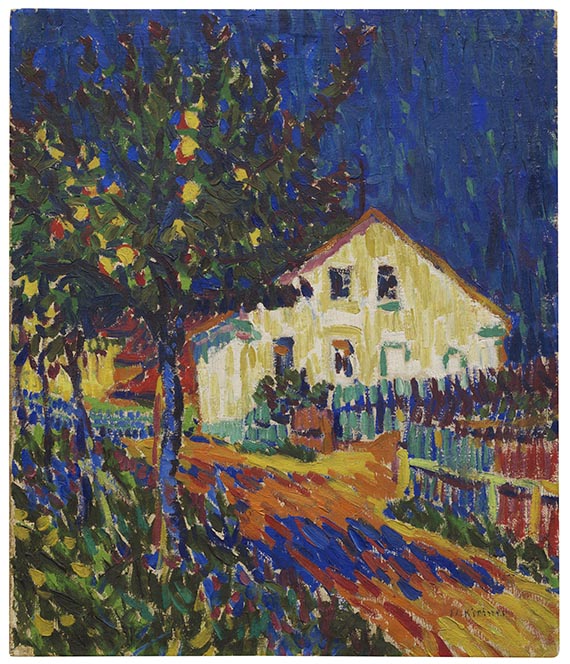
Ernst Ludwig Kirchner
Dorfstrasse mit Apfelbäumen, 1907.
Oil on canvas
Estimation: € 400,000 / $ 464,000
Les informations sur la commission d´achat, les taxes et le droit de suite sont disponibles quatre semaines avant la vente.
126000501
Ernst Ludwig Kirchner
Dorfstrasse mit Apfelbäumen, 1907.
Oil on canvas
Estimation: € 400,000 / $ 464,000
Les informations sur la commission d´achat, les taxes et le droit de suite sont disponibles quatre semaines avant la vente.
Ernst Ludwig Kirchner
1880 - 1938
Dorfstrasse mit Apfelbäumen. 1907.
Oil on canvas.
Signed “E. L. Kirhner” [sic], presumably by Erna Kirchner, in the lower right. 60 x 50 cm (23.6 x 19.6 in).
[JS].
• Rediscovery: Until 2020, the whereabouts of this Kirchner painting from his early “Brücke” period were unknown.
• Pioneering: an outstanding testament to Kirchner’s bold leap into Expressionism and its vivid colosr.
• Exceptional & rare: a luminous landscape rendered in a highly dynamic style, described by Kirchner himself as technically unique within his oeuvre.
• Museum-quality: The comparable painting “Grünes Haus” (1906) is part of the Modern Art Collection at the Museum of Modern Art, Ludwig Foundation, Vienna.
• Excellent provenance: from the important early Expressionist collection of Martha and Paul Rauert, Hamburg.
• Continuous provenance: fully traceable from its creation to today.
Accompanied by a written certificate of authenticity issued by Dr. Wolfgang Henze, Wichtrach/Bern, dated June 24, 2020. This work is documented in the Ernst Ludwig Kirchner Archive, Wichtrach/Bern, and will be included in the addendum to the catalogue raisonné.
PROVENANCE: Collection of Martha and Dr. Paul Rauert, Hamburg (acquired from Erna Kirchner in 1918; in their possession until 1937).
Hildebrand Gurlitt, Hamburg (acquired from the above in 1937).
Collection of Dr. Johannes Schürer, Mülheim an der Ruhr (acquired from the above in 1937).
Private collection, North Rhine-Westphalia (inherited from the aforementioned owner, held until 2020).
Private collection, Bavaria (acquired from the above in 2020).
Private collection, Lower Saxony (donated by the above in 2020).
The work is free of restitution claims.
EXHIBITION: Nyare Tysk Konst, Liljevalchs Konsthall, Stockholm, 1922.
Loan exhibition from a private collection in Hamburg at the Kunsthalle, May 1925, No. 168 (Haus mit Apfelbaum).
LITERATURE: Gerd Presler, Ernst Ludwig Kirchner. Die Skizzenbücher. “Ekstase des ersten Sehens,” 1996, p. 229 (mentioned in Skb 35, p. 41).
Hans Delfs, Ernst Ludwig Kirchner—der gesamte Briefwechsel “Die absolute Wahrheit, so wie ich sie fühle,” 2010, no. 1379.
“Dorfstrasse mit Apfelbäumen” (Village Street with Apple Trees, 1907) – The Early “Brücke” Period and Kirchner’s Transition to Expressionism
Ernst Ludwig Kirchner’s painting “Dorfstrasse mit Apfelbäumen”, executed in a luminous, energetic style, is not only unique in his oeuvre for its technical realization of this midsummer motif, but also a fascinating testament to the international fusion of painterly styles at the height of European Modernism. When he created the painting, Kirchner was in his late twenties—young, bold, and bursting with energy. Just two years earlier, in 1905, he had completed his architecture studies in Dresden and, together with Erich Heckel, Fritz Bleyl, and Karl Schmidt-Rottluff, founded the Expressionist artists’ group “Die Brücke,” which remains one of the most important artistic associations of European Modernism. Kirchner’s years in Dresden—from the founding of “Die Brücke” in 1905 to his relocation to the international art metropolis of Berlin in 1911—defined his entire artistic oeuvre. From Dresden, the “Brücke” artists set out during the summer months of 1909 through 1911 for their legendary trips to the Moritzburg Lakes, where the painters, while sketching and painting nude models in nature, developed their anti-academic and today world-famous “Brücke” style. Dresden, then the capital and royal seat of the Kingdom of Saxony, also offered Kirchner and the other young “Brücke” painters a wealth of new artistic inspiration through its vibrant nightlife; moreover, around 1907, it was one of the dynamic centers of the rise of European Modernism. The “Brücke” artists—above all the young Ernst Ludwig Kirchner, who stood out for his extraordinary stylistic progressiveness—absorbed these influences from the international art scene, which at the time was particularly concentrated in two progressive Dresden galleries: the Galerie Ernst Arnold and the Kunstsalon Emil Richter. “Die Brücke” aimed to create a new, anti-academic style of painting that rejected purely naturalistic representation and championed emotionality and direct expression. The “Die Brücke” artists drew inspiration from the paintings of the great European pioneers of Modernism.
Nonconformist and Progressive: Kirchner and the Pioneers of European Modernism
During these years, Galerie Ernst Arnold exhibited, among others, not only Vincent van Gogh’s extremely raw and bold paintings, but also the works of the French avant-garde—representatives of Pointillism and Divisionism—which appeared just as unfinished to viewers at the time, as well as the paintings of the Vienna Secession, including the ornamental landscape paintings by Gustav Klimt and other Viennese artists, who were known for their radical break with academic Historism. In the “Wiener Ausstellung” of 1907,the gallery displayed, among others, Klimt’s painting “Goldener Apfelbaum” (Golden Apple Tree, 1903), which was destroyed during World War II. Also on display were the works of Edvard Munch, one of the most important catalysts of German Expressionism, whose painting—scandalously perceived as crude and unfinished—had, since the famous Munch scandal in November 1892, served as a nonconformist and courageous role model for all avant-garde painters, including the young Ernst Ludwig Kirchner.
With confidence, courage, anti-academic flair, and radical innovation, Kirchner applied this brilliant work in individual, luminous brushstrokes onto the partly blank, light-colored canvas. This painting—in which Kirchner merged the diverse influences of European Modernism into his own groundbreaking composition—exudes a powerful, raw, and immediate impact. Applied to the canvas in nearly unmixed, intensely luminous colors, it stands as a powerful artistic testament to Kirchner’s bold departure into the colors and forms characteristic of “Brücke” Expressionism. “Dorfstrasse mit Apfelbäumen” attests to Kirchner’s masterful and bold engagement with tradition; he absorbs, selects, varies, and transforms what he has observed, using this artistic process as the decisive foundation for developing his own novel visual language. In principle, Kirchner’s working method and innovative power are therefore comparable to those of another German artist of the century: Gerhard Richter, who likewise based his famous black-and-white “photo-paintings” of the 1960s on an intensive process of reception and selection; through this intensive artistic process, he not only created something radically new, but—just as Ernst Ludwig Kirchner had done sixty years earlier in Dresden—made a decisive contribution to European Modernism.
The History and Rediscovery of an Extraordinary Painting
The young Kirchner painted this bright summer landscape with intense energy. Whether Kirchner painted it during his summer stay in Goppeln near Dresden in 1907, where he stayed with his friend Max Pechstein, or from memory in his studio somewhat later, remains an open question. Years later, in a letter to Gustav Schiefler dated December 15, 1924, the artist also briefly comments on the stylistic peculiarity of this landscape, which he constructed from single strokes of pure color. Works of comparable quality and style are exceptionally rare in Kirchner’s early Expressionist oeuvre, which embodies a carefree, radical rebellion against academic traditions. The painting “Grünes Haus” (1906), created a year earlier, is closely related in style and subject matter. Since 1963, it has been part of the important collection of Peter and Irene Ludwig, which features masterpieces of Classical Modernism and the postwar avant-garde, and is currently one of the highlights of the collection at the Museum of Modern Art in Vienna. As is often the case with paintings by Ernst Ludwig Kirchner, the present work was retroactively “signed” by Kirchner’s partner, Erna Schilling, in the course of its sale. The former Berlin nightclub dancer managed, on behalf of the artist, the inventory of his Berlin studio and its sale during the long periods of Kirchner’s absence—both during the war and the Davos years. According to a shipping list dated April 15, 1918, written by Erna, this early “Brücke” landscape was sent to “Dr. Rauert, Hamburg Kleinflottbeckerw” under the title “Dorfstrasse Haus mit Obstbäumen u. Zaun” and entered the collection of Martha and Dr. Paul Rauert in Hamburg. In a letter from Gustav Schiefler to Kirchner dated April 16, 1924, Rauert, at the artist’s indirect request, confirmed this painting as one of his six Kirchner works. “Dorfstraße” (Village Street)—another title for this painting—remained in the Rauert collection until 1937. In June of that year, he sold the painting to Hildebrand Gurlitt, an art historian and art dealer based in Hamburg who, after being dismissed as director of the Hamburger Kunstverein, set up his own business as a knowledgeable art dealer in July 1933. That same month, he brokered the sale of “Dorfstraße” to a collector in Mülheim; the well-documented work resurfaced from that collector’s possession in 2020—and was thus rediscovered and made accessible to Kirchner researchers from its previously unknown location. Although not yet listed in Donald E. Gordon’s catalogue raisonné published in 1968, this important early painting has since been registered at the Ernst Ludwig Kirchner Archive in Wichtrach/Bern as one of the extremely rare paintings from Kirchner’s early Expressionist period with a provenance documented from its creation to the present day, and it has been included in the addendum to the catalogue raisonné. [JS]