


Image du cadre
Raumbeispiel
178
Max Slevogt
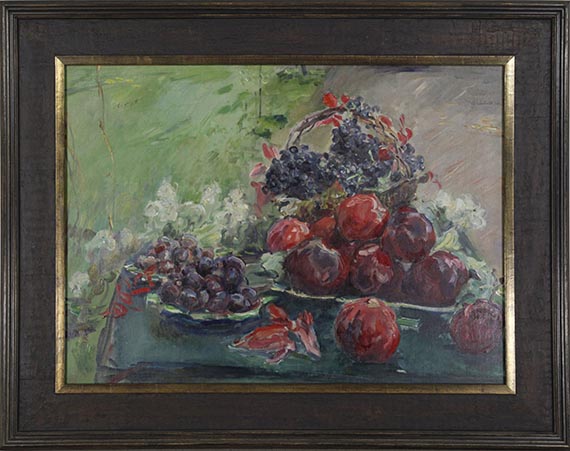
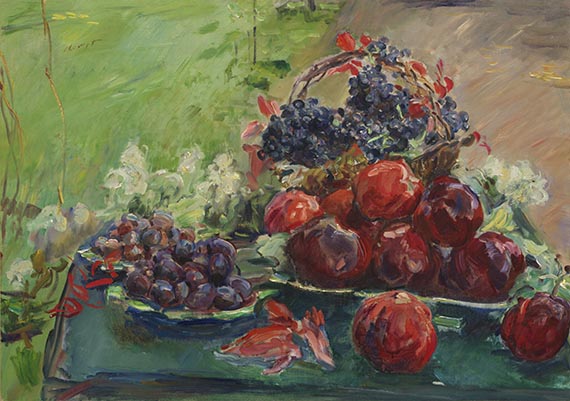
Stillleben mit Äpfeln, Trauben und Zwetschgen, (Vor) 1920.
Oil on canvas
Estimation: € 60,000 / $ 67,200
178
Max Slevogt
Stillleben mit Äpfeln, Trauben und Zwetschgen, (Vor) 1920.
Oil on canvas
Estimation: € 60,000 / $ 67,200
Max Slevogt
1868 - 1932
Stillleben mit Äpfeln, Trauben und Zwetschgen. (Vor) 1920.
Oil on canvas.
Signed in the upper left. 61 x 84 cm (24 x 33 in).
Max Slevogt memtioned the preent work in a handwritten inventory of paintings as “red apples and plums”, along with a note regarding the owner: “Steinbart?” [AW].
• A particularly radiant and lively fruit still life by the important German Impressionist.
• With a masterfully loose and dynamic brushstroke, Max Slevogt captures the ephemeral on canvas.
• Once in the family collection of Slevogt collector and patron Carl Steinbart (1852–1923) for 100 years.
• The artist’s fruit still lifes are held in renowned museums, including the Städel Museum in Frankfurt am Main, the Staatliche Kunsthalle in Karlsruhe, and the Neue Pinakothek in Munich.
The authenticity of this work was verbally confirmed by Bernhard Geil.
PROVENANCE: Collection of Carl Steinbart, Berlin (purchased from the artist ca. 1920/1923).
Collection of Dora Stach, née Steinbart, Amsterdam (inherited from the above in 1923; remained in the family until 2022).
Private collection, Northern Germany (acquired from the above).
EXHIBITION: Herbstausstellung, Academy of Arts, Berlin, 1920.
Max Slevogt. Gemälde, Aquarelle, Pastelle, Zeichnungen. Zu seinem 60. Geburtstage, Prussian Academy of Arts, Berlin, Oct./Nov. 1928, cat. no. 142 (p. 15, dated “1922” here).
Schilderkunst uit La Belle Epoque, Singer Museum, Laren, 1964, cat. no. 64
Impressionismus in Deutschland. Max Liebermann und seine Zeit, Museum Frieder Burda, Baden-Baden, October 3. 2025 - February 8, 2026, cat. no. 99 (illustrated in color on pp. 200f.).
LITERATURE: Hans-Jürgen Imiela, Max Slevogt. A Monograph, Karlsruhe 1968, p. 437, note 1.
- -
Max J. Friedländer. Die Herbausstellung der Berliner Akademie, in: Kunst und Künstler, vol. XIX, no. 4, January 1921, pp. 124–138, here p. 133 (with illu. on p. 124).
Wilken von Alten, Max Slevogt, Bielefeld/Leipzig 1926, pp. 71ff. and p. 69 (with ill. 82).
Called up: December 5, 2026 - ca. 14.44 h +/- 20 min.
Max Slevogt’s “Still Life with Apples, Grapes, and Plums” combines the immediate vividness of the moment with a masterfully crafted composition. On the dark-green tabletop, the artist arranges bright red apples, dark violet-blue grapes, and plums into a balanced, pyramid-shaped composition. Loose, dynamic brushstrokes give the fruits a lively presence. The light streaming in from the left beautifully highlights their forms and subtle color gradations. In the background, the green meadow glows, anchoring the still life in a summer scene where the changing seasons are already hinted at by the reddish grape leaves.
Beginning in 1914, Slevogt regularly spent the summer months at his country estate near Neukastel. The landscape's tranquility offered him both a retreat and inspiration. Time and again, he moved his work from the studio to the outdoors. In this way, he developed a distinctive style of plein air painting that, alongside that of Max Liebermann and Lovis Corinth, made an important contribution to German Modernism. In the early 1920s, he also resumed painting still lifes—and brought a fresh, immediate visual language to this familiar subject.
Created around 1920/1923, this work is part of a series of still lifes Slevogt painted on the terrace of his country estate. In addition to his landscapes, in which he expresses his close connection to the nature of the Palatinate, he devotes himself here to directly observing everyday motifs. In doing so, he combines Impressionist spontaneity with an expressive, at times vivid use of color. The sketch-like sections contrast with the fruits, which are rendered with a three-dimensional quality. The clear composition and free application of paint also echo Slevogt’s engagement with Édouard Manet, whose works he encountered in 1899 at Paul Cassirer’s gallery and later in the Secession exhibitions.
This early reception confirms the painting’s special esteem. Carl Steinbart (1852–1923) likely acquired it around 1920/1923 directly from the artist and included it in his significant collection of contemporary art. In addition to works by Gustave Courbet and Arnold Böcklin, this collection includes works by Max Liebermann, Lovis Corinth, and Edvard Munch. However, Slevogt's works make up the largest portion of the collection, with more than 70 paintings. “Still Life with Apples, Grapes, and Plums” remained in the family’s possession for decades and was exhibited at the Berlin Academy of Arts shortly after its creation, attesting to its early recognition. In his review, Max J. Friedländer highlights the painting, a tribute that underscores its artistic quality and historical significance. [AW]
Commission, taxes et droit de suite
Cet objet est offert avec imposition régulière ou avec imposition différentielle.
Calcul en cas d'imposition différentielle:
Prix d’adjudication jusqu’à 1 000 000 euros : frais de vente 34 %.
Des frais de vente de 29% sont facturés sur la partie du prix d’adjudication dépassant 1 000 000 euros. Ils sont additionnés aux frais de vente dus pour la partie du prix d’adjudication allant jusqu’à 1 000 000 euros.
Des frais de vente de 22% sont facturés sur la partie du prix d’adjudication dépassant 4 000 000 euros. Ils sont additionnés aux frais de vente dus pour la partie du prix d’adjudication allant jusqu’à 4 000 000 euros.
La commission comprend la TVA, mais celle-ci n'est pas indiquée.
Calcul en cas d'imposition régulière:
Prix d'adjudication jusqu'à 1 000 000 € : 29 % de commission.
Prix d'adjudication supérieur à 1 000 000 € : montants partiels jusqu'à 1 000 000 € 29 % de commission, montants partiels supérieurs à 1 000 000 € : 23 % de commission.
Prix d'adjudication supérieur à 4.000 000 € : montants partiels supérieurs à 4.000 000 € : 15 % de commission.
La TVA légale de 7 % est prélevée sur la somme du prix d'adjudication et de la commission.
Si vous souhaitez appliquer l'imposition régulière, merci de bien vouloir le communiquer par écrit avant la facturation.
Calcul en cas de droit de suite:
Pour les œuvres originales d’arts plastiques et de photographie d’artistes vivants ou d’artistes décédés il y a moins de 70 ans, soumises au droit de suite, une rémunération au titre du droit de suite à hauteur des pourcentages indiqués au § 26, al. 2 de la loi allemande sur les droits d’auteur (UrhG) est facturée en sus pour compenser la rémunération liée au droit de suite due par le commissaire-priseur conformément au § 26 UrhG. À ce jour, elle est calculée comme suit :
4 pour cent pour la part du produit de la vente à partir de 400,00 euros et jusqu’à 50 000 euros,
3 pour cent supplémentaires pour la part du produit de la vente entre 50 000,01 et 200 000 euros,
1 pour cent supplémentaire pour la part entre 200 000,01 et 350 000 euros,
0,5 pour cent supplémentaire pour la part entre 350 000,01 et 500 000 euros et
0,25 pour cent supplémentaire pour la part au-delà de 500 000 euros.
Le total de la rémunération au titre du droit de suite pour une revente s’élève au maximum à 12 500 euros.