


Image du cadre
Raumbeispiel
171
Otto Mueller
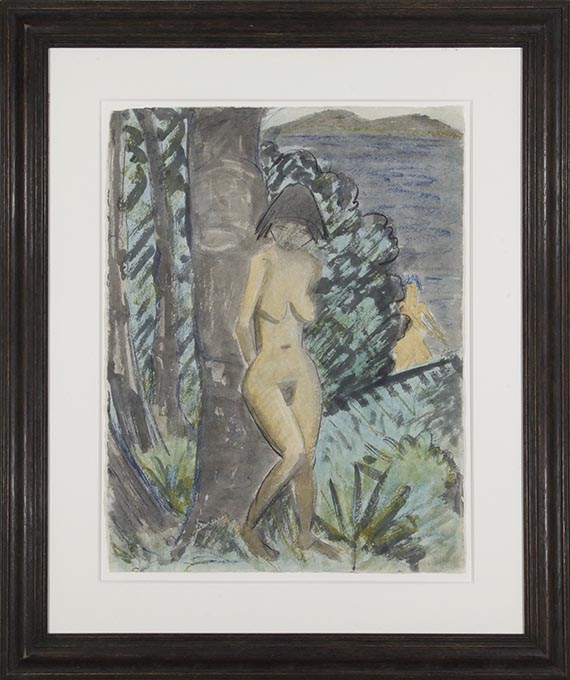
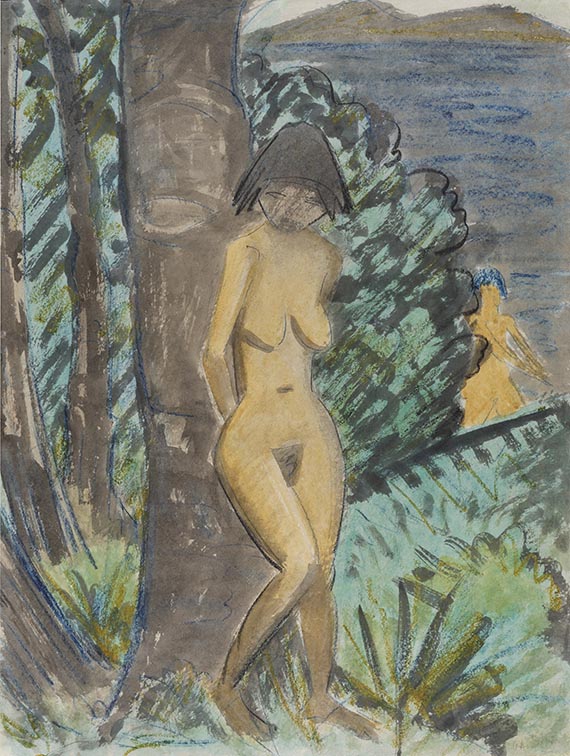
Stehender weiblicher Akt, Um 1928.
Watercolor and color chalk
Estimation: € 80,000 / $ 89,600
171
Otto Mueller
Stehender weiblicher Akt, Um 1928.
Watercolor and color chalk
Estimation: € 80,000 / $ 89,600
Otto Mueller
1874 - 1930
Stehender weiblicher Akt. Um 1928.
Watercolor and color chalk.
Signed in the lower right. Inscribed “J.M.3” on the reverse. On wove paper. 68.5 x 52.5 cm (26.9 x 20.6 in), the full sheet. [AW].
• A characteristic motif in a particularly well-balanced composition.
• With their perfect movement and grace, these bathers embody Otto Mueller’s personal ideal.
• The multi-figure nude depictions are considered the artist’s most sought-after works on the international auction market.
• Distinguished provenance: Once owned by Otto Mueller’s son for over 60 years.
PROVENANCE: From the artist’s estate (1930).
Josef Mueller-Herbig, Karlsruhe/Lübeck (inherited from the above in 1931).
Private collection, Southern Germany (since 1998, Galerie Kornfeld).
Galerie Thomas, Munich (acquired from the above in 2009, Ketterer Kunst).
Private collection, Berlin (acquired from the above in 2009).
EXHIBITION: Otto Mueller, Kunstblätter der Galerie Nierendorf 4/5, Berlin, June 29–October 14, 1964, cat. no. 49 (with ill.).
LITERATURE: Mario-Andreas von Lüttichau, Tanja Pirsig-Marshall, Otto Mueller. Vol. 2: Zeichnungen und Aquarelle, Cologne 2020, CR no. P1928/06 (680) (with a color illustration on p. 225).
- -
Galerie Kornfeld, Bern, 221st Auction, June 19, 1998, lot 95 (with a color illustration).
Ketterer Kunst, Munich, 360th Auction, December 12, 2009, lot 165 (with a color illustration on p. 103).
Called up: December 5, 2026 - ca. 14.34 h +/- 20 min.
1874 - 1930
Stehender weiblicher Akt. Um 1928.
Watercolor and color chalk.
Signed in the lower right. Inscribed “J.M.3” on the reverse. On wove paper. 68.5 x 52.5 cm (26.9 x 20.6 in), the full sheet. [AW].
• A characteristic motif in a particularly well-balanced composition.
• With their perfect movement and grace, these bathers embody Otto Mueller’s personal ideal.
• The multi-figure nude depictions are considered the artist’s most sought-after works on the international auction market.
• Distinguished provenance: Once owned by Otto Mueller’s son for over 60 years.
PROVENANCE: From the artist’s estate (1930).
Josef Mueller-Herbig, Karlsruhe/Lübeck (inherited from the above in 1931).
Private collection, Southern Germany (since 1998, Galerie Kornfeld).
Galerie Thomas, Munich (acquired from the above in 2009, Ketterer Kunst).
Private collection, Berlin (acquired from the above in 2009).
EXHIBITION: Otto Mueller, Kunstblätter der Galerie Nierendorf 4/5, Berlin, June 29–October 14, 1964, cat. no. 49 (with ill.).
LITERATURE: Mario-Andreas von Lüttichau, Tanja Pirsig-Marshall, Otto Mueller. Vol. 2: Zeichnungen und Aquarelle, Cologne 2020, CR no. P1928/06 (680) (with a color illustration on p. 225).
- -
Galerie Kornfeld, Bern, 221st Auction, June 19, 1998, lot 95 (with a color illustration).
Ketterer Kunst, Munich, 360th Auction, December 12, 2009, lot 165 (with a color illustration on p. 103).
Called up: December 5, 2026 - ca. 14.34 h +/- 20 min.
Otto Mueller’s outdoor nudes lend his paintings a distinctive sense of vitality. They are rooted in a Romantic conception of nature, in which the landscape appears as a symbol of the primordial. His figures do not appear as bourgeois individuals asserting a newly gained freedom through their nudity. Rather, they are part of their surroundings and blend into them naturally. In this way, the artist removes the motif from any voyeuristic context. The girl leaning against a tree, for example—a motif Mueller explored in many variations—appears completely absorbed in her own thoughts and pays little attention to her nudity.
This perspective is reflected in Mueller’s idiosyncratic use of artistic media. Drawing and watercolor complement one another, lending the subject both solidity and openness. Using a spare palette, the artist develops a distinctive visual language that gives the subject room to feel unaffected. The technique does not serve to provide a detailed description, but rather a personal interpretation of the experience of nature and the body. Even the landscapes rarely have a specific geographical reference. For the most part, they are timeless vignettes in which individual trees, loosely arranged groups of trees, tall grasses, reeds, and shrubs line lakes, ponds, or streams. The locations feel less like topographically identifiable settings than atmospheric pictorial spaces. Within them, young women—and occasionally men—move about carefree and unobserved. Nature and the human figure merge into a timeless vision of carefree joie de vivre.
Mueller’s artistic interest lies less in describing or critiquing social conditions than in searching for the self and an inner core of humanity. His pursuit of creating “archetypal images” makes sense in this context. It is accompanied by the study of artistic models, the intensive observation of the female body, the formative influence of the women in his life, and ongoing self-reflection. He carefully develops and varies his visual language. Often, just a few changes are enough to open up new possibilities of expression. Drawings and lithographs serve as important testing grounds before the artist realizes his visual ideas in mature compositions using watercolor and colored chalk. The “Standing Female Nude,” created around 1928, illustrates this delicate interplay of graphic precision, painterly freedom, and Mueller’s distinctive conception of humanity in nature. [AW]
This perspective is reflected in Mueller’s idiosyncratic use of artistic media. Drawing and watercolor complement one another, lending the subject both solidity and openness. Using a spare palette, the artist develops a distinctive visual language that gives the subject room to feel unaffected. The technique does not serve to provide a detailed description, but rather a personal interpretation of the experience of nature and the body. Even the landscapes rarely have a specific geographical reference. For the most part, they are timeless vignettes in which individual trees, loosely arranged groups of trees, tall grasses, reeds, and shrubs line lakes, ponds, or streams. The locations feel less like topographically identifiable settings than atmospheric pictorial spaces. Within them, young women—and occasionally men—move about carefree and unobserved. Nature and the human figure merge into a timeless vision of carefree joie de vivre.
Mueller’s artistic interest lies less in describing or critiquing social conditions than in searching for the self and an inner core of humanity. His pursuit of creating “archetypal images” makes sense in this context. It is accompanied by the study of artistic models, the intensive observation of the female body, the formative influence of the women in his life, and ongoing self-reflection. He carefully develops and varies his visual language. Often, just a few changes are enough to open up new possibilities of expression. Drawings and lithographs serve as important testing grounds before the artist realizes his visual ideas in mature compositions using watercolor and colored chalk. The “Standing Female Nude,” created around 1928, illustrates this delicate interplay of graphic precision, painterly freedom, and Mueller’s distinctive conception of humanity in nature. [AW]


Commission, taxes et droit de suite
Cet objet est offert avec imposition régulière ou avec imposition différentielle.
Calcul en cas d'imposition différentielle:
Prix d’adjudication jusqu’à 1 000 000 euros : frais de vente 34 %.
Des frais de vente de 29% sont facturés sur la partie du prix d’adjudication dépassant 1 000 000 euros. Ils sont additionnés aux frais de vente dus pour la partie du prix d’adjudication allant jusqu’à 1 000 000 euros.
Des frais de vente de 22% sont facturés sur la partie du prix d’adjudication dépassant 4 000 000 euros. Ils sont additionnés aux frais de vente dus pour la partie du prix d’adjudication allant jusqu’à 4 000 000 euros.
La commission comprend la TVA, mais celle-ci n'est pas indiquée.
Calcul en cas d'imposition régulière:
Prix d'adjudication jusqu'à 1 000 000 € : 29 % de commission.
Prix d'adjudication supérieur à 1 000 000 € : montants partiels jusqu'à 1 000 000 € 29 % de commission, montants partiels supérieurs à 1 000 000 € : 23 % de commission.
Prix d'adjudication supérieur à 4.000 000 € : montants partiels supérieurs à 4.000 000 € : 15 % de commission.
La TVA légale de 7 % est prélevée sur la somme du prix d'adjudication et de la commission.
Si vous souhaitez appliquer l'imposition régulière, merci de bien vouloir le communiquer par écrit avant la facturation.
Calcul en cas de droit de suite:
Pour les œuvres originales d’arts plastiques et de photographie d’artistes vivants ou d’artistes décédés il y a moins de 70 ans, soumises au droit de suite, une rémunération au titre du droit de suite à hauteur des pourcentages indiqués au § 26, al. 2 de la loi allemande sur les droits d’auteur (UrhG) est facturée en sus pour compenser la rémunération liée au droit de suite due par le commissaire-priseur conformément au § 26 UrhG. À ce jour, elle est calculée comme suit :
4 pour cent pour la part du produit de la vente à partir de 400,00 euros et jusqu’à 50 000 euros,
3 pour cent supplémentaires pour la part du produit de la vente entre 50 000,01 et 200 000 euros,
1 pour cent supplémentaire pour la part entre 200 000,01 et 350 000 euros,
0,5 pour cent supplémentaire pour la part entre 350 000,01 et 500 000 euros et
0,25 pour cent supplémentaire pour la part au-delà de 500 000 euros.
Le total de la rémunération au titre du droit de suite pour une revente s’élève au maximum à 12 500 euros.
Calcul en cas d'imposition différentielle:
Prix d’adjudication jusqu’à 1 000 000 euros : frais de vente 34 %.
Des frais de vente de 29% sont facturés sur la partie du prix d’adjudication dépassant 1 000 000 euros. Ils sont additionnés aux frais de vente dus pour la partie du prix d’adjudication allant jusqu’à 1 000 000 euros.
Des frais de vente de 22% sont facturés sur la partie du prix d’adjudication dépassant 4 000 000 euros. Ils sont additionnés aux frais de vente dus pour la partie du prix d’adjudication allant jusqu’à 4 000 000 euros.
La commission comprend la TVA, mais celle-ci n'est pas indiquée.
Calcul en cas d'imposition régulière:
Prix d'adjudication jusqu'à 1 000 000 € : 29 % de commission.
Prix d'adjudication supérieur à 1 000 000 € : montants partiels jusqu'à 1 000 000 € 29 % de commission, montants partiels supérieurs à 1 000 000 € : 23 % de commission.
Prix d'adjudication supérieur à 4.000 000 € : montants partiels supérieurs à 4.000 000 € : 15 % de commission.
La TVA légale de 7 % est prélevée sur la somme du prix d'adjudication et de la commission.
Si vous souhaitez appliquer l'imposition régulière, merci de bien vouloir le communiquer par écrit avant la facturation.
Calcul en cas de droit de suite:
Pour les œuvres originales d’arts plastiques et de photographie d’artistes vivants ou d’artistes décédés il y a moins de 70 ans, soumises au droit de suite, une rémunération au titre du droit de suite à hauteur des pourcentages indiqués au § 26, al. 2 de la loi allemande sur les droits d’auteur (UrhG) est facturée en sus pour compenser la rémunération liée au droit de suite due par le commissaire-priseur conformément au § 26 UrhG. À ce jour, elle est calculée comme suit :
4 pour cent pour la part du produit de la vente à partir de 400,00 euros et jusqu’à 50 000 euros,
3 pour cent supplémentaires pour la part du produit de la vente entre 50 000,01 et 200 000 euros,
1 pour cent supplémentaire pour la part entre 200 000,01 et 350 000 euros,
0,5 pour cent supplémentaire pour la part entre 350 000,01 et 500 000 euros et
0,25 pour cent supplémentaire pour la part au-delà de 500 000 euros.
Le total de la rémunération au titre du droit de suite pour une revente s’élève au maximum à 12 500 euros.