


Image du cadre
Autre image
Autre image
Autre image
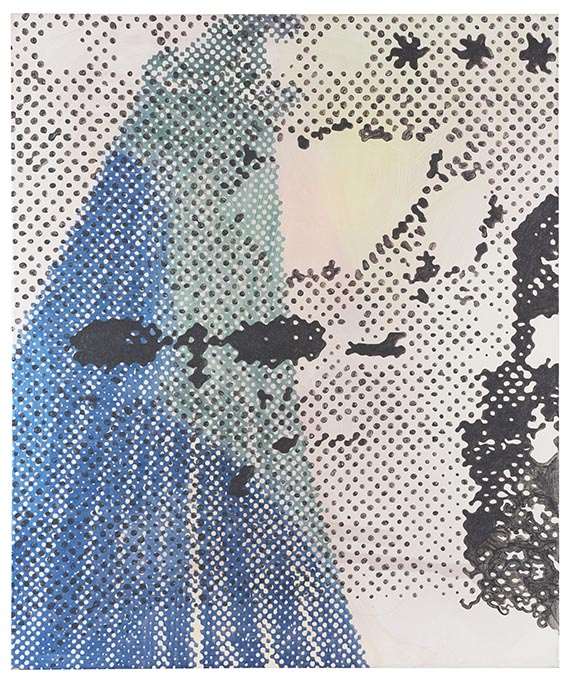
19
Sigmar Polke
Le Lit, 1994.
Acrylic on canvas
Estimation: € 240,000 / $ 268,800
19
Sigmar Polke
Le Lit, 1994.
Acrylic on canvas
Estimation: € 240,000 / $ 268,800
Sigmar Polke
1941 - 2010
Le Lit. 1994.
Acrylic on canvas.
Signed and dated on the folded canvas. 120 x 100 cm (47.2 x 39.3 in). [JS].
• GRID PAINTING Polke’s grid paintings are icons of German Post-War Art.
• GERMAN POP Together with Gerhard Richter, Polke has been making art history since the 1960s.
• AMBIGUOUS Glitter, minimalism, and subtle eroticism at the boundaries of figurative art.
• ANTI ART From Rembrandt to Polke: tradition and humorous negation.
• INTERNATIONAL ACCOLADE In 2014, a major retrospective was held at the Museum of Modern Art in New York, the Tate Modern in London, and the Museum Ludwig in Cologne.
We are grateful to Mr. Michael Trier for his kind assistance.
PROVENANCE: The artist’s studio (at least until 1995).
Galerie Schönewald und Beuse, Krefeld (with a label on the stretcher).
Private collection, North Rhine-Westphalia (acquired from the above around 1999).
EXHIBITION:
Sigmar Polke, IVAM Centre del Carme, Valencia, Oct. 20, 1994–Jan. 8, 1995 (with the label on the stretcher).
Called up: December 4, 2026 - ca. 17.36 h +/- 20 min.
1941 - 2010
Le Lit. 1994.
Acrylic on canvas.
Signed and dated on the folded canvas. 120 x 100 cm (47.2 x 39.3 in). [JS].
• GRID PAINTING Polke’s grid paintings are icons of German Post-War Art.
• GERMAN POP Together with Gerhard Richter, Polke has been making art history since the 1960s.
• AMBIGUOUS Glitter, minimalism, and subtle eroticism at the boundaries of figurative art.
• ANTI ART From Rembrandt to Polke: tradition and humorous negation.
• INTERNATIONAL ACCOLADE In 2014, a major retrospective was held at the Museum of Modern Art in New York, the Tate Modern in London, and the Museum Ludwig in Cologne.
We are grateful to Mr. Michael Trier for his kind assistance.
PROVENANCE: The artist’s studio (at least until 1995).
Galerie Schönewald und Beuse, Krefeld (with a label on the stretcher).
Private collection, North Rhine-Westphalia (acquired from the above around 1999).
EXHIBITION:
Sigmar Polke, IVAM Centre del Carme, Valencia, Oct. 20, 1994–Jan. 8, 1995 (with the label on the stretcher).
Called up: December 4, 2026 - ca. 17.36 h +/- 20 min.
A genius against his will—this is probably the most apt description of Sigmar Polke and his revolutionary artistic work. The unique energy and vitality Polke’s creations still exude today can be attributed to his nonconformist personality, which views traditions and conventions not as guidelines but as obsolete hurdles to be overcome with nonchalance. “We cannot rely on the fact that good paintings will be created one day—we must take matters into our own hands!” is a famous quote by Sigmar Polke and his artist friend Gerhard Richter, and Polke and Richter indeed took matters into their own hands. By the time he created his programmatic painting “Higher Beings Commanded: Paint the Upper Right Corner Black!” (1969, Froehlich Collection, Stuttgart), Polke officially claimed to be the much-vaunted “revolutionary anti-artist.” With wit and irony, Polke pokes fun at the traditional art world and the notion of a divinely inspired artistic genius. But Polke’s art also radically broke with art-historical tradition through his legendary grid paintings. Well into the wild decades of the 1980s and 1990s—a time when the Rhineland was the vibrant center of the German art scene—Polke continued to develop this style of painting toward a radical form of anti-art, layering it across multiple pictorial planes and weaving it—through his increasingly technically experimental painting—into a cohesive whole, dense in both visual and conceptual terms. With confidence and a great sense of humor, Polke alluded to—and at the same time poked fun at—a long tradition of motifs dating back at least to Rembrandt in the painting “Le Lit” (French for “the bed”), which captivates viewers with its slightly glittering and shimmering surface. Formally, Polke pushed the boundaries of representational art to their absolute limit: Only upon reading the title can one discern, as a light spot amid the painted grid dots, the outline of a white pillow. The black form in the foreground is also provocative and ambiguous: is it part of the bed frame, or rather a stylized reference to male—or even female—genitalia? Rembrandt’s etching “Le Lit à la française” (1646) quickly gained fame for its direct depiction of sexuality, without the veiled eroticism of mythological scenes that was still customary at the time. An early scandal in art history, it deliberately shattered social conventions and transcended traditional ways of seeing. With his work “Le Lit,” Polke joins a significant art-historical tradition that was carried into the modern era by artists such as Toulouse-Lautrec and Edvard Munch in his famous painting “The Day After” (1894/95). Furthermore, ever since van Gogh’s painting “Vincent’s Bedroom in Arles” (1888/89, Van Gogh Museum, Amsterdam), the bed has always simultaneously served as a visual reference to its creator—another tradition closely linked to the motif of the bed, which, alongside Polke, was continued into the 1990s by artists such as Tracey Emin in her installation “My Bed” (1998).
Most recently, the Polke retrospective presented by the Museum of Modern Art in New York and Tate Modern in London in 2014–15 demonstrated the international significance of Polke's innovative oeuvre.
Most recently, the Polke retrospective presented by the Museum of Modern Art in New York and Tate Modern in London in 2014–15 demonstrated the international significance of Polke's innovative oeuvre.
Commission, taxes et droit de suite
Cet objet est offert avec imposition régulière ou avec imposition différentielle.
Calcul en cas d'imposition différentielle:
Prix d’adjudication jusqu’à 1 000 000 euros : frais de vente 34 %.
Des frais de vente de 29% sont facturés sur la partie du prix d’adjudication dépassant 1 000 000 euros. Ils sont additionnés aux frais de vente dus pour la partie du prix d’adjudication allant jusqu’à 1 000 000 euros.
Des frais de vente de 22% sont facturés sur la partie du prix d’adjudication dépassant 4 000 000 euros. Ils sont additionnés aux frais de vente dus pour la partie du prix d’adjudication allant jusqu’à 4 000 000 euros.
La commission comprend la TVA, mais celle-ci n'est pas indiquée.
Calcul en cas d'imposition régulière:
Prix d'adjudication jusqu'à 1 000 000 € : 29 % de commission.
Prix d'adjudication supérieur à 1 000 000 € : montants partiels jusqu'à 1 000 000 € 29 % de commission, montants partiels supérieurs à 1 000 000 € : 23 % de commission.
Prix d'adjudication supérieur à 4.000 000 € : montants partiels supérieurs à 4.000 000 € : 15 % de commission.
La TVA légale de 7 % est prélevée sur la somme du prix d'adjudication et de la commission.
Si vous souhaitez appliquer l'imposition régulière, merci de bien vouloir le communiquer par écrit avant la facturation.
Calcul en cas de droit de suite:
Pour les œuvres originales d’arts plastiques et de photographie d’artistes vivants ou d’artistes décédés il y a moins de 70 ans, soumises au droit de suite, une rémunération au titre du droit de suite à hauteur des pourcentages indiqués au § 26, al. 2 de la loi allemande sur les droits d’auteur (UrhG) est facturée en sus pour compenser la rémunération liée au droit de suite due par le commissaire-priseur conformément au § 26 UrhG. À ce jour, elle est calculée comme suit :
4 pour cent pour la part du produit de la vente à partir de 400,00 euros et jusqu’à 50 000 euros,
3 pour cent supplémentaires pour la part du produit de la vente entre 50 000,01 et 200 000 euros,
1 pour cent supplémentaire pour la part entre 200 000,01 et 350 000 euros,
0,5 pour cent supplémentaire pour la part entre 350 000,01 et 500 000 euros et
0,25 pour cent supplémentaire pour la part au-delà de 500 000 euros.
Le total de la rémunération au titre du droit de suite pour une revente s’élève au maximum à 12 500 euros.
Calcul en cas d'imposition différentielle:
Prix d’adjudication jusqu’à 1 000 000 euros : frais de vente 34 %.
Des frais de vente de 29% sont facturés sur la partie du prix d’adjudication dépassant 1 000 000 euros. Ils sont additionnés aux frais de vente dus pour la partie du prix d’adjudication allant jusqu’à 1 000 000 euros.
Des frais de vente de 22% sont facturés sur la partie du prix d’adjudication dépassant 4 000 000 euros. Ils sont additionnés aux frais de vente dus pour la partie du prix d’adjudication allant jusqu’à 4 000 000 euros.
La commission comprend la TVA, mais celle-ci n'est pas indiquée.
Calcul en cas d'imposition régulière:
Prix d'adjudication jusqu'à 1 000 000 € : 29 % de commission.
Prix d'adjudication supérieur à 1 000 000 € : montants partiels jusqu'à 1 000 000 € 29 % de commission, montants partiels supérieurs à 1 000 000 € : 23 % de commission.
Prix d'adjudication supérieur à 4.000 000 € : montants partiels supérieurs à 4.000 000 € : 15 % de commission.
La TVA légale de 7 % est prélevée sur la somme du prix d'adjudication et de la commission.
Si vous souhaitez appliquer l'imposition régulière, merci de bien vouloir le communiquer par écrit avant la facturation.
Calcul en cas de droit de suite:
Pour les œuvres originales d’arts plastiques et de photographie d’artistes vivants ou d’artistes décédés il y a moins de 70 ans, soumises au droit de suite, une rémunération au titre du droit de suite à hauteur des pourcentages indiqués au § 26, al. 2 de la loi allemande sur les droits d’auteur (UrhG) est facturée en sus pour compenser la rémunération liée au droit de suite due par le commissaire-priseur conformément au § 26 UrhG. À ce jour, elle est calculée comme suit :
4 pour cent pour la part du produit de la vente à partir de 400,00 euros et jusqu’à 50 000 euros,
3 pour cent supplémentaires pour la part du produit de la vente entre 50 000,01 et 200 000 euros,
1 pour cent supplémentaire pour la part entre 200 000,01 et 350 000 euros,
0,5 pour cent supplémentaire pour la part entre 350 000,01 et 500 000 euros et
0,25 pour cent supplémentaire pour la part au-delà de 500 000 euros.
Le total de la rémunération au titre du droit de suite pour une revente s’élève au maximum à 12 500 euros.